


Music Production Software article
Music Production Software Explained: Features, Types and Tips

Music production software sits at the centre of modern music-making. It's where ideas become sounds, where sketches become songs, where the scrappy basement setup meets the infinite flexibility of code. If you've ever wondered what's actually running when a producer talks about working in their DAW, or why different producers swear by different software, this is where to start understanding it.
What Is a Digital Audio Workstation?
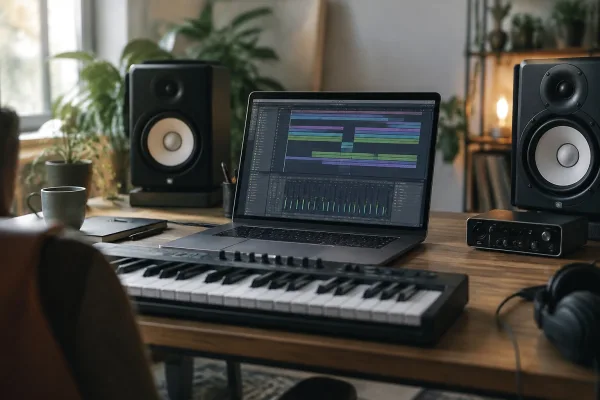
A digital audio workstation—or DAW—is an application that lets you record, edit, arrange, mix and often master audio and MIDI. At its core, a DAW is software that tries to recreate what a professional recording studio does, but inside your computer. It combines multitrack recording, MIDI sequencing, digital signal processing, effects, software instruments and mixing all in one environment.
The key word is integration. A DAW isn't just a recorder or just a sequencer or just an effects processor. It's all of those things working together in the same project. You can record a vocal on top of a drum machine you've programmed on top of a bass synth you're controlling with MIDI, adjust the timing of everything, add reverb to the vocal, compress the bass and export the whole thing—all without leaving your DAW.
How a DAW Fundamentally Changed Production
Before software DAWs, production meant tape machines, mixing consoles, outboard effects units and a lot of physical tape. You could record multiple tracks by bouncing between tape machines, but once something was recorded and printed to tape, changing it meant physically splicing and rerecording. Mixing meant moving faders on a console while something played. Effects were external boxes that cost thousands of pounds each.
DAWs changed everything. First, they made recording nonlinear. You can record a take, hear it back, rerecord it, cut and move sections around, all without permanently altering the original recording. Nothing is destructive unless you choose to make it destructive. Second, they made everything recallable. Your mix settings, your routing, your plug-in parameters—all saved and recallable instantly. No more writing down console settings and trying to recreate them.
Third, they put professional mixing and effects capability in reach of anyone with a decent computer. The reverb effect that cost £4,000 as a hardware unit now costs £30 as a plug-in, or is included free with your DAW. That's transformed music production entirely.
Understanding DAW Workflow Categories
Not all DAWs work the same way. There are different workflow approaches built into different software, and understanding which one suits you matters more than feature checklists.
Some DAWs emphasise linear, timeline-based work. You've got a track with audio or MIDI, you move through it left to right, and you record, edit and arrange as you go. This approach is natural for bands recording in sequence, for singer-songwriters recording vocals on top of arrangements, and for film post-production where you're working to a picture locked to a specific timeline.
Other DAWs emphasise clip-based, loop-based workflow. You build musical ideas in clips or loops, arrange them in a session grid, and you can play them back and trigger them live. This approach is common in electronic music, beatmaking and live performance, where you might want to layer loops, improvise with sections and respond to what's happening in the room.
Some DAWs emphasise MIDI and software instruments, designed for people composing with virtual orchestras or synths. Others prioritise audio recording, designed for engineers capturing live performances and vocals. Many DAWs do all of these things, but their default workflows and which features are front-and-centre matter for how you actually work.
The Essential Components of Any DAW
Whatever DAW you use, it will have certain basic components. Audio tracks hold recorded sound. MIDI tracks hold performance data—notes, timing, velocity information—that controls synthesizers or samplers. The mixer shows your channels, lets you adjust levels, pan, route signals and control effects. Automation lets you record changes to volume, panning and effect parameters over time, so a reverb can get bigger and then smaller, or a vocal can get louder in the chorus.
Plug-ins are the instruments and effects that actually create and process sound. They might be built into your DAW or installed separately. Equalizers, compressors, reverbs, delays, synthesizers and samplers are all typically plug-ins. Your DAW is the host that lets them all work together.
Routing determines how audio moves through your system. A simple setup might be: audio tracks feed a mix bus, the mix bus goes to mastering effects, and the output goes to your speakers. A complex setup might have parallel compression, headphone mixes, stem tracks and surround routing. Routing is how you shape the signal flow of your production.
Choosing Between Workflow Styles
If you're coming to music production software fresh, think about how you work. Do you want to record a band live and layer parts on top of each other? A timeline-based DAW like Logic Pro or Pro Tools will feel natural. Are you building electronic music from loops and samples? Ableton Live's clip-based approach is built for that. Do you want the most affordable software that does everything? REAPER. Do you want something focused on composing and scoring? Cubase or Studio One. Do you want something simple for learning? GarageBand.
There's no objectively best DAW. There's the DAW that fits how you want to work, what your computer can run, what your collaborators use, and what you can afford to pay.
The Role of Your Audio Interface
Your DAW is only part of your production system. An audio interface connects your microphones and instruments to your computer. It converts analogue signals from a microphone into digital information your DAW can record, and converts the digital audio from your DAW into analogue signals your speakers can play. A poor audio interface with high latency and noisy preamps will frustrate you. A good one with stable drivers and low latency becomes invisible—you're just making music.
Important interface specs include the number of inputs and outputs you need, microphone preamp quality, latency, connection type (USB, Thunderbolt) and whether it has built-in monitoring and headphone outputs.
Plugins, Instruments and the Ecosystem
Your DAW comes with some built-in effects and instruments, but the ecosystem of third-party plug-ins is enormous. Companies like Native Instruments, Universal Audio, Waves, FabFilter and Arturia make professional-grade effects and instruments. Some are expensive, some are cheap, and many are free. Over time, your collection of plug-ins becomes part of your sound and workflow.
Why Flexibility Is Both Power and Paralysis
The main advantage of a DAW is flexibility. You can record unlimited tracks (until your computer runs out of power). You can edit any audio down to the sample level. You can automate any parameter. You can undo almost anything. This flexibility is genuine power. It lets you capture ideas and refine them. But it can also slow you down. With infinite options, decision-making becomes harder. With unlimited editing ability, you can endlessly tweak something that was already good. Knowing when to stop is a skill that develops with experience.
Conclusion
Music production software—the DAW—is the centre of modern music-making. It combines recording, MIDI sequencing, mixing and effects in one environment. The DAW you choose depends on your workflow, your computer, what you can afford and what your collaborators use. Understanding how a DAW works and which workflow suits you matters more than feature lists. The software is just a tool; it's how you use it that makes the music.



Comments