


Presonus Studio Monitors article
The Ultimate Guide to Presonus Studio Monitor Speakers
PreSonus studio monitors deliver professional accuracy across all budgets. From affordable Eris speakers for bedroom studios to professional Sceptre monitors, find the right reference speakers for transparent, honest mixing.
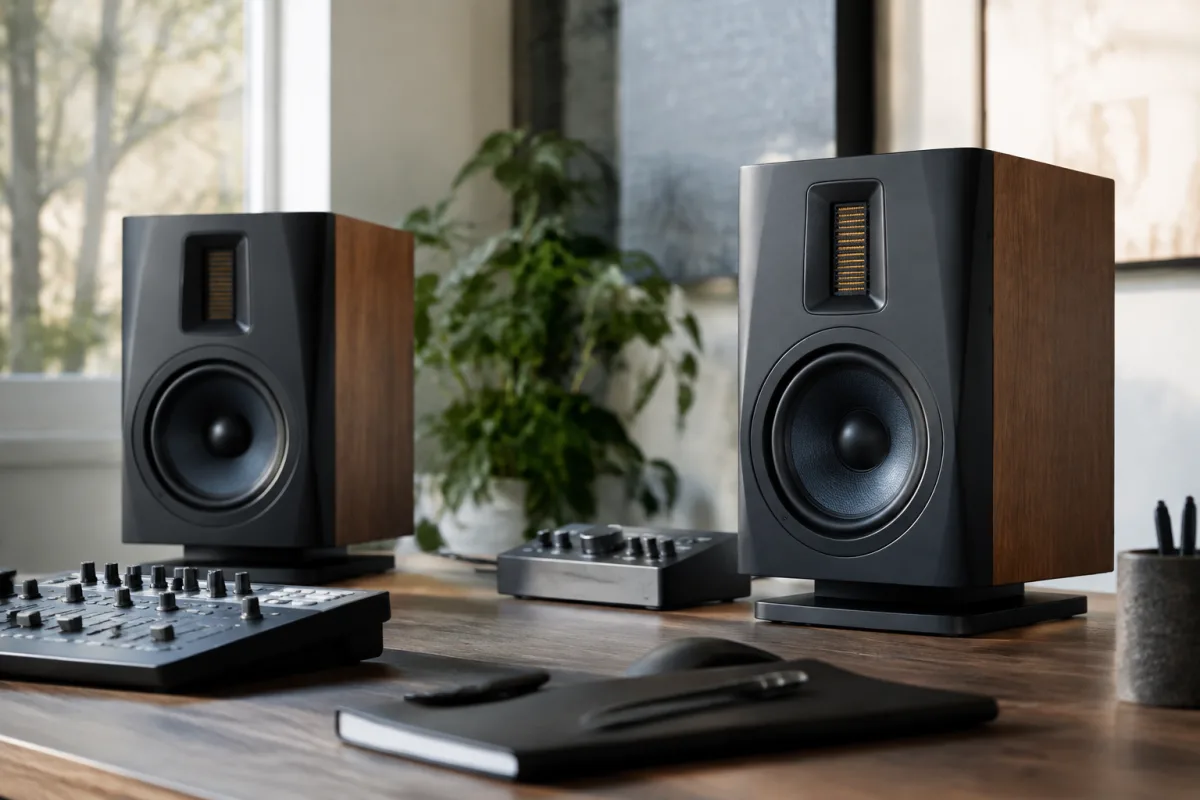
PreSonus studio monitors populate control rooms from tiny bedrooms to professional facilities worldwide. They've earned that presence through simple logic: make genuinely useful reference speakers at prices that don't require begging for studio funding. Walk into most working studios in the UK and you'll spot PreSonus monitors, whether it's the compact Eris line or the professional Sceptre series. That ubiquity isn't accident—it's result of relentless engineering focused on what recording engineers actually need.
Who Is PreSonus?
PreSonus is an American audio company built on one principle: make professional gear accessible. They started with audio interfaces and DAW software (Studio One) and expanded into monitoring, microphones, mixing consoles and complete studio solutions. PreSonus monitors specifically aim to deliver accuracy without requiring a second mortgage or a degree in acoustic physics. They're the company that understands your studio probably fits in a bedroom and your budget is tight but your standards aren't negotiable.
That philosophy—accessible professionalism—shapes every PreSonus monitor. They're not chasing exotic prestige or boutique legends. They're engineering honest speakers that sound right and are built to last.
The PreSonus Monitor Range
Eris Series: Compact and Affordable
The Eris line (Eris 3.5, Eris 4.5, Eris 5, Eris 8) targets bedroom producers and small studios. Small woofers (3.5–8 inches), compact form factor, genuinely accurate sound. The Eris 4.5 is perhaps the most sensible all-round nearfield monitor available—compact enough for desks, honest enough for serious mixing, affordable enough that you can own a pair without financial stress. They punch well above their price point, which explains why so many bedroom producers trust them.
Sceptre Series: Professional Monitoring
The Sceptre line (Sceptre 4 One, Sceptre 6 One, Sceptre 8 One) sits firmly in professional territory. Larger woofers, extended bass reach, more sophisticated electronics. These are monitors that professional studios run alongside subwoofers. They're honest, revealing, and genuinely transparent. When a professional tracking engineer needs to hear everything, a Sceptre series monitor makes it possible.
Ultrakompakt Series: Portable and Practical
The Ultrakompakt line handles nearfield monitoring in genuinely compact form—useful for mobile studios, portable rigs, or where desk space is non-existent. They don't sacrifice accuracy for size, which is the PreSonus approach throughout their range.
Why Studios Choose PreSonus Monitors
Honest Transparency Across the Spectrum
PreSonus monitors deliver genuinely flat frequency response. A vocal that's slightly harsh becomes obvious; sloppy bass lines show themselves. That honesty is the whole point. You're not chasing after the speaker's character; you're hearing the mix clearly. In a mixing scenario, that clarity is worth more than prestige.
Build Quality That Lasts
PreSonus monitors are engineered for real-world studio life. Cables get tangled, monitors get moved, spilled coffee happens. PreSonus builds robust equipment that survives this. The amplifiers are stable, the crossovers are solid, the drivers hold up. That durability matters across years of daily use.
Value That Actually Works
A pair of Eris 4.5 monitors costs around £150–£200. That's genuinely affordable without being toys. You get actual mixing reference, not a gamble. Professional engineers choosing Sceptre series monitors at £800–£1,200 get transparent clarity at less than premium competitors. That value equation drives adoption.
Integration with Studio Workflows
PreSonus makes audio interfaces, DAW software, and mixing consoles alongside monitors. The whole system works together seamlessly. Many producers find it sensible to standardise on PreSonus across their studio setup—it all talks to each other, updates integrate smoothly, and the ecosystem feels coherent.
PreSonus Monitors: Technical Features
Driver Technology
PreSonus uses combination of proprietary and proven driver designs. The woofers are typically polypropylene or composite materials (durable and accurate), and tweeters are silk dome (smooth and natural treble). This combination has proven reliable across thousands of installations. Nothing exotic, nothing problematic—just sensible engineering.
Amplification and Headroom
PreSonus monitors use Class AB amplifiers in professional models and Class D in compact Eris speakers. Both work well; Class D is more efficient and heat-friendly, Class AB is traditional and robust. Either way, you get enough headroom to reach reference levels without strain.
Acoustic Tuning
Professional Sceptre models include boundary compensation controls—switches that let you dial down bass if your monitors sit near walls. This is essential in real rooms. Eris speakers have similar controls on many models. These aren't gimmicks; they're tools for getting accurate sound in ordinary spaces.
Comparison: PreSonus Against Other Monitor Makers
| Brand | Typical Price (6–8 inch) | Character | Ideal For |
|---|---|---|---|
| PreSonus | £150–£1,200 | Flat, transparent, reliable | Bedrooms to professional studios |
| Yamaha HS | £300–£1,500 | Bright, present, engineered | Mixing pop and rock |
| Adam Audio | £600–£2,000 | Detailed, transparent, premium | Critical listeners, large rooms |
| KRK Rokit | £200–£800 | Bass-forward, coloured, fun | Producers valuing extended low end |
PreSonus sits in an interesting position—competitive pricing with honest sound. You're not paying for legendary prestige, but you're not sacrificing quality either. That's precisely where most working studios need to be.
Real-World Performance: What Mixing on PreSonus Sounds Like
Mix a vocal on a pair of Eris 4.5 monitors and you immediately hear every issue in the take. Breath noise, tuning problems, overshooting consonants—none of it is hidden. That honesty forces you to make real decisions: re-track the vocal or accept the imperfection. You can't blame the monitor. Similarly, a rhythm section shows its timing clearly; if the drums lag the bass, you'll hear it. That's genuinely useful information.
On Sceptre series monitors, that information gets even more detailed. The extended bass reach means you're hearing actual low-end content rather than guessing. A kick drum sits accurately; a bass guitar reveals its true character. Mixes done on Sceptre monitors translate confidently to other playback systems because you actually heard what was there.
Practical Considerations
Room Treatment and Placement
PreSonus monitors, like all nearfield monitors, benefit from decent room treatment. Bass traps in corners, absorption panels on walls, and thoughtful speaker placement dramatically improve accuracy. A pair of Sceptre monitors in a treated room outperforms the same monitors in an untreated room by a significant margin.
Listening Level
Mix at moderate volume—around 85dB SPL. Your ears are most accurate at this level, and you'll catch mixing problems more easily. Loud mixing fatigues your hearing and distorts judgment. Quiet mixing makes you push levels excessively. Find the middle ground and commit to it.
Subwoofer Pairing
PreSonus monitors pair excellently with subwoofers when you need extended bass information. The Sceptre series especially benefits from a quality sub; the Eris series works fine alone for most music but can gain low-end depth with a paired sub.
Budget Considerations and Value
Entry-level PreSonus Eris monitors (Eris 3.5, 4.5) at £150–£250 per pair are among the best values in studio monitoring. You genuinely get professional-quality transparency. Mid-range Eris models (Eris 5, 8) at £300–£600 offer expanded bass and clarity. Professional Sceptre series at £800–£1,200 deliver genuine studio-grade accuracy.
For most independent musicians and home studios, an Eris 4.5 or Eris 5 pair is the sensible choice. For semi-professional tracking and mixing, Sceptre 6 One monitors make excellent economic sense. The price-to-performance ratio across the PreSonus line is genuinely impressive.
Making Your Choice
Start by assessing your space. Small bedroom? Eris 3.5 or 4.5. Larger room with mixing ambitions? Eris 5 or 8. Professional studio setup? Sceptre series. Then consider whether you'll add a subwoofer—if yes, smaller monitors work fine; if not, go bigger.
Listen if you can—many retailers have demo units. Bring a mix you know and compare. Trust your ears; a monitor that sounds "right" to you matters more than any specification sheet.
Finally, remember that monitors are one tool among many. Room treatment, speaker placement, and your own listening discipline matter equally. PreSonus makes genuinely good monitors, but they can't overcome untreated rooms or careless mixing practices. Use them as part of a professional approach, and they'll serve you well for years.
Conclusion
PreSonus studio monitors represent intelligent engineering applied to the genuine need for affordable professional monitoring. Whether you choose compact Eris speakers for a bedroom studio or Sceptre series monitors for professional work, you're getting honest sound and solid build quality. That combination—transparency plus durability—is exactly what working studios need. PreSonus delivers it reliably and at prices that make sense.



Comments