


Nearfield Monitors article
The Ultimate Guide to Nearfield Studio Monitors
Nearfield monitors are the foundation of accurate studio mixing. Discover how they work, what features matter, and how to choose the right size and setup for your recording space.
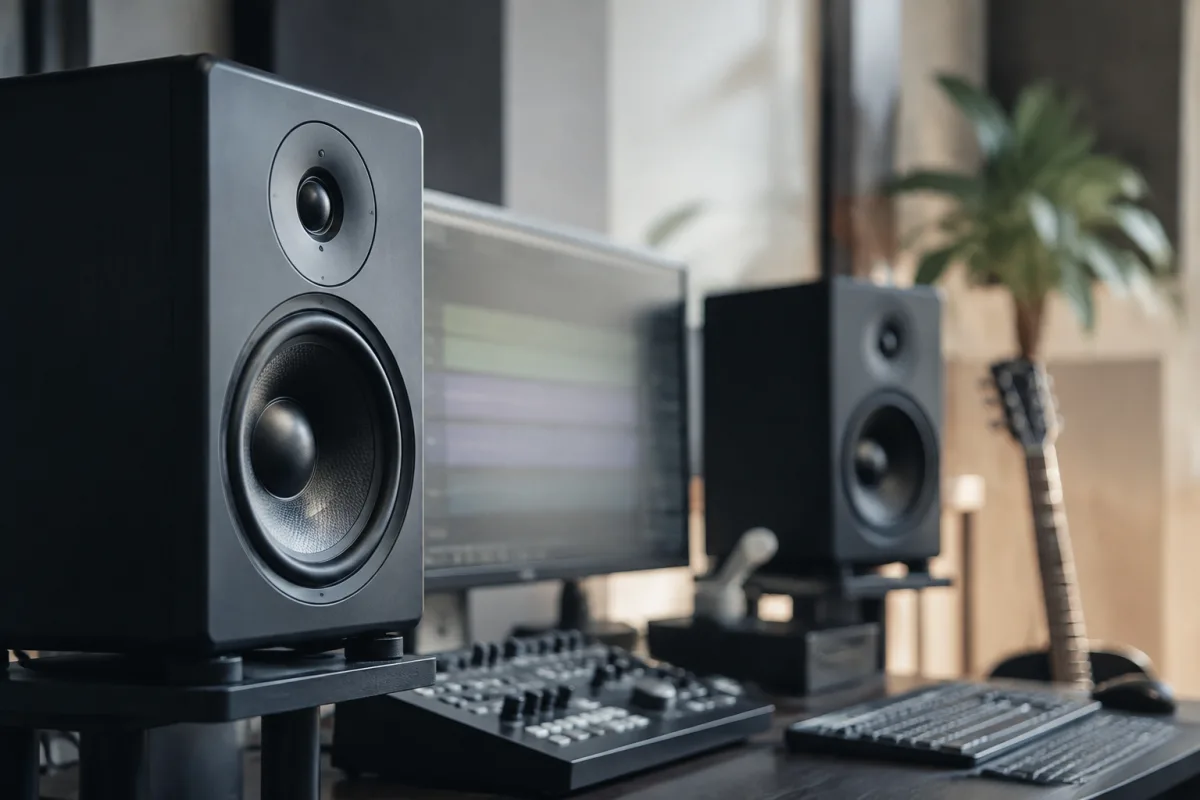
Nearfield monitors sit closer to you than traditional studio speakers—hence the name—and they're fundamental to how modern recording and mixing happens. Pull apart any working bedroom studio or professional control room, and you'll find them: compact, accurate, and absolutely essential. They're not glamorous, but they're the speakers that determine whether your mix actually translates. Get them right, and your work sounds good everywhere. Get them wrong, and you're chasing your tail through endless revisions, never quite trusting what you're hearing.
What Are Nearfield Monitors and Why Do They Matter?
Nearfield monitors are studio reference speakers designed to be placed close to the listener—typically 1 to 2 metres away. Unlike big passive speakers that need distance and room treatment, nearfields work accurately even in untreated spaces because you're hearing the direct sound from the speaker before room reflections muddy things.
The logic is simple: if you're mixing a track, you need to hear what's actually in the mix, not what your room is doing to it. Nearfield monitors let you hear closer to the source. You can place them on your desk, on stands beside your chair, or mounted on walls—anywhere that lets you sit in the nearfield zone and make decisions based on genuine sound, not acoustic lies.
How Nearfield Monitors Work
Active vs. Passive Design
Nearly all nearfield monitors are active—meaning the amplifier is built in. You plug them directly into your audio interface with balanced XLR cables, and they power on. This is simpler than passive speakers, which require external amplifiers, and it's become the industry standard precisely because it works so well in compact studio setups.
Speaker Architecture
Most nearfield monitors use a two-way or three-way design: smaller woofers (usually 4–8 inches) handle bass and low-midrange, whilst tweeters manage treble clarity. Some add a mid-range driver for even greater accuracy. The goal is flat frequency response—meaning they don't add exaggerated bass or treble—so you hear what's actually recorded, not what the speaker wants to emphasise.
The Concept of Flatness
Speaker flatness is about honest reproduction across the frequency spectrum. A flat speaker shows problems: a vocal that's slightly out of tune, a bass line that's muddy, a vocal reverb that's too long. Consumer speakers add bass and treble to sound impressive, but that lies to you. In the studio, you want the truth. Nearfield monitors deliver it.
Key Features to Understand
Frequency Response
Nearfield monitors typically handle frequencies from 40Hz (or lower) to 20kHz or beyond. The lower the bottom end, the better you can mix bass without a subwoofer. Most accurate monitors reach down to at least 40Hz; premium models go lower. Your room and speaker placement affect how low frequencies actually sound, but the spec tells you what's possible.
Wattage and Output
Studio monitors typically range from 30 to 100+ watts per speaker. More power doesn't mean louder; it means the speaker can reach its maximum volume without distorting. In small rooms, 40–50 watts is plenty. Larger spaces or listening at distance might need more power, but nearfield mixing rarely demands extreme volume.
Acoustic Tuning Controls
Most professional nearfield monitors include controls for room compensation. A bass roll-off switch lets you dial down low-end if you're in a small room or placing speakers near walls. Boundary EQ switches adjust for where the speaker sits. These aren't fixes for poor placement; they're tools to get honest sound in real-world rooms.
Choosing Nearfield Monitors: Size Matters
Compact Monitors (4–5 inch woofer)
Perfect for small rooms, desks, or portable studios. They offer surprisingly good accuracy despite the smaller woofer. The trade-off is reduced low-end depth—you might not hear everything a subwoofer would catch, but compact monitors are honest within their range. They're affordable and practical for bedrooms or project studios.
Mid-Size Monitors (6–8 inch woofer)
The workhorse size. Most professional studios run 6- or 8-inch nearfield monitors because they offer genuinely extended bass response with compact form factors. You get serious low-end information without needing dedicated subwoofers, though many engineers add one anyway for extreme bass frequencies.
Large Monitors (8+ inch)
Larger woofers and bigger cabinets push deeper and louder. They're excellent for bigger control rooms or when you want that extra bass information. The downside is size and cost—they take up more desk space and command higher prices.
Nearfield vs. Alternative Monitoring Solutions
| Solution | Use Case | Advantages | Disadvantages |
|---|---|---|---|
| Nearfield Monitors | Studio mixing and recording | Accurate, compact, no room treatment needed | Requires placement care; can't handle extreme bass alone |
| Monitors + Subwoofer | Full-range mixing in larger rooms | Extended bass, complete frequency picture | More expensive, bigger setup |
| Headphones | Reference on the move, late-night work | Portable, no room acoustic issues | Unnatural stereo image; easy to mix badly |
| Passive + Amp | High-end audiophile studios | Can sound exceptional, flexible | Complex, expensive, needs amp matching |
The Role of Room Acoustics
The absolute best nearfield monitors will sound terrible in a heavily reflective room. The reverse isn't quite true: good room treatment makes even modestly accurate monitors work well. The key is understanding that your listening environment shapes what you hear as much as the speaker does.
Basic room treatment means absorbing reflections. Bass traps in corners, panels on parallel walls, and diffusion scattered throughout turn a boomy bedroom into a usable mixing space. You don't need thousands of pounds of professional acoustic treatment; basic rockwool panels and DIY absorbers work remarkably well.
Speaker placement matters equally. Nearfield monitors belong somewhere that gives you symmetric positioning—sit between them, equidistant from each. Avoid corners (which trap bass) and placing speakers against walls without space behind them (which boosts low end unnaturally). Distance your monitors at least a foot from walls if possible.
Practical Considerations for Nearfield Monitoring
Calibration and Measurement
Many professional studios use calibration microphones and software to measure how their monitors actually sound in their specific room. It's not essential for every home studio, but it's enlightening. Tools like REW (Room EQ Wizard, free software) let you see frequency response curves and identify room resonances. Once you know your monitors' real signature, you can compensate for it in your mixing decisions.
Listening Level
Mix at moderate volume—around 85dB SPL, which is conversational loudness. Your ears are more accurate at moderate levels than at extremes. Loud mixing fatigues your hearing and tricks you into using excessive compression and EQ. Quiet mixing makes you push levels too hard. Find the sweet spot and stick with it.
Taking Breaks and Second Ears
Your ears adapt to monitor colouration, room resonances, and fatigue. After two hours of mixing, you're essentially deaf to certain issues. Step away, come back fresh. Reference your mix on headphones, in your car, on your phone speakers. If it sounds good everywhere, your nearfield mixing worked.
Budget Considerations
Quality nearfield monitors start around £150–£200 per pair for compact beginner-friendly models and climb to £1,000+ for professional-grade equipment. The relationship between price and accuracy isn't linear. A £400 pair of Yamaha HS7s will give you better information than £150 budget speakers, but the improvement from £800 monitors to £1,500 monitors is less dramatic.
For most home studios and even semi-professional operations, spending £300–£600 on a pair of nearfield monitors is the right balance. You get genuine accuracy without excessive cost.
Making Your Choice
Consider your room size first. Small bedroom? Compact 4–5 inch monitors make sense. Medium control room? 6–8 inch models. Then ask whether you'll add a subwoofer—if yes, smaller nearfields work fine. If not, go bigger on the woofers.
Listen to potential purchases if possible—many shops have demo rooms. Bring a mix you know well and compare what you hear. Trust your ears more than specs; a monitor that sounds "right" to you is more valuable than one with impressive numbers on paper.
Finally, remember that monitors are only part of the solution. Room treatment, speaker placement, and your own listening discipline matter equally. Great monitors in a terrible room make terrible mixing. Modest monitors in a treated room make genuinely good mixing possible.
Conclusion
Nearfield monitors are the foundation of modern studio work—not glamorous, but absolutely essential. They let you hear truth instead of lies, which means your mixes translate. Invest in quality monitors, treat your room, place them carefully, and listen critically. That discipline is where actual mixing skill lives. The monitors are just the tool that makes it possible.



Comments