


Desktop Studio Monitors Buying guide
Desktop Studio Monitors: A Complete Buyer's Guide
Buying the right desktop studio monitors means knowing what actually matters for your mixing environment. This guide cuts through marketing and focuses on specifications that determine whether these speakers will work for you.
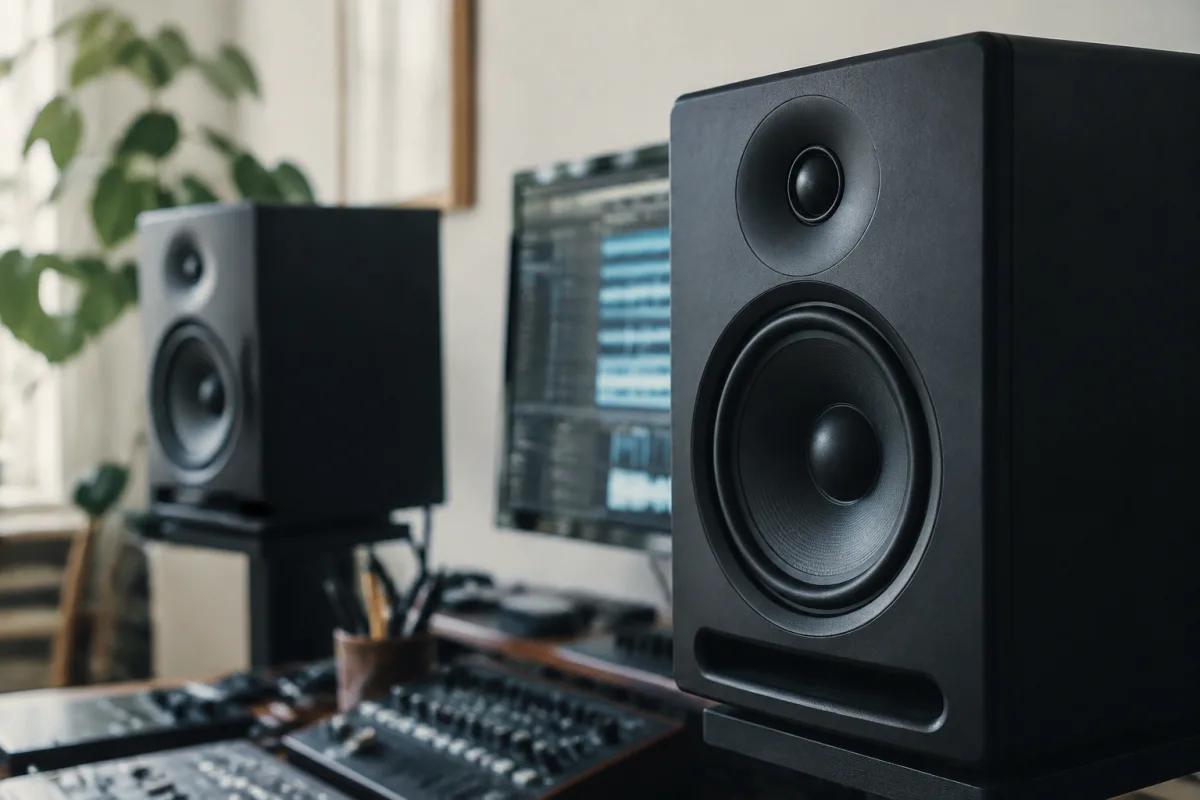
Buying the right desktop studio monitors means knowing what actually matters for your mixing environment. This guide cuts through the marketing and focuses on the specifications that determine whether these speakers will work for you.
Why these speakers differ from standard options
Desktop studio monitors are engineered for accuracy at close range, not power in a room. They're smaller, they run cool, and they're designed to reveal the truth about your mix when positioned on a desk. That honesty costs money, but it saves you bad mixes.
Standard bookshelf speakers colour everything. These don't. That's the entire difference, and it matters enormously when making decisions about EQ, level and balance.
Specifications that actually matter
Start with frequency response. Any monitor claiming to go below 50 Hz in a desktop footprint is either lying or producing room-shaking bass you don't want close by. Look for honest specs like 50 Hz to 20 kHz. Anything below 50 Hz requires a subwoofer anyway.
Wattage is irrelevant. Ten watts of clean amplification is infinitely better than 100 watts of coloured, distorted output. Check for Class D amplification (efficient and cool-running) or Class AB (cleaner, heats more). Avoid Class T or other exotic claims—traditional designs win.
Impedance matching to your interface matters. Most are 2-ohm load, which works with any audio interface. Some are 4-ohm, which is fine. Ignore this specification unless it's wildly outside normal range.
Driver size and physical dimensions
For desktop placement, 4-inch woofers are standard and sufficient. 5-inch woofers give a hair more low end without requiring a bigger cabinet. 6-inch and above are massive for desktop use and are really meant for furniture-sized stands in control rooms.
If your desk is smaller than 1.2 metres wide, 4-inch drivers are the right choice. If you have a 1.5-metre desk and can position them well back, 5-inch models work. Anything larger looks absurd on a desktop and wastes money.
Amp power and cooling
Most monitors come with 20-30 watts of amplification per channel. This is more than enough for comfortable monitoring at proper levels (80-85 dB). Anything significantly higher is needless power you'll never use, and it means the amp runs hotter and the fans run louder.
Check the cooling design. Monitors with rear vents are fine on a desk if you have air circulation. Side-venting speakers sometimes push warm air directly at your head, which is uncomfortable. Front-venting is rare but ideal. Top-venting tells you the thermal design is poor.
Signal-to-noise floor
A quiet unit matters when you're working late and the room is silent. Cheap models hiss noticeably when nothing is playing. Look for reviews mentioning noise floor, not specs (manufacturers rarely list it honestly). You want speakers you can't hear noise from when there's no input.
This is especially important if you work with orchestral music, ambient music or jazz where quiet passages reveal background hiss. If you mix rock and metal, you'll never notice even a mediocre noise floor.
Input options and connectivity
XLR connectors are the standard. They're balanced, they reject interference, and they're reliable. RCA connectors are unbalanced and prone to noise over long cable runs. If you have a choice, always choose XLR.
USB input is often poorly implemented and can introduce jitter (timing distortion). Skip it and use analogue XLR connections from your interface to your speakers. If the monitor offers USB, treat it as a bonus feature you'll probably not use.
Calibration controls and adjustments
The best models have at least a high-frequency trim switch (+2/-2 dB or similar). This lets you compensate for treble reflections off your desk surface. Some have bass trim switches too, which help with desk boundary reinforcement.
Avoid monitors with no calibration controls at all. They're fixed and unforgiving if your desk position isn't perfect. Simple controls (single bass and treble trim each) are infinitely more useful than units with a dozen controls that require a manual you'll never read.
Price tiers and value
Under £300 per pair, you're buying brand reputation and hope. Most options in this range have poor amp design or noisy electronics.
£300-£600 per pair is the sweet spot for home use. This is where you get honest monitoring, clean electronics, useful controls, and reliability. Most professionals working from home stay in this range.
£600-£1200+ per pair buys marginal improvements: slightly lower noise floor, slightly better driver quality, sometimes better cooling. The returns diminish fast. Very expensive models are usually control room monitors meant for stands, not desks.
Acoustic treatment around your desk
Desktop studio monitors will show you reflections from your desk surface and nearby walls. This is not the speaker's fault—it's room acoustics. Before buying expensive options, understand that a poorly treated desk is worse than a medium monitor in a treated space.
Use absorption panels behind and above your speakers. Use bass traps in corners if you have them. These are usually cheaper than upgrading and will have more impact on what you hear.
Common pitfalls when buying
Don't buy based on peak SPL (sound pressure level). These don't need to play at 110 dB. They need to play cleanly at 80-85 dB. Peak SPL specs are marketing fiction.
Don't fall for claims like "studio-grade" or "professional-quality" without specs to back them up. Marketing is free. Honest frequency response, low noise floor, and useful controls cost money and are rare under £300 per pair.
Don't assume bigger is better. A 5-inch speaker will teach you more accurate mixing than a bedroom control room monitor the size of a filing cabinet. Context and placement matter far more than raw size.
Return policies and testing
Buy from retailers with at least 30-day returns. Test your new speakers in your actual setup. Some sound great in a showroom and terrible on your desk. If they don't work out, return them and try something else.
Listen to reference mixes you know well. A good monitor will reveal problems you didn't hear before, but they'll be real problems with the mix, not problems with the speaker.
Making your final choice
The best option for you is one that reveals mix problems accurately, has controls that let you compensate for your desk position, runs cool and quiet, and costs within your budget. Everything else is marketing. Find honest reviews online, check the spec sheet for obvious red flags, and buy from someone who takes returns.
For deeper context on specific desktop monitoring solutions and control centre options, check out our guide to desktop studio monitors and professional control solutions.
Conclusion
Buying desktop studio monitors is about getting honest monitoring at your desk, not buying the biggest or most expensive option. Focus on specs that matter: frequency response, noise floor, calibration controls, and cooling. A £400 pair will teach you more accurate mixing than £200 speakers, but a £1200 pair won't teach you twice as much. Smart buying means getting the best honest monitoring you can afford within the desktop form factor.


Comments