


Ear Training App article
Everything You Need to Know About Ear Training App
Ear training apps develop your ability to recognise intervals, chords and scales by ear. This guide covers top apps and how to maximise your results.
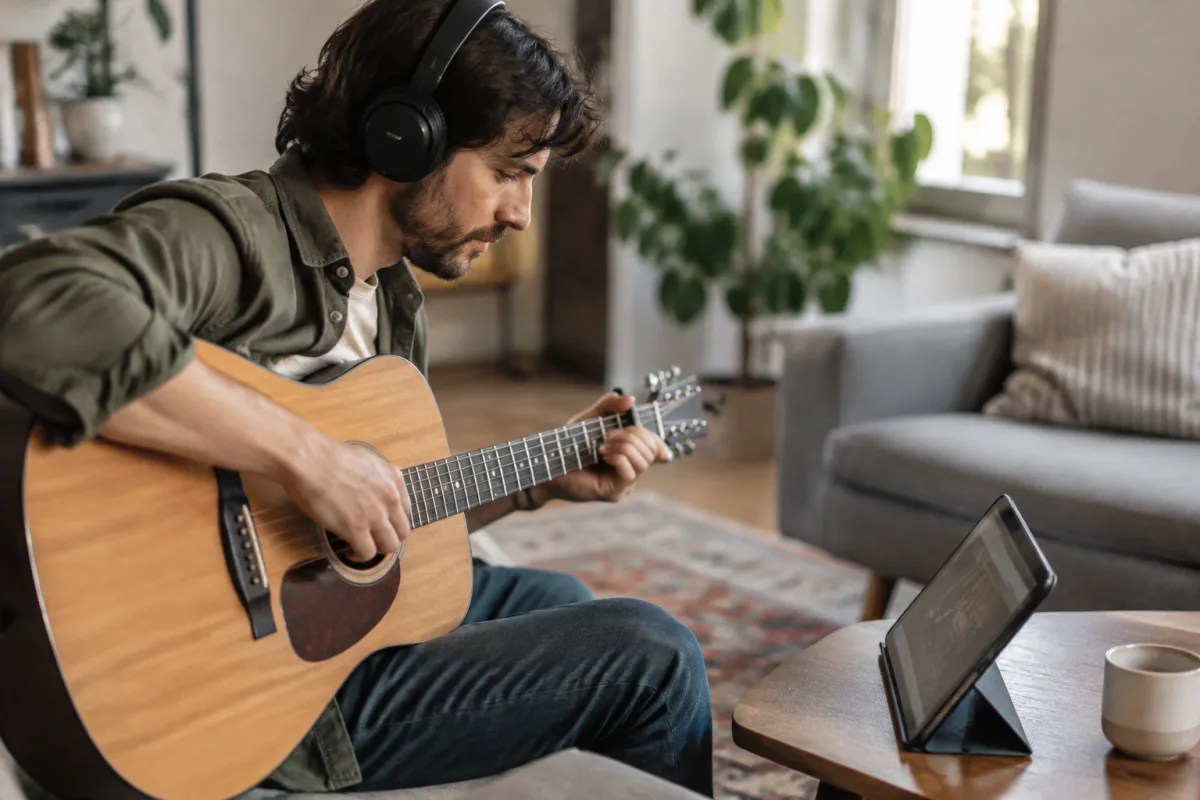
Ear training—developing the ability to identify musical intervals, chords, scales and rhythmic patterns by ear alone—remains one of the most rewarding yet challenging skills musicians can develop. Historically, ear training required patient study with a teacher or theory textbook. Today, an ear training app brings structured, interactive music theory practice directly to your phone or tablet, making daily ear development accessible and affordable. This guide explores how ear training apps work, what they teach, and which approaches suit different musical goals.
What Is Ear Training?
Ear training is the systematic practice of recognising musical sounds and translating them into musical understanding. A trained ear allows musicians to:
- Identify intervals (the distance between two notes) by sound alone
- Recognise chord qualities (major, minor, diminished, augmented)
- Pick out melodies by ear and play them on your instrument
- Detect rhythmic patterns and time signatures in unfamiliar music
- Understand harmonic progression and chord substitution by listening
- Transcribe songs, solos and arrangements by ear
Musicians with developed ear skills learn faster, memorise more easily, improvise more confidently and enjoy deeper musical understanding. Ear training forms the foundation of musicianship at every level from beginner to virtuoso.
How Ear Training Apps Work
Modern ear training apps employ several pedagogical approaches, often combined within a single application:
Interval Identification
The app plays two notes in sequence or harmony and asks you to identify the interval (unison, minor second, major third, perfect fifth, octave, etc.). Interval training is foundational because every melodic and harmonic relationship reduces to an interval. Apps typically start with large, easily distinguishable intervals and progress toward small, challenging intervals like the minor second and major seventh.
Chord Recognition
The app plays a chord and asks you to identify its quality: major, minor, dominant seventh, diminished, augmented, suspended, etc. Chord recognition develops faster than interval training for many learners because chords employ familiar patterns rather than precise interval measurement.
Scale Degree Identification
The app plays a note within a major or minor scale and asks you to identify its position (root, second, third, fourth, etc.). Scale degree training develops relative pitch and harmonic awareness, essential for improvisation and composition.
Melody Transcription and Singing
Advanced apps include exercises where you hear a short melody and must transcribe it into notation, play it on your instrument, or sing it back. These activities bridge the gap between theoretical ear training and practical musical application.
Rhythm and Time Signature Recognition
Rhythm-focused exercises teach recognition of rhythmic patterns, time signatures, and rhythmic subdivisions by listening and tapping along or notating what you hear.
Popular Ear Training Apps and Platforms
Several apps have earned widespread adoption among musicians:
EarMaster
A comprehensive desktop and mobile application offering interval, chord, scale, melody and rhythm training. EarMaster provides structured lessons with adjustable difficulty and detailed progress tracking. The software is widely used in music schools and universities. Pricing spans from free basic versions to paid subscriptions with full feature access (typically £30–60 annually).
Tenuto
A feature-rich mobile app (iOS and Android) offering interval, chord, and rhythm training with beautiful, intuitive interface. Tenuto's adaptive algorithm adjusts difficulty based on your performance, keeping you challenged without overwhelming. A free version provides core features; premium subscription (£3–5 monthly) unlocks advanced content.
Perfect Ear
A gamified ear training app available on iOS and Android. Perfect Ear teaches intervals, chords, scales, and rhythms through game-like exercises with points and levels. The free version covers core intervals and chords; premium features (£2–4 annually) unlock additional training modes.
Moises
An innovative app combining audio processing tools (tempo control, pitch shifting) with ear training focused on learning by ear from real songs. Moises allows you to slow down recordings, isolate instruments and train your ear against actual music rather than synthesised tones. A free version offers basic features; premium (£5–10 monthly) unlocks advanced separations and tools.
TrainEar
A browser-based and mobile ear training platform with interval, chord, scale and rhythm exercises. TrainEar emphasises simplicity and focuses purely on ear development without gamification. Pricing is straightforward: free basic access or a modest one-time purchase for unlimited content.
Advantages of App-Based Ear Training
Ear training apps offer several compelling advantages over traditional study methods:
- Accessibility — Train anywhere, anytime on your phone or tablet. Consistent daily practice is more important than lengthy weekly sessions.
- Immediate feedback — Apps tell you instantly whether your answer is correct, reinforcing learning rapidly.
- Adaptive difficulty — Quality apps adjust challenge to match your current level, keeping you engaged without frustration.
- Personalised progress — Apps track your specific weak areas (perhaps you struggle with augmented intervals but excel at fifths) and focus practice accordingly.
- Affordability — Annual subscriptions typically cost £30–60, far less than weekly ear training lessons with a teacher.
- Gamification — Points, levels and streaks make daily practice engaging and motivating for many learners.
- No teacher required — You work at your own pace without scheduling constraints.
Limitations and Considerations
Ear training apps are powerful tools but carry some limitations:
- Synthesised tones versus real instruments — Many apps use piano or synth sounds. Developing ear for actual instruments (trumpet, violin, voice) requires additional practice with real recordings.
- No feedback on technique — Apps cannot correct your posture, embouchure or fingering when singing or playing responses back.
- Limited contextual learning — Pure interval and chord recognition is easier than applying ear skills to real music with harmonic complexity and emotional context.
- Potential for rote memorisation — Some learners memorise expected sequences rather than developing genuine listening skills.
- Passive listening limitation — Apps excel at recognition but less at production skills (singing or playing what you hear), which are equally important for complete ear development.
Maximising Results: Best Practices
To get the most from an ear training app, follow these guidelines:
- Practice consistently (ideally daily) for 10–20 minutes rather than occasional hour-long sessions.
- Focus on one skill at a time (intervals first, then chords, then scales) rather than jumping between modes.
- Start with easy exercises and progress gradually. Struggling with challenges beyond your current level discourages improvement.
- Combine app training with practical application—actively listen to songs you know and identify intervals and chords by ear.
- Supplement app work with instrument practice, singing exercises and real music listening to develop applied ear skills.
- Use real instrument sounds (not just piano) once you develop basic interval recognition.
- Don't rely solely on apps; combine them with music theory study and instruction for complete musical development.
Choosing the Right App for Your Goals
Different apps suit different goals and learning styles. Evaluate your needs:
- Beginner looking for interactive fun: Perfect Ear or Tenuto offer engaging, accessible interfaces.
- Serious student wanting comprehensive curriculum: EarMaster provides structured lessons and detailed tracking.
- Musician who learns by ear from real music: Moises combines ear training with practical song learning.
- Minimalist preferring pure ear development without gamification: TrainEar offers straightforward, no-frills training.
Combining Apps With Traditional Study
The most effective ear training combines app-based practice with traditional methods. Supplement daily app work with:
- Weekly lessons with a music teacher who can correct technique and contextualise ear development within broader musicianship
- Singing intervals and chords to embed the sounds in your voice and ear simultaneously
- Active listening to professional musicians and transcribing passages by ear
- Theory study to understand *why* intervals and chords sound the way they do
- Improvisation practice applying ear skills to real music-making
Conclusion
An ear training app makes systematic ear development accessible, affordable, and enjoyable. Consistent daily practice with a quality app develops real, transferable listening skills that enhance every aspect of your musicianship. Whether you are a classical musician learning to recognise harmonic function, a jazz improviser developing melodic intuition, or a songwriter seeking deeper harmonic understanding, an ear training app accelerates your development significantly. Choose an app matching your learning style and goals, commit to daily practice, and combine app work with real-world musical application to unlock the profound benefits of a trained ear.



Comments