


Mechanical Metronome article
Mechanical Metronome for Beginners: A Complete Guide
Nervous about using a mechanical metronome for the first time? This beginner's guide breaks down the essentials into simple, friendly steps.
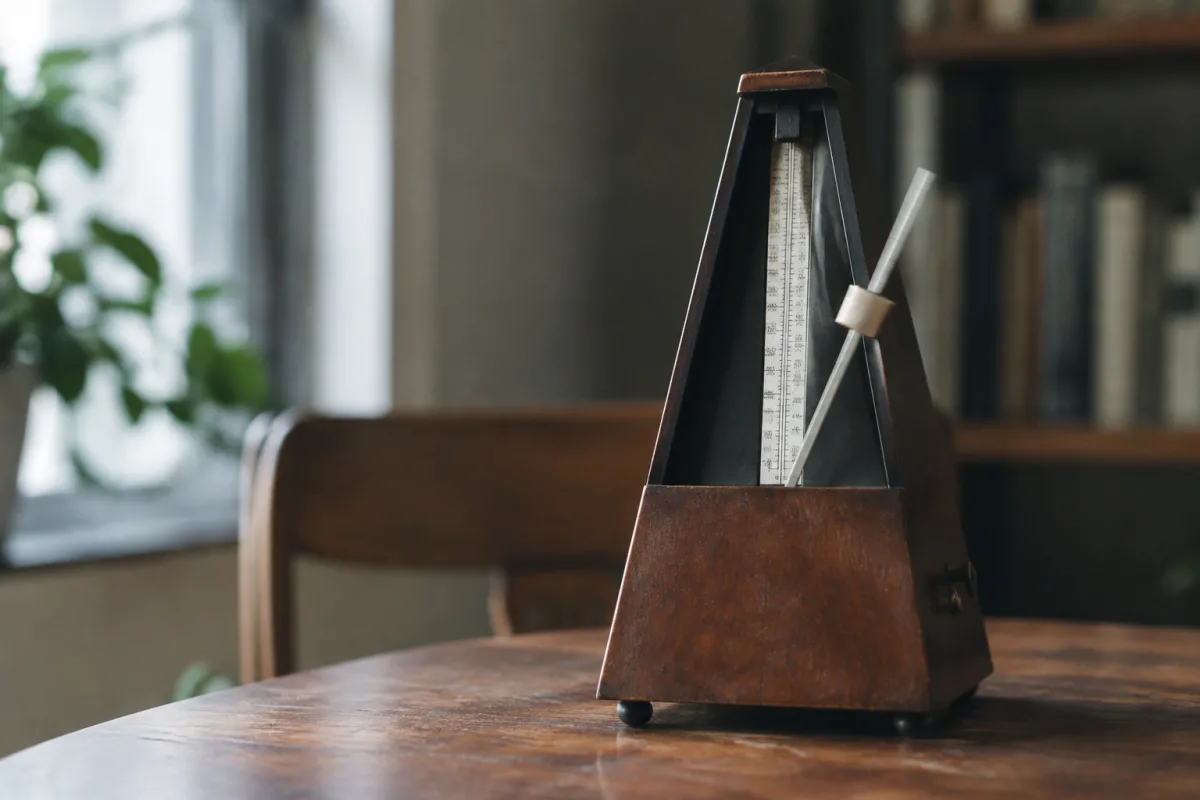
Starting with a mechanical metronome can feel daunting if you've never used one before. Unlike digital devices, mechanical metronomes require a bit of hands-on familiarity—but don't let that intimidate you. Once you understand the basics, a mechanical metronome becomes a lovely, reliable companion for your practice sessions. This guide walks you through your first steps with a mechanical metronome, breaking down what can seem mysterious into simple, manageable actions.
Your First Look: What You're Seeing
A mechanical metronome is simpler than it appears. At the top sits a pendulum—the arm that swings back and forth, ticking out the beat. The pendulum has a sliding weight on it; sliding that weight up or down changes the speed. Below the pendulum is a keyhole or a wind-up knob on the back or side. Inside is a clockwork mechanism that powers the whole thing. That's genuinely all there is. You're not operating anything scary; you're just winding a clock and moving a weight.
Getting Started: The Three Essential Steps
Step 1: Wind It Up
Open the little door on the back (or look for the wind-up knob). Insert the small key or your finger (if it has a round knob) and turn it clockwise gently. Wind it until you feel resistance—usually 10–20 turns. Don't force it; you'll know when it's wound. If your metronome has a keyhole, the key should always be kept safely nearby. This single wind-up typically keeps the device running for a full practice session or longer.
New players often worry they'll break the mechanism. You won't. It's deliberately made to be sturdy. Wind it confidently, and if it ever feels jammy or wrong, stop and check if anything's blocking the knob—but this almost never happens.
Step 2: Set the Tempo
Look at the pendulum arm. You'll see a triangular or circular weight on it, and a numbered scale printed along the arm showing tempos in BPM (beats per minute). To slow down the beat, slide the weight down toward the base of the pendulum. To speed it up, slide the weight up toward the top. Start by sliding it to around 60 BPM—a calm, human heartbeat speed, perfect for learning.
The scale on the arm isn't perfectly accurate (mechanical metronomes drift slightly), but it's close enough. If you want to be really precise, check your tempo against your smartphone's metronome app for comparison. But for practice, don't obsess over exact precision at first.
Step 3: Start It Ticking
Some mechanical metronomes have a small lever or switch at the base; move it up or to the side to start the pendulum. Others start automatically once wound and set. Push the pendulum gently to one side to get it going if it doesn't start on its own. It should begin swinging back and forth, clicking at each swing. If nothing happens after a few tries, it may need winding again, or check that the tempo weight isn't stuck at the very bottom of the arm.
Once it's ticking, just listen. Don't overthink it. Let the rhythm become familiar.
Using Your Mechanical Metronome: Common First-Timer Questions
Will It Tick Loudly? Is That Normal?
Yes, mechanical metronomes are intentionally audible—that's the point. Some people find the sound charming; others find it loud, especially in quiet spaces. This is perfectly normal. If the sound bothers you, you can place the metronome on a soft surface (a towel, a cushion) to dampen it slightly, though it will still be clearly audible. Many beginners come to love the ticking sound as it becomes the heartbeat of their practice.
What If It Stops Ticking?
It's probably just run out of wind. Wind it up again. Mechanical metronomes do eventually wind down—they're not perpetual. That's actually fine; the winding becomes part of your practice ritual, and it takes seconds. Some metronomes tick for 20 minutes per wind, others for over an hour. It depends on the model.
I Can't Hear It Over My Instrument—What Do I Do?
Move it closer, or move your instrument slightly away when practising with the metronome. Or simply accept that you'll hear it less clearly on louder instruments (drums, loud guitars) and use it as an occasional checkpoint rather than a constant guide. This is actually a good thing—it trains your internal sense of time.
The Weight Keeps Sliding Down—Is It Broken?
No. Some mechanical metronomes have friction on the weight, others don't. If yours slides easily, just gently push it back up to your target tempo before you start. It's a small quirk, not a fault.
Your First Week of Practice
Don't try to master your mechanical metronome in one go. Here's a forgiving path:
- Day 1–2: Just wind it, set it to 60 BPM and listen for five minutes. Get used to the sound and feel. No playing needed—just listening.
- Day 3–4: Play simple scales along with it at 60 BPM. Don't worry if you're not perfectly in time. Just try to match the beat roughly.
- Day 5–7: Move up to 70–80 BPM once 60 feels easy. Play the same scales or simple melodies. Congratulations—you're now using a mechanical metronome properly.
That's genuinely all there is. You're building a habit and an ear, not passing an exam.
Mistakes Beginners Make (and How to Avoid Them)
- Winding it too hard or forcing the knob: Wind it gently until you feel natural resistance. You're not opening a jam jar. Gentle always.
- Setting it too fast too soon: If 120 BPM makes you tense and you rush, you're training yourself to rush. Start slow, build comfort, then gradually increase tempo. Slow wins.
- Expecting it to be perfectly silent: It's not. It ticks. If silence is essential, a digital metronome might suit you better—but give the mechanical sound a week before deciding you hate it.
- Moving the weight mid-practice: Once you've set your tempo, leave it alone for the whole session. Don't fiddle. You're not trying to adjust; you're learning to lock into what you've set.
- Assuming you need it to be perfectly accurate: A mechanical metronome is good enough for learning. It's not a lab instrument. Tiny drifts in tempo are fine and actually somewhat realistic—live drummers aren't robots either.
When to Move On (or Move Back)
After a few weeks, you'll know if a mechanical metronome suits you. If you love the ritual and the sound, stick with it. If the ticking drives you mad, switch to digital—no shame in that. Some players use mechanical for certain practice sessions and digital for others. Many beginners find that after four to six weeks, they've internalised the rhythm well enough that they don't need the metronome as often.
For broader information on how mechanical metronomes compare to other options, see our complete mechanical metronome guide.
The Bottom Line
A mechanical metronome is a beautiful tool, even if it seems odd at first. Wind it, set it, listen, and play along. You don't need to understand the clockwork inside; you just need to understand that it ticks reliably and your job is to match that tick. Within a week, it will feel normal. Within a month, you'll feel the difference in your playing—your timing will be steadier, your confidence higher. Be kind to yourself as you learn, keep it simple, and enjoy the satisfaction of watching that pendulum swing to the rhythm of your practice.


Comments