


Passive PA Speaker article
The Ultimate Guide to Active or Passive Pa Speakers
Passive PA speakers require external amplification but offer cost-effective, flexible sound reinforcement. Discover how to choose, match amplifiers and set up professional passive systems.
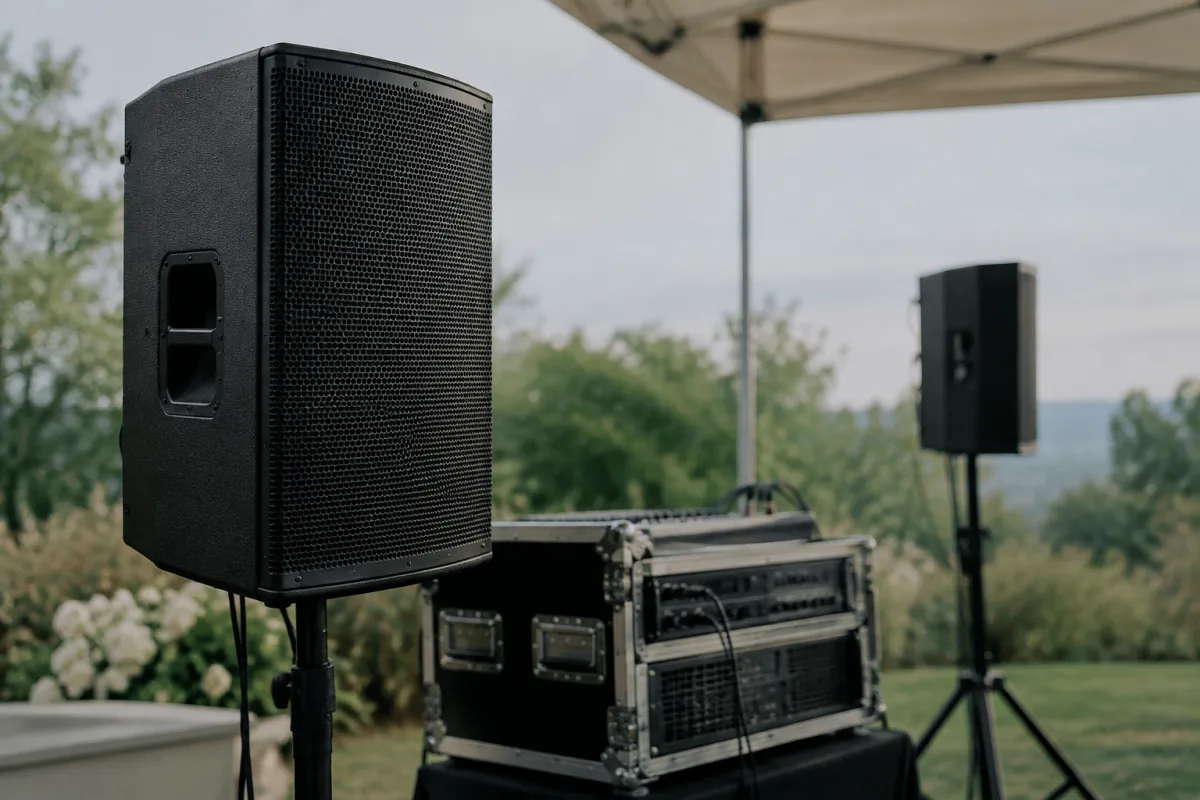
Understanding Passive PA Speakers
A passive PA speaker is an unpowered loudspeaker cabinet designed to reproduce sound from a separate amplifier. Unlike active (powered) PA speakers which have built-in amplifiers, passive speakers are purely acoustic devices—they require external amplification to operate. This distinction matters significantly for sound system design, budgeting and setup. Understanding passive PA systems unlocks affordable, flexible solutions for venues, events and live sound reinforcement.
How Passive PA Speakers Work
The Signal Chain
In a passive system, audio travels from the mixing console to a dedicated power amplifier, then to the passive speaker cabinet. The amplifier supplies the electrical power that drives the speakers' driver components (woofers and tweeters). The crossover network inside the cabinet divides frequencies between drivers: low frequencies go to the woofer, high frequencies to the tweeter. The cabinet's acoustic design shapes how sound radiates into the room.
Key Components
- Woofer: The large driver (typically 10 to 15 inches) reproducing low and mid frequencies.
- Tweeter: The small driver (1 to 2 inches) reproducing high frequencies.
- Crossover: An electronic circuit splitting the signal by frequency, sending appropriate signals to each driver.
- Impedance: Measured in ohms (typically 4, 8 or 16 ohms), this electrical characteristic affects how the speaker loads the amplifier.
- Sensitivity (SPL): How loud the speaker plays given a standard input level, measured in decibels (dB). Higher sensitivity means more output per watt of amplification.
Passive vs. Active (Powered) Speakers
Advantages of Passive Speakers
- Lower cost per unit: Passive speakers are cheaper because they lack the amplifier electronics. A £200 passive speaker might cost £400 with built-in amplification.
- Centralised amplification: A single powerful amplifier serves multiple speakers, which can be more efficient and easier to manage than multiple powered units.
- Greater flexibility: You can pair passive speakers with different amplifiers, adapting power levels to venue size and needs.
- Better for large venues: Multiple passive speakers fed by a powerful amp system distribute sound evenly across large rooms. This is harder with powered speakers.
Disadvantages of Passive Speakers
- Requires separate amplification: You must purchase and power a dedicated amplifier, adding cost and complexity.
- More cabling: Connections between mixer, amplifier and speakers require quality cables and careful setup.
- Setup complexity: Matching impedances, gain staging and amplifier power to speaker sensitivity requires basic technical knowledge.
- Less portable: Carrying a separate amplifier is bulkier than an all-in-one powered speaker.
Types and Sizes of Passive PA Speakers
Compact Passive Speakers
Small cabinet passive speakers (using 8-inch or 10-inch woofers) are ideal for small venues—coffee shops, small clubs, rehearsal spaces. They're lightweight, affordable and require modest amplification (typically 100–300 watts). Pair two or four compact speakers with an appropriate amplifier for intimate venues.
Mid-Size Speakers
Standard PA speakers use 12-inch or 15-inch woofers and suit medium venues—larger clubs, theatres, wedding receptions. These require 300–800 watts per pair depending on sensitivity and desired volume. Mid-size speakers offer the best balance of portability, cost and coverage for most live sound applications.
Large Format Speakers
Professional venues use large cabinet speakers (15-inch or dual 12-inch woofers) paired with powerful amplification (1000+ watts). These systems are designed for maximum output, even coverage and durability in demanding professional environments—touring bands, stadiums, permanent installations.
Subwoofers
Passive subwoofers (typically 15 to 18-inch drivers) reproduce frequencies below 100 Hz, adding physical bass impact to live sound. Combined with main speakers handling midrange and treble, a subwoofer system provides full-range coverage with specialised handling of challenging low frequencies.
Key Specifications to Understand
Power Handling (Watts)
The maximum electrical power the speaker can handle safely without damage. Continuous power handling (RMS) is more important than peak ratings. A speaker rated 300W RMS should be fed by an amplifier outputting 200–300 watts into the speaker's impedance.
Impedance (Ohms)
Passive speakers are typically 4, 8 or 16 ohms. The amplifier must match this impedance. Connecting multiple speakers in parallel (positive to positive, negative to negative) lowers overall impedance. A 4-ohm amplifier can drive two 8-ohm speakers, resulting in a 4-ohm load.
Sensitivity (dB SPL)
Measured as output in dB at 1 metre when given 1 watt input. A sensitive speaker (90+ dB) produces more volume from less amplification. Lower-sensitivity speakers require more powerful amplifiers to reach the same loudness.
Frequency Response
The range of frequencies the speaker reproduces effectively, typically listed as (e.g.) 50 Hz–20 kHz. Wider response means more complete sound, though even specification tells nothing about flatness or tonal accuracy.
Choosing an Amplifier for Passive Speakers
Matching Power to Venue Size
Small venues (coffee shops, rehearsal studios) need 100–300 watts total. Medium venues (clubs, theatres, medium events) need 500–1200 watts. Large venues need 2000+ watts. This is a rough guide; actual needs depend on speaker sensitivity, venue acoustics, and desired volume.
Calculating Total Impedance
If you're running two 8-ohm speakers in parallel, total impedance is 4 ohms. Your amplifier must be rated to handle 4 ohms, not just 8. Mismatching impedance can damage the amplifier or cause it to shut down for protection.
Amplifier Type: Class D, AB or Other
Modern Class D amplifiers are efficient and compact. Class AB amplifiers are more traditional and generally sound excellent for live sound. Most touring systems use Class D for portability; fixed installations often use Class AB. Both are professional choices.
Setting Up a Passive PA System
The Basic Chain
Microphones → Mixing console → Power amplifier → Passive speakers. The mixing console must have sufficient output to drive the amplifier's input (typically –10 dBu balanced XLR or RCA connectors). Use quality balanced cables (XLR) between amplifier and speakers.
Gain Staging
Adjust the amplifier's input gain so the mixing console operates at nominal levels without clipping. Set speaker output volume on the amplifier to the desired level, then control dynamics with the mixing console's channel and master faders.
Speaker Placement
Position speakers on stands or mounts at ear level, angled toward the audience. Avoid placing speakers in corners where bass will boom uncontrollably. If using subwoofers, position them centrally and adjust their crossover frequency (typically 80–150 Hz) so they blend smoothly with main speakers.
Advantages for Specific Scenarios
Touring and Mobile Sound
Passive systems with a dedicated amplifier can be more durable than powered speakers for heavy touring. Flight cases protect both speakers and amplifier; the entire rig can be rebuilt quickly at each venue.
Fixed Installations
Permanent venues often favour passive systems. A central amplifier rack can power multiple zones; wiring runs through walls to each speaker location. This approach scales elegantly and allows centralised control.
Festival and Event Sound
Large events typically use passive systems. A powerful amplifier system feeds multiple speaker arrays positioned strategically throughout the venue. This provides even coverage and facilitates remote mixing from a central FOH (front of house) position.
Common Mistakes to Avoid
Don't mismatch impedance—check all cable connections and ensure parallel speaker wiring is correct. Don't under-power your system—a 100-watt amplifier pushing four 8-ohm speakers is inadequate; use at least 300 watts for medium venues. Don't neglect cables and connectors—poor-quality or damaged cables introduce noise and signal loss. Finally, don't skip gain staging and level setting; proper setup prevents distortion and protects your equipment.
Conclusion
Passive PA speakers remain a versatile, cost-effective solution for live sound reinforcement, touring and venue installations. Combining passive speakers with appropriate amplification offers flexibility, durability and scalability that powered solutions sometimes lack. Understanding passive speaker fundamentals—impedance, power handling, sensitivity—empowers you to design systems suited to your specific venue, budget and acoustic needs. Whether you're setting up a small venue system or a large touring rig, passive speakers deliver the reliability and sound quality that professionals depend on.




Comments