


Precision Bass article
Precision Bass for Beginners: A Complete Guide
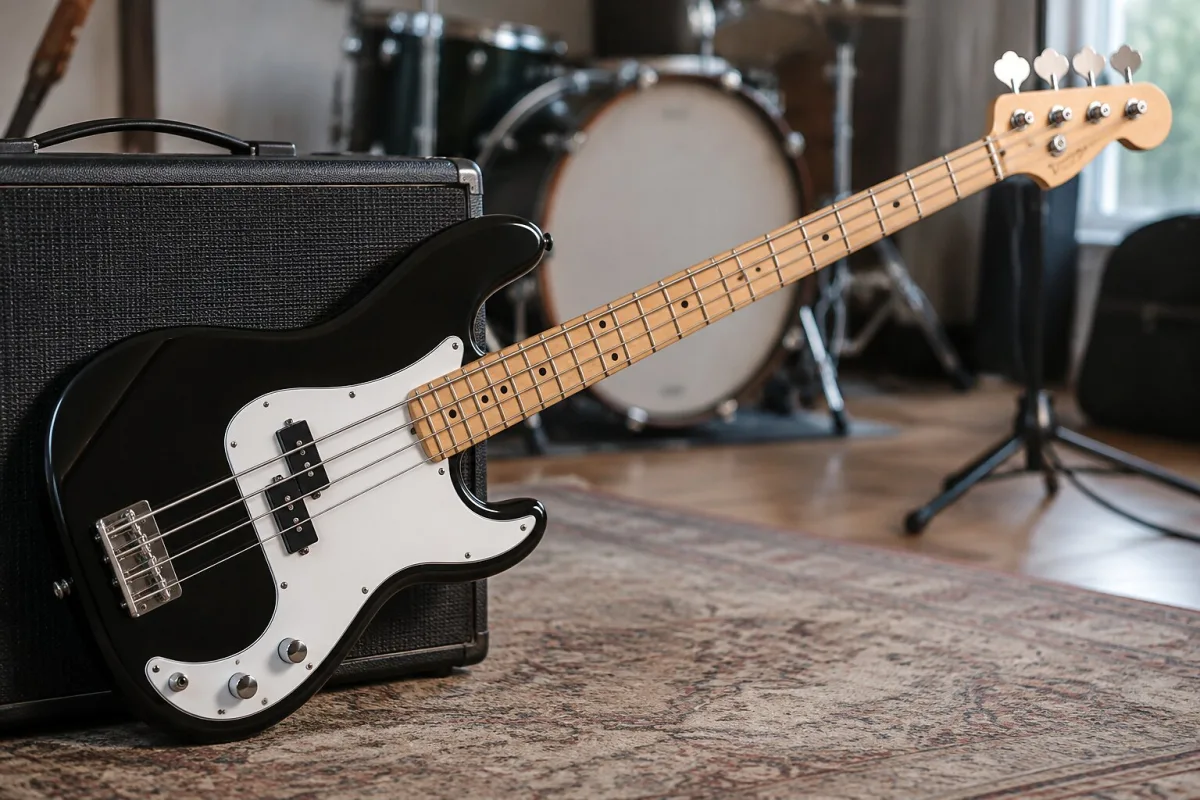
You've decided to learn bass, and you've noticed that the Fender Precision Bass shows up on almost every recording you've ever respected. Is a P Bass a good first bass? Absolutely. Is it the only choice for a beginner? No. But it's a smart one, and this guide walks you through what makes it beginner-friendly, what to expect when you pick one up for the first time, and how to get the most from it while you're learning.
Why the Precision Bass Is a Good First Bass
The P Bass rewards good technique immediately. It's not a forgiving instrument in the way that some cheap basses forgive sloppy playing. If your fingers are in the right position, you get crystal-clear note definition. If you're off, the note dies or buzzes. That immediate feedback teaches you to play accurately faster than an instrument that sounds okay no matter what you do.
The simple electronics—just volume and tone—mean there's nothing to hide behind. You learn what matters: your technique, your strings, your amp. You're not distracted by pickup switches or complex tone controls. That simplicity is pedagogical genius: the P Bass teaches you bass fundamentals without complexity.
The split-coil pickup is forgiving in one important way: it handles pick playing, fingerstyle, and hybrid techniques equally well. Whether you play with your fingers near the bridge or closer to the neck, the P Bass responds musically. Many beginner bassists discover their playing style by experimenting on a P Bass, and the instrument adapts to whatever technique feels natural.
Choosing a First Precision Bass: Budget and Practicality
Your first bass doesn't need to be expensive. A Fender Player Precision Bass (£450–500) is ideal for beginners: it's affordable enough not to feel like a mistake if you decide bass isn't for you, but good enough that you won't outgrow it quickly. Many experienced players still use Player basses, so your first instrument can grow with you.
Entry-level imported basses under £300 work, but they're often poorly set up from the factory. You might spend £50–100 getting a cheap bass playable, which defeats the budget logic. Splurge slightly on a Player or used American bass if you can. The improved setup and build quality will make learning more enjoyable.
Understanding the 34-Inch Scale as a Beginner
The Precision Bass's 34-inch scale is the standard for bass guitars, which means you're learning on the industry norm. Yes, 34 inches feels long at first if you've never played bass. Your fingers have to stretch wider than they would on a guitar. Your hand position takes adjustment. But within weeks, 34-inch scale feels normal, and you're building finger strength and dexterity that will serve you on any bass.
This is actually an advantage: you're learning proper scale length from the start, not developing bad habits on a short-scale instrument and having to re-learn everything later. The 34-inch scale becomes your baseline, and switching to other bass formats is easier than the reverse.
The Split-Coil Pickup Explained for Beginners
The P Bass has one pickup—a split-coil design divided into two sections. Don't worry about the technical details; just know that this design produces the classic P Bass tone: focused, punchy, and clear in a mix. It's the same pickup design Leo Fender created in 1951, and it's still the standard because it works.
As a beginner, you don't need to replace the pickup or modify it. Learn on the stock pickup and understand what it teaches you about bass tone. If you later play a Jazz Bass or a PJ bass, you'll appreciate the differences from experience rather than just reading about them.
Setting Up Your First Bass Properly
After you buy your first P Bass, take it to a qualified bass technician for a proper setup. This means: checking that the neck is straight, adjusting the action (string height) to a comfortable playing position, ensuring the pickup height is optimal, and verifying that the intonation is accurate across the entire neck.
A good setup costs £50–100 and transforms how your bass plays. Don't skip this step. A poorly set-up bass makes learning frustrating; a well-set-up bass makes playing enjoyable. One visit to a technician early on is worth months of struggling with high action or a twisted neck.
Strings and Sound: What Beginners Should Know
Stock strings that come with new basses are often cheap and go dead quickly. Replace them with a quality brand—Fender, GHS, DR or Ernie Ball roundwound strings (around £20–30 per set) transform how your bass sounds and feels.
Roundwound strings (the usual choice) have bright attack and upper-midrange presence. Flatwound strings (less common for beginners) produce a smooth, warm tone associated with vintage and jazz playing. Start with roundwounds. After you're comfortable, experiment with flatwounds and discover the tonal difference.
Change strings every 3–6 months as a beginner—the exact schedule depends on how much you play. Fresh strings sound bright and responsive; dead strings sound dull and tired. The habit of regular string changes teaches you to listen critically to your instrument.
Playing Technique: Pick Versus Fingers
Beginner bassists face a choice: play with a pick (plectrum) or with your fingers? The P Bass works equally well with both techniques. Playing with a pick gives you bright attack and strong note definition; playing with fingers gives you warmth and control of dynamics.
Try both. Many great bassists use a pick; many use fingers. Some use a hybrid technique, combining both. The P Bass doesn't force you into one style—it adapts to your natural preference. Play what feels comfortable, and don't let anyone convince you there's only one "correct" way.
Practice Essentials: What You Actually Need to Learn
Focus on timing, not speed. A beginner who plays one note per beat with perfect timing sounds better than someone racing through complicated runs with sloppy timing. The P Bass forces you into this discipline: there's nowhere to hide, and every note either lands in time or it doesn't.
Learn the chromatic scale and major scales on your instrument. Learn basic bass lines from songs you love. Learn to read standard notation or tablature. Practice with a click track or metronome to develop timing precision. These fundamentals matter more than flashy technique.
Find a teacher if possible, even for just a few lessons. A qualified instructor can correct your hand position early, show you proper technique, and answer questions that YouTube videos can't address. Three or four lessons with a good teacher often accelerate learning more than months of self-teaching.
Common Beginner Mistakes (and How to Avoid Them)
Mistake one: tuning inconsistency. Use a reliable tuner (not your ear) every single time you play. Tuning instability teaches bad habits. Mistake two: playing with high action because you think that's normal. Adjust your setup for comfortable action—you can always increase it later if you want more sustain. Mistake three: ignoring timekeeping and focusing only on technique. Bass is a time instrument first, technique second. Practice with metronomes constantly.
Mistake four: playing too hard and developing tension. Relax your hands. You don't need to thrash a bass to play it well. Mistake five: avoiding difficult songs because they seem too hard. Slow down difficult passages and learn them at half speed. Speed comes naturally once you know the notes.
Beyond the Basics: The First Year
After six months of practice, you should be comfortable with open-position bass lines, basic scales, and timing. After a year, you might be ready to play simple gigs or join a band. The P Bass teaches you these fundamentals quickly because it's unforgiving—bad technique shows immediately.
By the end of your first year, you'll know whether bass is a lifetime pursuit or a passing interest. If it's the former, you'll want to upgrade or branch into other bass formats. If it's the latter, you've learned on a genuine classic and discovered something important about yourself.
Conclusion
The Precision Bass is an excellent first bass: beginner-friendly, simple enough to teach fundamentals without distraction, and professional enough that it grows with you. Buy a Player series or quality used bass, get it properly set up, put good strings on it, and practice consistently. You'll be learning on the same instrument type that built modern bass playing, and that's a genuinely solid foundation.




Comments