


Bluetooth Monitors article
The Complete Guide to Bluetooth Monitors
Bluetooth monitors offer wireless studio monitoring without compromising audio accuracy. Discover how these professional-grade speakers deliver flexible connectivity and reliable reference sound for mixing and mastering.
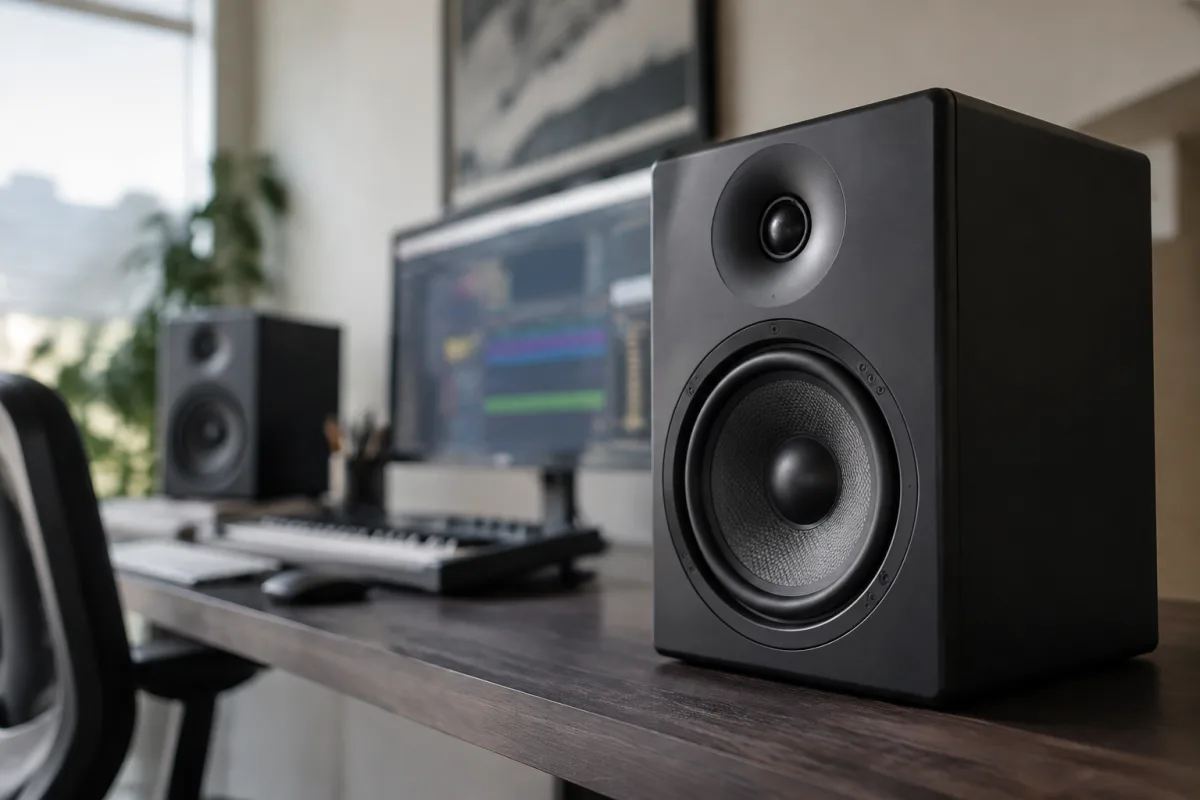
Bluetooth monitors represent a modern solution for studio professionals and home recordists seeking flexibility without compromising audio fidelity. These wireless reference speakers combine convenience with accuracy, transforming how producers work in contemporary recording environments.
Understanding Bluetooth Monitors
Bluetooth monitors are studio reference speakers equipped with wireless connectivity alongside traditional wired connections. Unlike entertainment Bluetooth speakers, Bluetooth monitors prioritise accurate frequency response and minimal latency, essential for critical listening tasks. Professional Bluetooth monitors deliver the sonic transparency needed for mixing and mastering, not merely background music playback.
The convenience factor cannot be overstated. Bluetooth monitors eliminate cable clutter, simplify studio reconfiguration, and enable temporary monitoring setups. For travelling producers and mobile studios, Bluetooth monitors offer unprecedented flexibility.
Key Technical Specifications
When evaluating Bluetooth monitors, several specifications determine real-world performance. Look for Bluetooth monitors supporting aptX or LDAC codecs, which transmit audio at higher bitrates than standard SBC codec, reducing compression artefacts. Many professional Bluetooth monitors feature dual inputs—allowing simultaneous wired and wireless connectivity for seamless switching between devices.
Frequency response flatness matters tremendously in Bluetooth monitors. Professional models target ±3dB response from 50Hz to 20kHz, providing the accuracy necessary for reliable mixing decisions. Equally important, Bluetooth monitors should minimise group delay and phase distortion across the audible spectrum.
Active vs. Passive Bluetooth Monitors
Nearly all Bluetooth monitors on the professional market are active designs, incorporating built-in amplification. This eliminates the need for external power amplifiers and simplifies connections. Some Bluetooth monitors utilise Class D amplification for efficiency and compact sizing, whilst others employ more traditional Class AB designs for warmer sonic characteristics.
Passive Bluetooth monitors are virtually nonexistent in professional circles. The amplification within Bluetooth monitors allows engineers to tailor gain structure precisely, crucial for accurate mixing.
Cabinet Design and Acoustic Treatment
| Cabinet Type | Characteristics | Best For |
|---|---|---|
| Sealed Enclosure | Extended bass response, larger cabinet size | Bass-heavy mix analysis, larger rooms |
| Ported Design | Increased output, compact packaging | Portable Bluetooth monitors, small spaces |
| Waveguide | Controlled dispersion, coherent midrange | Nearfield monitoring, compact studios |
Bluetooth monitors benefit tremendously from proper acoustic treatment. Placing Bluetooth monitors away from boundary walls reduces bass buildup. Tilting Bluetooth monitors to align with ear level during mixing ensures consistent frequency response perception. Professional Bluetooth monitors include angle-adjustment feet for precise positioning.
Connectivity and Latency Considerations
Latency—the delay between audio transmission and reproduction—presents the primary technical challenge in Bluetooth monitors. Professional Bluetooth monitors employ low-latency Bluetooth protocols, keeping latency below 30 milliseconds. For monitoring purposes, this threshold remains imperceptible to most engineers.
Quality Bluetooth monitors incorporate aptX Low Latency codec specifically to minimise delay. Simultaneously, Bluetooth monitors typically retain analogue XLR, USB, and optical inputs, allowing engineers to choose appropriate connectivity based on workstation setup and monitoring requirements.
Gain Staging and Monitoring Level
Proper gain structure separates professional Bluetooth monitors from consumer devices. Most Bluetooth monitors feature dedicated gain controls, volume controls, and input level metering. This allows engineers to maintain consistent monitoring levels independent of source device volume, crucial for reliable mixing decisions.
Bluetooth monitors should be set at a consistent reference level—typically 83dB SPL at the mixing position. Quality Bluetooth monitors include calibration tools or partnerships with SPL metering applications to establish proper reference levels.
Advantages of Bluetooth Monitors
- Wireless Freedom: Bluetooth monitors eliminate cable runs, enabling flexible studio layouts and temporary monitoring solutions
- Rapid Deployment: Setting up Bluetooth monitors requires only power connection and wireless pairing, ideal for mobile producers
- Multi-Device Support: Bluetooth monitors connect to laptops, tablets, and smartphones, facilitating collaborative sessions
- Reduced Interference: Professional Bluetooth monitors operate on dedicated frequencies with robust error correction, avoiding wireless interference
- Professional Sound Quality: Modern Bluetooth monitors deliver accuracy rivalling wired alternatives, particularly with aptX codecs
Limitations and Considerations
Bluetooth monitors do present certain practical limitations. Battery life on wireless models varies considerably—some Bluetooth monitors last 4 hours, whilst mains-powered designs offer unlimited operation. Range limitations mean Bluetooth monitors perform optimally within 10 metres of the transmitting device.
Additionally, Bluetooth monitors sharing bandwidth with Wi-Fi networks may experience occasional interference. Professional studios often employ frequency hopping and error correction built into Bluetooth monitors to mitigate this concern.
Choosing the Right Bluetooth Monitors
Studio size dramatically influences Bluetooth monitors selection. Compact nearfield Bluetooth monitors suit small bedrooms and mobile rigs, whilst larger Bluetooth monitors suit midfield applications in professional control rooms. Consider your primary mixing material—acoustic music benefits from neutral Bluetooth monitors, whilst electronic music production may favour models with extended bass response.
Budget considerations are legitimate. Entry-level Bluetooth monitors cost considerably less than professional studio monitors, making wireless flexibility accessible to ambitious home recordists. Premium Bluetooth monitors justify their investment through superior accuracy and build quality.
Integration with Professional Workflows
Many professional studios employ Bluetooth monitors as secondary nearfield reference, complementing larger main monitors. This dual-monitor approach allows engineers to check mixes on different monitoring perspectives. Bluetooth monitors serve particularly well in this supplementary role, offering portability without compromising accuracy.
Some Bluetooth monitors include wireless multiroom capabilities, allowing audio streaming throughout studios. However, for critical mixing and mastering, wired connection to Bluetooth monitors eliminates latency concerns entirely, combining wireless convenience with guaranteed stability.
Conclusion
Bluetooth monitors have matured into genuinely professional tools, particularly for contemporary recording workflows. Their combination of wireless convenience, professional-grade audio quality, and flexible connectivity makes Bluetooth monitors essential equipment for modern producers. Whether operating a mobile studio or enhancing a fixed installation, quality Bluetooth monitors deliver the accuracy and flexibility today's music professionals demand.
Frequently Asked Questions
- Are Bluetooth monitors suitable for mastering work?
- Professional Bluetooth monitors with flat frequency response and low-latency codecs can serve mastering purposes when calibrated correctly. However, traditional wired monitors remain the conservative choice for critical mastering applications.
- What latency should I expect from Bluetooth monitors?
- Modern professional Bluetooth monitors operate below 30 milliseconds latency, imperceptible for monitoring purposes. This differs from Bluetooth headphones, which may exhibit significantly higher latency.
- Can I use Bluetooth monitors with my recording interface?
- Yes. Most professional Bluetooth monitors accept USB audio input directly, allowing connection to modern recording interfaces without additional wireless transmitters.
- How do Bluetooth monitors compare to wired studio monitors?
- Professionally designed Bluetooth monitors match wired monitors' frequency response when employing high-quality codecs. The primary difference lies in convenience and flexibility rather than audio quality.
- Do Bluetooth monitors work if I have Wi-Fi interference in my studio?
- Professional Bluetooth monitors employ frequency hopping and robust error correction, typically avoiding Wi-Fi interference entirely. Positioning wireless transmitters away from Wi-Fi routers adds extra protection.
- What size Bluetooth monitors should I choose for my studio?
- Studio dimensions determine appropriate Bluetooth monitors sizing. Small bedrooms suit 5-6 inch Bluetooth monitors, whilst larger rooms benefit from 8-10 inch designs providing better bass extension.



Comments