


MIDI Drum Pads article
The Complete Guide to Midi Drum Pads
MIDI drum pads have revolutionised percussion performance and production. These velocity-sensitive controllers unlock creative possibilities for hip-hop, electronic music, and beyond.
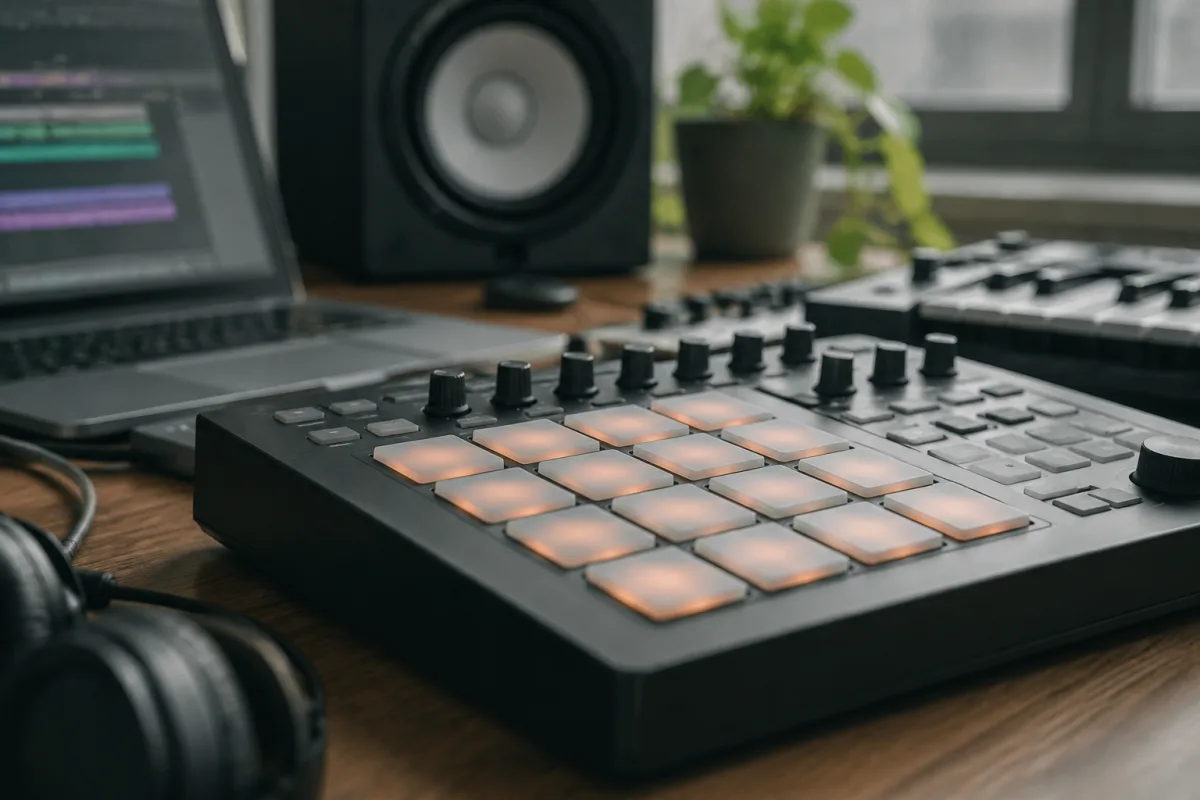
These controllers have revolutionised how musicians create and perform percussion. Sensitive, velocity-responsive devices, they translate physical strikes into MIDI data, enabling producers to trigger unlimited percussion sounds and effects in real-time. Whether you're a hip-hop producer, electronic musician, live performer, or recording engineer, MIDI drum pads offer unprecedented creative possibilities and precise control over your percussive elements.
Understanding MIDI Drum Pads
These interface devices send MIDI note and velocity information to a connected synthesiser, sampler, or digital audio workstation. Each pad responds to finger strikes with sensitivity proportional to strike force—a light tap produces a softer velocity value, a forceful strike triggers a higher velocity. This dynamic control allows expressive performance impossible with traditional percussion instruments or fixed velocity controllers.
The fundamental principle remains consistent across all models: physical strike → sensor detection → MIDI message → sound generation. What varies dramatically between units is pad sensitivity, response characteristics, build quality, and integration with broader production ecosystems. Premium models offer near-acoustic feel and responsiveness, whilst budget options provide essential functionality for learning and casual use.
Types of Controllers
These devices come in several distinct formats. Standalone pad controllers—devices with integrated sequencers and sound banks—operate independently without computer connection. These remain essential tools for live performance, offering portability and minimal technical requirements.
USB-connected models link directly to computers or tablets, controlling software instruments and DAWs. This category encompasses everything from compact two-pad finger controllers to full 16-pad systems with comprehensive control surfaces. The connectivity option dramatically affects workflow and creative potential.
Embedded pad systems are built into synthesisers, samplers, and music production controllers, providing integrated percussion control within a larger instrument. Many modern keyboards and workstations feature excellent pads as standard components.
Key Specifications to Understand
Pad sensitivity—measured in how quickly a controller responds to strikes and how accurately it captures velocity information—distinguishes quality options from mediocre ones. Premium units employ superior sensors and signal processing, capturing subtle velocity variations that budget alternatives lose entirely. This sensitivity directly affects your ability to achieve expressive, human-feeling percussion patterns.
Response time measures the latency between striking a pad and hearing the triggered sound. Low response times (measured in milliseconds) are critical for responsive performance, particularly during live playing. A controller with 50+ milliseconds latency feels sluggish and discourages expressive playing, whilst those under 10 milliseconds feel immediate and natural.
Aftertouch capability—some advanced controllers support pressure sensitivity after initial strike—enables additional expression. Applying continued pressure after hitting a pad can modulate pitch, filter cutoff, or other parameters, adding performance dimension beyond simple note triggering.
| Specification | What It Affects | Why It Matters |
|---|---|---|
| Velocity sensitivity | Dynamic range of note expression | Captures nuanced playing technique; essential for realistic percussion |
| Response latency | Delay between strike and sound | Determines whether the pad feels "live" or sluggish during performance |
| Pad build quality | Durability and longevity | Low-quality pads develop dead spots and inconsistent responsiveness over time |
| Pad count | Available sounds simultaneously | More pads enable complex patterns without redundant finger movement |
Velocity Curves and Responsiveness
Different controllers employ different velocity curves—algorithms determining how physical strike intensity translates to MIDI velocity values. Linear curves provide direct proportional response, whilst non-linear curves compress or expand the dynamic range. Some musicians prefer curves emphasising subtle dynamics, others favour curves where light strikes trigger notably different velocities than hard strikes.
Programmable velocity curves give sophisticated controllers enormous performance flexibility. A curve perfectly suited for tight kick-drum programming might feel wrong for expressive tom fills. The ability to adjust curve characteristics per session transforms these devices from fixed controllers into truly adaptive tools.
Software Integration and Workflow
Modern MIDI drum pads integrate seamlessly with industry-standard DAWs. Ableton Live, Logic Pro, Pro Tools, and others include drum rack interfaces optimised for pad-based performance. Some MIDI drum pads come bundled with software or offer proprietory apps enhancing workflow integration beyond standard MIDI protocol.
Onboard sequencers and sound engines within some controllers allow standalone operation without computer connection. This feature matters for live performers and producers valuing creative independence from crash-prone software setups. Hybrid approaches—combining onboard capabilities with computer integration—offer maximum flexibility.
Choosing Your Controller
Budget-conscious producers and learners should consider compact four- or eight-pad controllers offering essential functionality without prohibitive expense. These units teach fundamental performance whilst proving adequate for many production scenarios. Mid-range 16-pad options deliver superior sensitivity and response, justifying modest investment through improved performance and creative satisfaction.
Professional touring musicians and serious producers benefit from premium controllers exhibiting near-acoustic responsiveness and advanced features. Spending on quality pays dividends through enhanced creative expression and reduced technical frustration during demanding sessions.
Performance Technique
Effective pad playing differs substantially from acoustic drumming. The controlled velocity range, lack of physical recoil, and absence of cross-stick resonance demand different strike techniques. Developing finger technique specifically for performance—lighter strikes for control, structured finger patterns for accuracy—proves essential for musical results.
Bouncing and rolling techniques familiar from electronic music production work well, as do rapid-fire single-pad strikes for creating tension and rhythmic complexity. Many drummers transitioning to these controllers initially find the experience unintuitive, but dedicated practice rapidly develops intuitive muscle memory.
Conclusion
These percussion controllers represent indispensable tools for modern music production and live performance. From compact finger controllers to full performance systems, MIDI drum pads enable expressive percussion creation impossible through traditional instruments. Whether producing hip-hop, performing electronic sets, recording acoustic-style drumming, or exploring experimental percussion textures, selecting the right controller transforms creative possibilities and opens new artistic directions. The technology continues evolving, with manufacturers refining response characteristics and expanding integration options, ensuring these tools remain at the forefront of modern percussion creation.


Comments