


Sizing a Violin article
Sizing A Violin for Beginners: A Complete Guide
Sizing a violin correctly is simpler than you think. This beginner's guide walks you through the measurement process, explains the sizing system, and helps you choose the right size for comfortable playing.
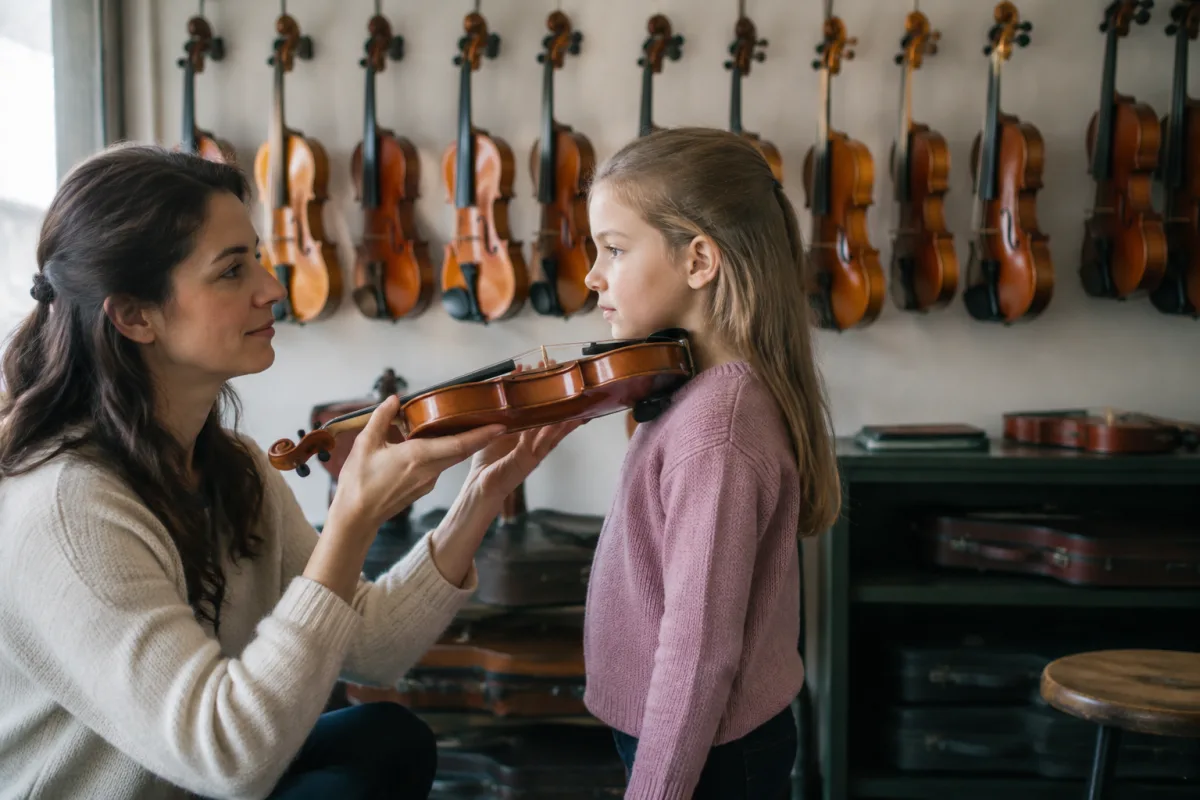
Sizing a violin correctly is one of the most overlooked yet critical steps in learning. A violin that's too large exhausts your arm and creates poor technique habits; one that's too small feels cramped and limits your progress. Yet many beginners agonise unnecessarily over sizing, uncertain how to measure, what the numbers mean, or which size fits them best. The truth is simple: sizing a violin is straightforward once you know what to measure and why it matters. This beginner's guide walks you through the measurement process, explains the sizing system, and helps you understand whether you're sizing a violin for yourself or a child learning for the first time.
The Violin Sizing System Explained
Violins come in specific fractional sizes, each corresponding to a physical length and suitable for a particular arm length range. Understanding this system removes the mystery from sizing a violin. The most common sizes are:
- 1/32 and 1/16: Tiny, for children under age 4 (rare; usually not recommended)
- 1/8: Children aged 4–6 with arm lengths under 48cm
- 1/4: Children aged 6–9 with arm lengths 48–57cm
- 1/2: Children aged 9–11 with arm lengths 57–66cm
- 3/4: Children aged 11–14 or smaller adults, arm lengths 66–73cm
- 7/8: Transitional size for growing teenagers or petite adults
- 4/4 (Full size): Adults and older teenagers with arm lengths over 73cm
Most adults play 4/4 violins. If you're sizing a violin and you're an adult, 4/4 is almost certainly correct unless you have particularly short arms or hands. Don't assume sizing a violin means going smaller than 4/4—it's rarely the right choice for adults.
How to Measure for Sizing a Violin
Sizing a violin accurately requires measuring from your neck to your fingertips, the distance where the violin's chin rest meets your arm's reach. Here's the proper method:
- Stand upright and relaxed with your arm extended straight out to the side, parallel to the ground. This is how you'll position your arm when holding a violin.
- Measure from the base of your neck to your fingertips. Ask someone to help with this measurement—extend your arm sideways and have them measure from the hollow at the base of your neck to the tip of your middle finger. This is your "arm length," the metric used for sizing a violin.
- Record the measurement in centimetres. This number directly corresponds to a violin size. An arm length of 57cm suggests sizing a violin at 1/4; 66cm suggests 1/2; 73cm or more indicates 4/4 (full size).
- If you're between sizes, choose the smaller size if you're uncertain. It's easier to move up to a larger violin later than to struggle with an oversized instrument.
This is the standard measurement method used by professional music teachers and retailers when sizing a violin for students.
Sizing a Violin for Children: Age as a Guide
If you're sizing a violin for a child, age provides a quick reference alongside arm length:
- Ages 4–6: Usually 1/8 size. At this age, the instrument's tiny size matches their physical development and makes holding and playing comfortable.
- Ages 6–9: Typically 1/4 size. By now, children can handle slightly larger instruments and the increased tone quality 1/4 violins produce.
- Ages 9–11: Generally 1/2 size. This is the most common student size in primary schools and youth orchestras.
- Ages 11–14: Often 3/4 size, though some tall children transition to 4/4 during this range. This is where sizing a violin becomes individual—measure your child rather than relying on age alone.
- Ages 14+: Almost always 4/4 (full size) unless the child has unusually short arms.
Growth happens unevenly, so a child's age is only a rough guide. Proper measurement is always more reliable than age when sizing a violin for a young learner.
Common Mistakes When Sizing a Violin
Several errors catch beginners and parents when sizing a violin:
- Measuring with the arm hanging down instead of extended sideways: The measurement must reflect how you'll hold the violin (arm roughly parallel to the ground), not how your arm hangs naturally. Incorrect measurement leads to sizing a violin incorrectly.
- Rounding up "because they'll grow into it": Oversizing a violin creates poor technique habits. A child struggling with an oversized instrument might develop tension in their shoulder and neck. It's far better to size a violin correctly now and upgrade when they've grown.
- Forgetting that hand size matters too: A large arm length doesn't guarantee comfortable finger reach across the strings. When sizing a violin, consider both arm length and hand size. Some players with long arms but small hands prefer 3/4 violins.
- Ignoring the teacher's recommendation when sizing a violin: If you've started lessons and your teacher suggests adjusting your violin size, trust their expertise. They've watched you play and can assess comfort and technique far better than a measurement alone.
- Assuming all fractional sizes fit identically: Sizing a violin is partly standardised, but different manufacturers create slightly different versions of the same size. A Stentor 1/4 might feel different from a Yamaha 1/4. When possible, handle multiple instruments before sizing a violin for purchase.
- Not considering the chin rest: Some chin rests are higher or lower than standard, affecting how the violin sits against your body. When sizing a violin, ask about chin rest height—you might need a custom or replacement chin rest to achieve perfect comfort.
Playing Comfort: How to Know Your Sizing is Correct
Once you've decided on a size when sizing a violin, evaluate comfort before committing to purchase:
- Can you hold the violin without hunching? The violin should nestle under your chin comfortably when your arm extends naturally. No shoulder elevation, no reaching.
- Are the strings within comfortable reach? Your fingers should bow across the strings without excessive stretching. Beginners often strain trying to reach strings on oversized violins.
- Does the bow balance easily in your hand? The bow should feel like a natural extension of your arm, not awkwardly heavy or light.
- Can you play for 15–20 minutes without fatigue? Sizing a violin correctly means comfort during realistic practice sessions. If you're exhausted after 15 minutes, the instrument might be too large.
- Is the tone audible and clear? A properly sized violin for your frame should produce projecting tone even during beginner attempts. Tiny, weak tone across the full bow suggests undersizing.
When to Upgrade: Outgrowing Your Violin Size
Children grow quickly, and sizing a violin means planning for transitions. Watch for these signs that it's time to upgrade:
- Arm length has grown 3–5cm beyond the violin's recommended size
- The child is beginning to scrunch or cramp when playing
- The teacher suggests the instrument is becoming too small
- The child is reaching the upper limit of their current size range (e.g., at age 10 in a 1/2 violin)
Upgrading can be expensive, so many families rent before buying. When sizing a violin for a growing child, ask the teacher or shop owner about rental-to-purchase plans.
Your First Violin: Confidence and Next Steps
Sizing a violin correctly is your foundation for success. The right size feels encouraging—it invites practice rather than discouraging it through discomfort. Take time with your measurement, trust the sizing system, and don't hesitate to ask your teacher or a professional at a music shop to double-check. Many shops offer free or low-cost sizing consultations.
Once you've sorted your sizing, you're ready to explore the broader world of violin choice and care. See our complete guide to sizing a violin for deeper information on the instrument itself.
You're closer to making music than you think. Sizing a violin is the first smart decision in a rewarding learning journey.


Comments