


Musician Ear Plugs article
Musician Ear Plugs Explained: Features, Types and Tips
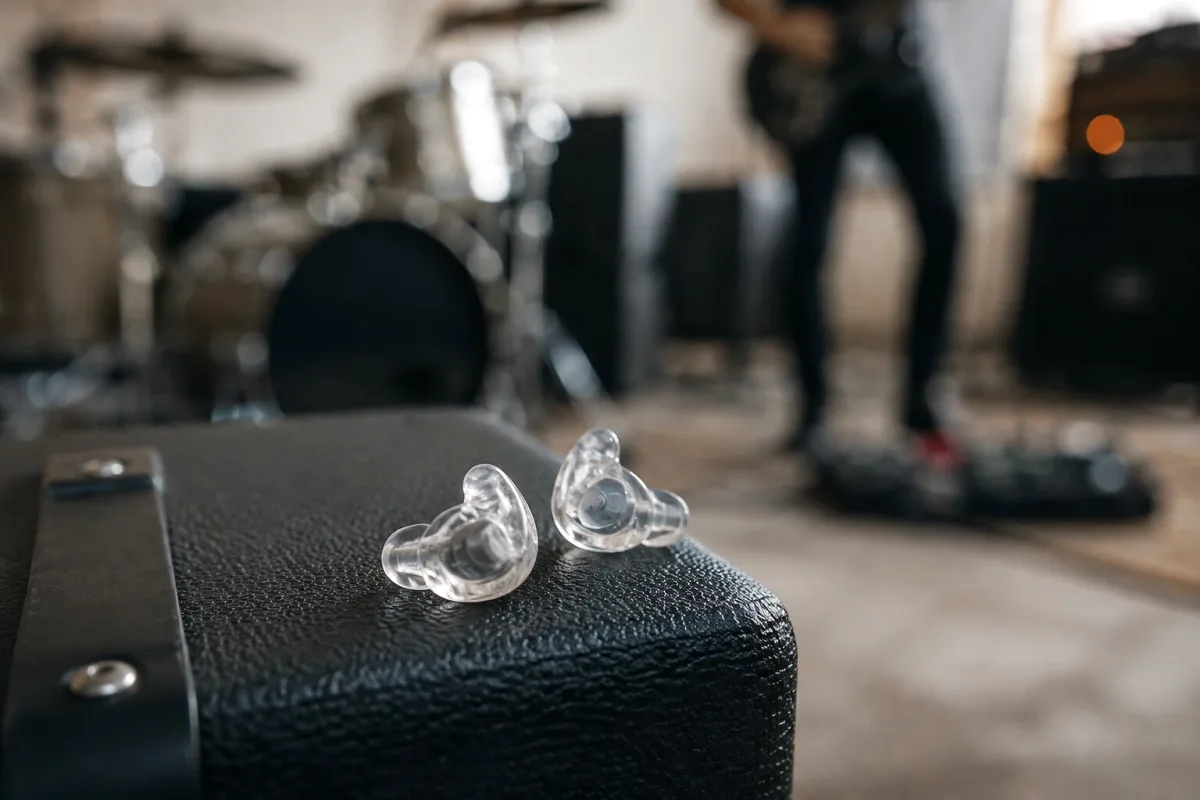
Musician earplugs are hearing protectors that do something conventional foam plugs don't: they reduce sound exposure whilst preserving the natural balance of bass, midrange and treble. Most traditional earplugs muffle the high frequencies, making cymbals sound dull and vocals lose their clarity. These specialized plugs use acoustic filters or custom molds to protect your hearing without making the music sound like you're listening through a pillow. If you're a performer, engineer, venue worker or simply a frequent concertgoer who wants to protect your ears without sacrificing what you actually came to hear, understanding how they work is the first step.
Why Conventional Plugs Sound Wrong
When you roll up a foam earplug and push it into your ear, it works by blocking sound indiscriminately. The problem is that it blocks high frequencies disproportionately—the ones your ear is most sensitive to. Cymbals, snare drums, vocals and the air and shimmer that makes live music exciting all suffer. This is why musicians often remove conventional plugs halfway through a show, or turn up the stage volume to compensate, which defeats the purpose.
The reason is straightforward physics. A foam plug's attenuation isn't flat across the frequency spectrum; it reduces the highest frequencies far more than the lows. Your brain interprets this unbalanced reduction as muffled sound. So a basic foam plug protects your ears but punishes your listening experience, and when the listening experience gets bad enough, people stop wearing them.
How These Plugs Work Differently
These specialized protectors address this by using an acoustic filter or resonance system—a diaphragm inside the earmold that's tuned to reduce all frequencies more evenly. This "spectrally flat attenuation" means you hear the mix much closer to how it actually sounds, just at a lower volume. The filter doesn't block the high frequencies as aggressively, so cymbals still ring, vocals remain clear and the room's natural acoustic character comes through.
The key insight is that the earmold itself—its shape, bore diameter and the acoustic cavity it creates—is part of the filter system. It's not just a tube with a plug in it; the resonance of the earmold and sound bore together create the flatter frequency response. This is why custom musician earplugs, made from impressions of your own ear, often perform better than universal models: they're tuned to your specific ear canal.
Three Main Types of Hearing Protection
Universal-fit filtered plugs are the most accessible option. Brands like Alpine MusicSafe Pro and Eargasm High Fidelity models come with multiple tip sizes and, in many cases, interchangeable filters tuned to different attenuation levels. They're reusable, relatively affordable (typically £30–100) and you don't need an audiologist appointment. The trade-off is that fit and seal vary with your ear canal shape, so protection might be inconsistent.
Custom-molded options are made from ear impressions taken by an audiologist or specialist. They cost more (£100–400 or more) but offer a personalised fit and consistently excellent acoustic performance. They often come with multiple filter options—typically 9 dB, 15 dB and 25 dB attenuation levels—so you can swap filters depending on the venue or activity. Once you've had the impressions made, ordering replacement plugs or filters is straightforward.
Electronic options represent the cutting edge. Products like Etymotic's Music•PRO use active circuitry to attenuate loud sound whilst preserving or even amplifying quieter sounds—speech, a conductor's cues, or the more delicate parts of a performance. They're expensive (£200–600+), battery-dependent and more complex to use, but for professional performers working in highly variable sound environments, they're worth considering.
Choosing the Right Attenuation Level
Attenuation is measured in decibels (dB). A plug rated at 9 dB reduces sound modestly; 15 dB provides moderate protection; 25 dB gives serious reduction. Which you need depends on the sound level you're exposed to and for how long.
If you're playing in a small acoustic ensemble or attending a folk club, 9 dB might be plenty. For rock rehearsals, live bands or DJing, 15 dB is often ideal—it protects without making communication difficult or stage monitoring a struggle. If you're a drummer in a metal band or working in front of a large PA system, 25 dB or even dual-protection (earplugs plus earmuffs) makes sense.
The golden rule is to choose the lowest attenuation that still gives you meaningful protection in your environment. More attenuation isn't always better; excessive reduction can interfere with pitch perception, make hearing your own voice during vocals difficult, and create communication problems with bandmates. Work out what level lets you protect your hearing whilst still performing naturally.
Fit and Insertion Matter Enormously
You can have the perfect earplug design, but if it's not inserted correctly, protection drops significantly. For foam plugs, you roll them into a narrow cylinder, pull your outer ear slightly upward and backward, insert the plug deep into the canal and hold it for 20–30 seconds whilst it expands. The key is depth: it needs to seal well past the first bend of your ear canal.
For universal filtered musician earplugs, try all the supplied tip sizes and pick the one that sits comfortably and forms a stable seal. Insert it until you feel resistance, not pain. A quick test: push the earplug slightly deeper; if the sound changes noticeably, your seal might be inconsistent and you should try a different tip size.
Custom earplugs require professional fitting, but the principle is the same. The original ear impression must extend far enough into the canal to capture its natural shape. When you receive custom earplugs, your audiologist should check the fit and sometimes offer adjustments if the seal isn't quite right.
The Maintenance Question
Universal filtered musician earplugs are reusable; wash the tips regularly according to the manufacturer's instructions and store them in a clean case. Keep filters free of wax and moisture. Replace tips if they become stiff or torn. With reasonable care, a good set will last 1–2 years or more.
Custom earplugs last longer but can't be washed the same way—follow your audiologist's care instructions. If they become damaged or your ear shape changes, you'll need new impressions and a new mold, which is why custom musician earplugs carry a higher ongoing cost.
When to Use Hearing Protection
The honest answer is: whenever sound levels are uncomfortably loud or you're exposed for extended periods. Live music above 85 dB can damage hearing over time. That's roughly the volume of a busy restaurant—sustained. Live gigs, rehearsals, DJ sets and amplified performances typically exceed that threshold. Even if you don't feel immediately uncomfortable, prolonged exposure adds up.
If you notice ringing in your ears after a gig, you've likely been exposed to damaging levels. That's a signal to step up your protection next time. Many musicians develop tinnitus over years of unprotected exposure. Musician earplugs won't undo existing damage, but they can prevent new damage and give you the best chance of protecting your hearing for a lifetime of music.
The musician earplug industry has grown specifically because ordinary protectors were failing musicians: they sounded terrible, so people didn't wear them, so their ears suffered. Modern musician earplugs solve that problem by making hearing protection actually tolerable to wear, and even pleasant. Your hearing is irreplaceable. Get the right protection, fit it correctly and actually use it.



Comments