


String Action Guitar article
String Action Guitar for Beginners: A Complete Guide
String action guitar setup affects your playing comfort more than you'd expect. This beginner's guide explains what action is, how to measure it, and when to seek professional adjustment.
If you're learning guitar and you've heard terms like "action" without understanding what they mean, you're not alone. String action guitar is one of those concepts that sounds technical but matters surprisingly for your playing comfort and progress. This guide is written for nervous beginners—people picking up a guitar for the first time and unsure whether their instrument's setup is even correct. Understanding string action will transform your practice sessions from frustrating to genuinely enjoyable.
What is String Action? Breaking Down the Basics
String action guitar simply means the distance between your strings and the fingerboard (the wooden surface you press strings against). That's it. Measure from the top of the fingerboard to the bottom of each string, and you're measuring string action. Lower action means strings sit closer to the fingerboard; higher action means they sit further away.
Why does string action guitar matter? Close your eyes and imagine pressing a string down. Easier, quicker pressing means faster playing and less finger fatigue. Strings that sit close to the fingerboard demand less effort, making practice sessions less painful. Conversely, high string action guitar feels like pressing metal wires into concrete—possible, but exhausting.
Why Your String Action Guitar Height Matters for Learning
A new guitarist's biggest hurdle isn't learning notes or rhythm. It's finger pain. Beginners' fingertips hurt because pressing strings requires effort your hand hasn't developed yet. High string action guitar multiplies this pain unnecessarily. You don't learn faster by suffering; you learn faster when practice feels achievable.
Here's the paradox: slightly lower string action guitar helps beginners because it reduces pain, but extremely low action creates buzz—unwanted rattling when strings vibrate too close to frets. The sweet spot is finding the balance. A professional can adjust your string action guitar perfectly, but understanding it yourself means you never feel trapped by your instrument's setup.
How to Measure Your String Action Guitar
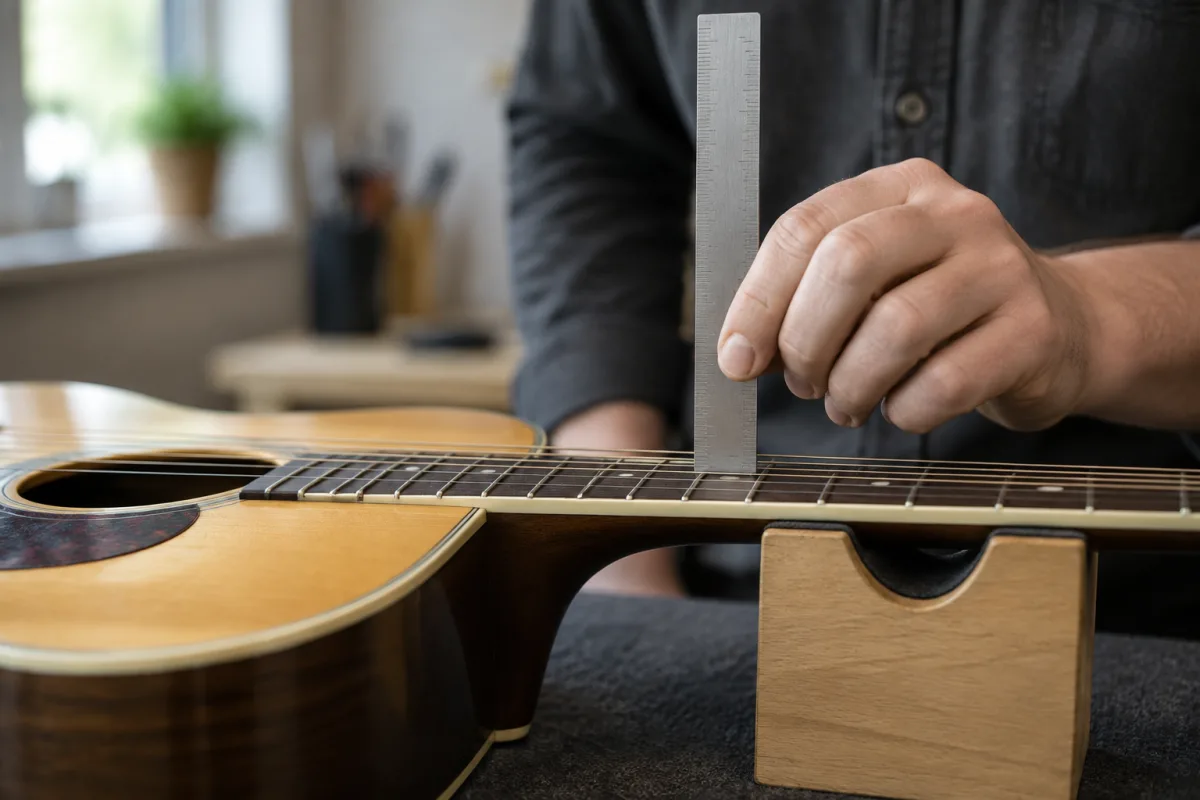
You don't need expensive tools. A simple ruler or even a credit card helps estimate string action guitar height. Place the ruler vertically at the 12th fret (roughly halfway along the fingerboard). Measure the gap between the underside of the lowest string (usually the thickest E string) and the ruler's top edge. This measurement is your string action guitar height at that point.
Typical string action guitar measurements vary by guitar type, but generally: acoustic guitars typically measure 2.2-2.5mm on the bass side (thick strings); electric guitars typically measure 1.5-2.0mm. If your measurement is significantly higher—say, 3.5mm or more—your string action guitar is likely too high, creating unnecessary playing difficulty.
Common Beginner Mistakes with String Action Guitar
We see predictable patterns when beginners encounter string action guitar issues:
- Assuming high string action guitar is normal. Many beginners receive guitars with unnecessarily high action and accept it as standard. They think their finger pain is personal weakness rather than a setup issue. A professional evaluation costs £20-40 and often reveals your instrument needs adjustment, not your hands.
- Ignoring string action guitar buzz. Some players tolerate subtle buzzing, thinking it's part of learning. Low-cost guitars buzz more easily, but too-low string action guitar creates annoying buzz even on quality instruments. The solution isn't ignoring it—it's adjustment.
- Adjusting string action guitar incorrectly. The truss rod (an internal rod controlling neck straightness) requires precise adjustment. Over-tightening damages guitars; under-tightening leaves them buzzing. Beginners shouldn't attempt this adjustment alone. A technician's few minutes of expertise saves significant frustration.
- Not checking string action guitar after changing strings. When you change strings, string action guitar might shift slightly. Quick checks prevent surprise problems.
- Confusing string action guitar with personal ability. Many beginners assume their finger pain means they're bad at guitar. Often it just means their string action guitar is too high. The same person with properly adjusted string action guitar suddenly progresses rapidly.
When to Adjust Your String Action Guitar
Adjust your string action guitar when playing becomes unnecessarily painful or when you notice consistent buzz. If your fingertips hurt after 10 minutes but you've been practising for a month, don't accept it as normal. Visit a guitar technician. If open strings buzz without being pressed, your string action guitar is too low or your neck is warped—also a technician issue.
New guitars sometimes have suboptimal string action guitar height from the factory. Professional setups cost £50-100 but transform your playing experience. Think of it as an investment in your learning, not an expense.
Bridge and Nut: The Key Components of String Action Guitar
String action guitar height is controlled by two components: the bridge (where strings meet the body) and the nut (where strings meet the headstock). Lowering the bridge slightly reduces string action guitar height; shaving the nut requires expertise. Most adjustments involve bridge work, which a technician handles safely. Your string action guitar problems usually point to one of these two components.
Acoustic guitars have fixed bridges that are difficult to adjust. Electric guitars have adjustable bridge saddles, making string action guitar adjustment more straightforward. Knowing your guitar type helps you understand why certain adjustments are difficult or straightforward.
Different String Action Guitar Heights for Different Styles
String action guitar preferences vary by playing style. Classical guitarists often prefer slightly higher action (around 2.6mm) because it prevents buzz when fingerstyle playing creates dynamic variations. Rock guitarists often prefer lower action (around 1.5mm) for faster playing. Beginners benefit from slightly lower action initially—around 1.5-1.8mm on electric guitars—because it reduces pain without creating buzz if the guitar is properly built.
As your playing develops and your hand strength improves, you can adjust string action guitar to match your preferences. Many experienced players eventually settle on action heights that would feel too high for beginners but suit their playing styles perfectly.
Testing Your String Action Guitar: A Simple Exercise
Play open strings (without pressing them) and listen. Any buzz? Your string action guitar might be too low, or your neck might need adjustment. Now press strings normally and play simple melodies. Does it feel easier or harder than expected? Try visiting a shop with a similarly-priced guitar and compare playing feel. If other guitars feel noticeably easier, your string action guitar is probably too high.
This testing costs nothing and reveals whether your setup needs professional attention. Trust your hands' feedback—they're reliable guides to string action guitar quality.
Long-Term String Action Guitar Maintenance
String action guitar height shifts slightly over months as wood naturally adjusts to humidity and temperature changes. Seasonal changes affect guitars noticeably—dry winters might require adjustment, as does spring humidity. Check your string action guitar every 6-12 months. A guitarist's routine includes checking string action guitar as part of general maintenance, alongside changing strings and cleaning the fingerboard.
Humidity control helps—avoid extreme dry or damp environments. Store your guitar in a stable climate, and you'll notice fewer seasonal string action guitar shifts. A climate-controlled case helps touring musicians, but bedroom players rarely need this.
Moving Forward: Taking Control of Your Setup
Understanding string action guitar empowers you to take control of your instrument's playability. You're no longer trapped by whatever setup the factory provided. A professional technician can adjust your string action guitar to your specifications. After a few adjustments, you'll develop clear preferences. For more detailed information about string action guitar, comprehensive resources exist covering advanced setup topics.
Learning guitar involves far more than memorising finger positions. Understanding why your guitar feels the way it does—why pressing strings hurts, why some notes buzz, why playing feels difficult—transforms your relationship with learning. String action guitar setup is foundational to this understanding. Visit a technician, get your action adjusted to beginner-friendly heights, and you'll discover that guitar playing actually becomes enjoyable when your instrument cooperates. Your improved comfort means improved progress, and that means genuine advancement within months.


Comments