


Hi-Fi System Buying guide
Hifi System: A Complete Buyer's Guide
Buying a hifi system requires understanding what matters, what to listen for, and where to compromise. This guide walks you through components, specs, price tiers and pitfalls so you build a system that sounds brilliant in your room.
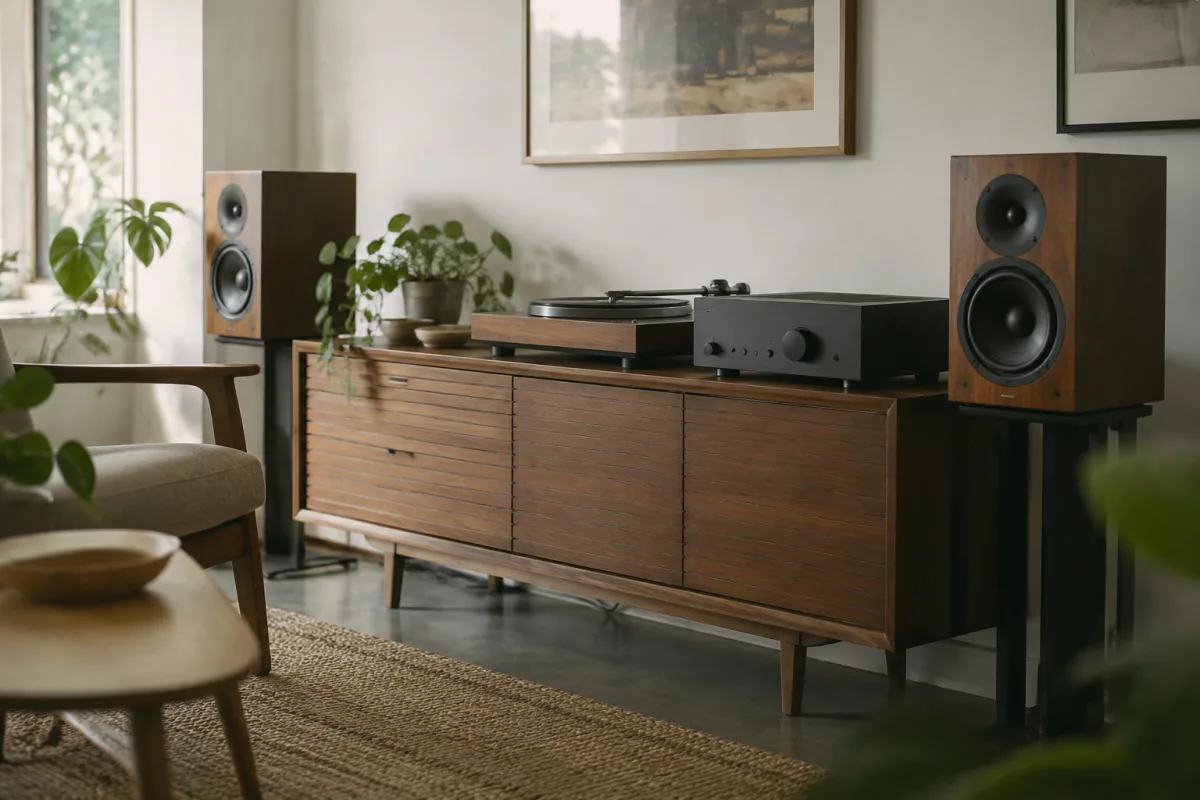
Buying a hifi system is an investment in how you listen to music, and it's easy to overspend on the wrong gear or underspend on crucial components. The good news is that a genuinely musical system doesn't require a fortune—but it does require understanding what matters, what to listen for, and where to compromise without losing sound quality. This guide walks you through the key components, the specs that actually matter, common pitfalls and realistic price tiers so you build a system that sounds great in your space.
The Core Components of a Hifi System
A hifi system has three essential parts: a source (turntable, CD player, streaming device, tuner), an amplifier (or receiver, which combines an amp and preamp), and speakers. Each component matters; a weak link anywhere degrades the whole chain. Many newcomers buy good speakers and a cheap amplifier, or vice versa, and then wonder why it doesn't sound right. Balance across the three is more important than one brilliant component and two mediocre ones.
Beyond these core three, you might add a dedicated preamplifier (if you need multiple sources switched cleanly), phono stage (if you're playing vinyl records), or active subwoofers (to extend bass). These are add-ons that depend on your specific needs and source priorities.
Understanding Amplifier Power and Speaker Matching
The first question people ask is "How many watts do I need?" The honest answer is usually far fewer than they think. A good 50-watt amplifier fills a medium living room easily. Power matters far less than efficiency—a speaker rated at 89 dB SPL needs less amplifier power to reach the same volume as a 84 dB SPL speaker. Before buying an amplifier, check your speakers' sensitivity rating.
Impedance matching is real but simpler than it sounds. Most speakers are 8 ohms; most amplifiers handle 4–8 ohms. As long as both numbers align, you're fine. Connecting an 8-ohm speaker to a 4-ohm amplifier output might reduce the amp's lifespan; going the other way is safe but the amp won't deliver full power.
Class A amplifiers are warm and musical but inefficient; they run hot and cost more. Class AB is the industry standard—smooth, efficient, reliable. Class D amplifiers (digital) are compact and cool-running, often sounding surprisingly good. Choose based on your space, budget and sonic preference, not hype.
Speakers: Size, Design and Placement Matter Most
Speaker size affects bass extension and room integration. A compact two-way speaker (small woofer, tweeter) is great for tight spaces and sounds detailed. A larger three-way speaker (separate woofer, midrange, tweeter) plays louder and goes deeper but needs proper placement and room space to avoid booming. Neither is objectively better; it depends on your room and listening priorities.
Efficiency (dB SPL at 1 watt/1 metre) tells you how loud a speaker plays with a given amplifier. High-efficiency speakers (>88 dB) work well with low-power tube amps and sound effortless. Lower-efficiency speakers (82–86 dB) need more amplifier power but offer more flexibility and often cost less. For a typical flat 40–50 watt amplifier, 85–87 dB efficient speakers are an easy, balanced match.
Room placement is often overlooked but crucial. Speakers pulled into the middle of a room, well away from walls, sound cleaner and more spacious than speakers crammed into corners. Large bass reflections off rear and side walls muddy the sound. If your room forces corner placement, consider a smaller speaker or a subwoofer to control the low end separately.
Source Quality: From Streaming to Vinyl
Streaming quality matters less than people fear. A modern streaming service at 320 kbps (Spotify Premium) or lossless (Apple Music, Tidal) sounds excellent through any decent system. You don't need exotic cables, isolators or "audiophile" tweaks; a clean, well-implemented setup from Spotify through a decent amplifier and speakers will delight you.
CD players remain a solid source and used ones are affordable. Vinyl records sound beautiful but require maintenance, a good turntable and a phono preamp; they're not a shortcut to better sound, just a different listening experience. Digital-to-analogue converters (DACs) make a real difference if your amplifier lacks a line input for digital signals, but the improvement diminishes as gear gets better.
Cable Basics and When to Upgrade
A competent system needs decent cables—audio-grade, shielded, proper connectors. A £50 interconnect cable between your source and amplifier is sensible. A £500 one rarely makes an audible difference. Speaker cables matter slightly more (they carry higher current) but again, a good one is £5–10 per metre; beyond that, sonic benefits are marginal. Focus your budget on components—source, amplifier, speakers—not cables.
Budget Planning: Realistic Price Tiers
A genuine, musical hifi system starts around £1,500–2,000. This buys you a respectable amplifier (£400–600), decent passive speakers (£600–1,000), and a source—either a used CD player (£100–200), a quality DAC and streaming device (£300–400), or a budget turntable (£200–400). Each tier sounds better than the last, but the jump from £1,500 to £3,000 is bigger than from £3,000 to £6,000. At £2,500–4,000, you enter upper-mid-fi: speakers with real presence, amplifiers with low distortion and dynamics, sources that disappear into the music. Beyond £5,000, improvements are refinements that require patience to hear.
The common mistake is buying at one price point without balance. A £4,000 amplifier matched with £400 speakers is wasteful; you're paying amplifier money for speaker problems. Spend proportionally: roughly 40% on speakers, 35% on amplifier, 20% on source (turntable, DAC/streamer), 5% on cables and stands. Adjust if your source is critical (vinyl enthusiasts might shift budget to turntable) but avoid extreme imbalance.
Active Versus Passive Speakers
Passive speakers require an amplifier; active (powered) speakers have an amplifier built in. For most home systems, passive speakers with a separate amplifier let you upgrade each piece independently and match them for sonic character. Active speakers are compact and convenient but harder to repair and upgrade—if the amp fails, the whole speaker is down. In a bedroom or small space, active speakers are sensible. For a living room system you'll keep for years, passive lets you swap components and evolve the sound.
The Room and Acoustics
Even the best speakers sound mediocre in a room with zero absorption—hard walls, bare floors, no furniture. Your listening room needs some damping. A sofa, curtains, a bookshelf, area rugs and artwork all help. You don't need acoustic treatment panels; natural furnishings work. Avoid symmetry—a perfectly square, reflective room sounds boxy. Position the listening seat away from the back wall and aim for listening triangles where you sit equidistant from both speakers.
Common Mistakes to Avoid
Buying speakers designed for a different room size (huge speakers crammed into a small space, or tiny speakers in a large room) is the most frequent error. Under-powering an amplifier—buying 20 watts when your speakers are 86 dB and your room is large—leaves you frustrated. Placing speakers in corners and wondering why the bass is boomy. Changing one variable at a time and assuming it's always an upgrade—a new cable, a new power conditioner, a tweak—when often the improvement is psychological or your ears are adjusting. Trust your ears, but listen critically for a few weeks before deciding something is better.
Another trap is buying preowned without hearing the components together. Hifi is system-dependent; components interact. A great speaker and a great amplifier might sound dull together due to a mismatch in voicing. Always audition combinations if possible, or buy from retailers who'll swap components easily if they don't gel.
Finding Your Sound
Your hifi system should reveal the music, not add color. Some gear sounds warm (boosted bass and lower midrange), other gear is bright (lifted treble). Neither is wrong, but they suit different tastes and room acoustics. A bright room (hard surfaces, no damping) benefits from warm-sounding gear. A dead, over-damped room might come alive with brighter components. Listen to familiar recordings—albums you know intimately—and notice what you hear in the new system that you missed before. That's where the real improvement lies.
Conclusion
Buying a hifi system is a gradual process, not a one-day decision. Start with balanced components at a realistic price point, listen critically in your room for a few months, then upgrade individual pieces if something bothers you. A £2,000 hifi system thoughtfully chosen and properly placed will sound excellent for a decade. For a deeper look at hifi systems and their broader context, see the comprehensive guide to hifi systems.


Comments