


Floorstanding Speakers article
Floorstanding Speakers Explained: Features, Types and Tips
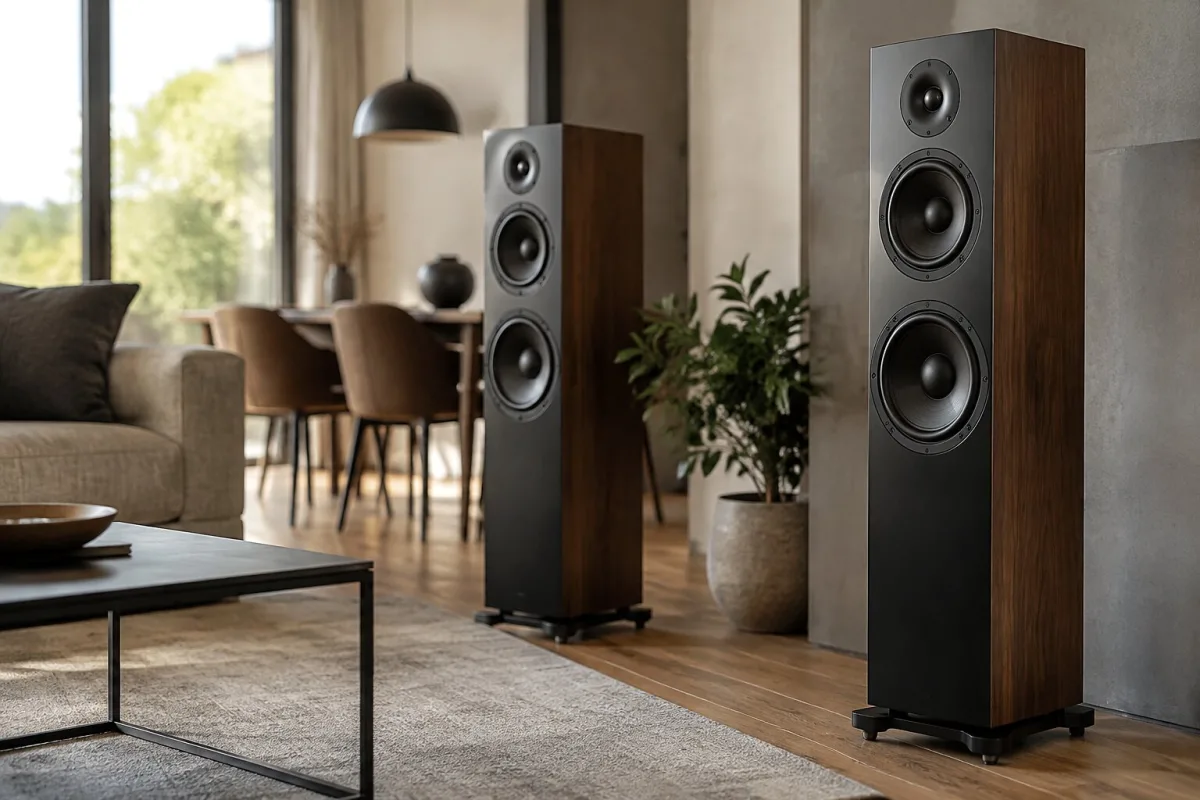
Floorstanding speakers are the visual anchor of a listening room—tall, substantial cabinets that sit on the floor beside your hi-fi or television. They're designed to deliver full-frequency audio without a subwoofer, using multiple drivers to cover everything from deep bass to crisp treble. For music lovers and film enthusiasts, the right floorstanding speaker transforms a room's acoustics and aesthetic.
What Makes a Floorstanding Speaker Different
A floorstanding speaker is fundamentally different from a compact bookshelf speaker or satellite speaker. Size matters. The cabinet has room for larger bass drivers (woofers), which move more air and deliver deeper, fuller bass. The enclosure is engineered to manage resonance and port tuning. Multiple drivers divide the frequency spectrum: woofers handle bass, midrange drivers handle voices and instruments, and tweeters handle high frequencies.
This is why floorstanding speakers can fill a room more effectively than smaller alternatives. They're designed to project sound across the listening space, not just the immediate area around them.
Driver Configuration and Cabinet Design
A typical floorstanding speaker might have one or more woofers (6–8 inches), one or two midrange drivers (2–4 inches) and a tweeter (0.75–1 inch). A three-way design (woofer, midrange, tweeter) is common; two-way designs (woofer, tweeter) are simpler; some premium designs add multiple drivers in each frequency range.
Cabinet design affects how the speaker sounds. A sealed cabinet (airtight) produces tighter, more controlled bass. A ported cabinet (with an opening that reinforces bass frequencies) produces deeper, more powerful bass but can be less accurate. A bass-reflex design carefully tunes the port to enhance certain frequencies without inducing boominess.
Materials matter. A rigid cabinet reduces unwanted vibrations. Some speakers use layered materials; others use premium wood veneers or metal accents. The crossover (electronic components that send frequencies to the correct drivers) can be simple or sophisticated, affecting phase coherence and smoothness.
Frequency Response and Power Handling
Frequency response describes the range of pitches a speaker reproduces. A speaker with 30Hz–20kHz response covers most of what human ears hear and music produces. Response below 30Hz requires a subwoofer. Response above 20kHz is beyond human hearing but can affect the overall sensation of presence and air.
Power handling (measured in watts) determines how loud a speaker can play safely. A speaker rated 100W RMS (root mean square) can handle 100 watts of sustained power. Peak power handling is higher but less relevant. More important than raw watts is sensitivity—how loud the speaker plays per watt of input. A highly sensitive speaker (88 dB per watt) plays louder with modest amplification than an insensitive speaker (82 dB per watt).
Impedance and Amplifier Matching
Impedance (measured in ohms) describes the electrical resistance of a speaker. Most speakers are 8 ohms; some are 4 ohms. An amplifier must match the speaker's impedance for optimal performance and safety. A typical amplifier rated for 8-ohm loads delivers less power into 4-ohm loads but is generally safe.
For most listeners, understanding impedance means checking that the amplifier's rating matches the speaker's impedance. Specialist retailers can advise if your equipment is compatible.
Acoustic Placement and Room Integration
Where you place a floorstanding speaker affects how it sounds. Too close to a corner emphasises bass. In the middle of a wall, sound disperses more evenly. Angled slightly toward the listening area provides more direct sound. Distance from the listener affects timing and integration—if stereo speakers are too far apart, the soundstage feels disconnected; if too close together, imaging suffers.
Room acoustics matter profoundly. Hard floors and glass reflect sound; soft furnishings absorb it. A treated room with balanced absorption and diffusion sounds significantly better than an untreated one. You don't need acoustic panels—just thoughtful placement of rugs, curtains and furniture.
Passive Versus Active Speakers
Passive floorstanding speakers require an external amplifier or receiver to function. This is the traditional hi-fi approach and offers flexibility: choose the amplifier that matches your ears and budget.
Active (powered) floorstanding speakers contain built-in amplifiers. They simplify setup and don't require separate gear, but offer less flexibility for upgrading individual components. Wireless connectivity via Bluetooth or WiFi is more common in active speakers.
Traditional Hi-Fi Versus Modern Convenience
Passive speakers demand more knowledge: you must understand amplification, impedance and cabling. But the result can be exceptional—a bespoke chain matched to your taste.
Active speakers plug in and work with most source devices via Bluetooth or WiFi. Convenience is the tradeoff for less flexibility in optimising individual components. For casual listeners, active speakers are often superior. For enthusiasts, passive speakers remain the gold standard.
Choosing Floorstanding Speakers for Your Space
Start with your room size. Small rooms benefit from efficient, compact floorstanding speakers that don't overwhelm the space. Large rooms need speakers with power and presence to fill the volume. Consider your listening distance: sitting 8 feet away versus 15 feet away changes what frequencies matter most.
Think about music preference. Speakers voiced for classical detail sound different from speakers voiced for bass-forward electronic music. A dealer who knows your taste and space can recommend speakers you'll love.
Floorstanding speakers are a long-term investment. Listen to multiple pairs before deciding. Trust your ears, not specs or reviews. The speakers that make you want to play music again and again are the right ones, regardless of what anyone else says.




Comments