


Synthesizers Music article
The Complete Guide to Synthesizers Music
Synthesizers music has shaped electronic, pop, rock, and nearly every contemporary genre. Learn how synthesis works, explore different synthesis techniques, and discover the creative power of electronic sound design.
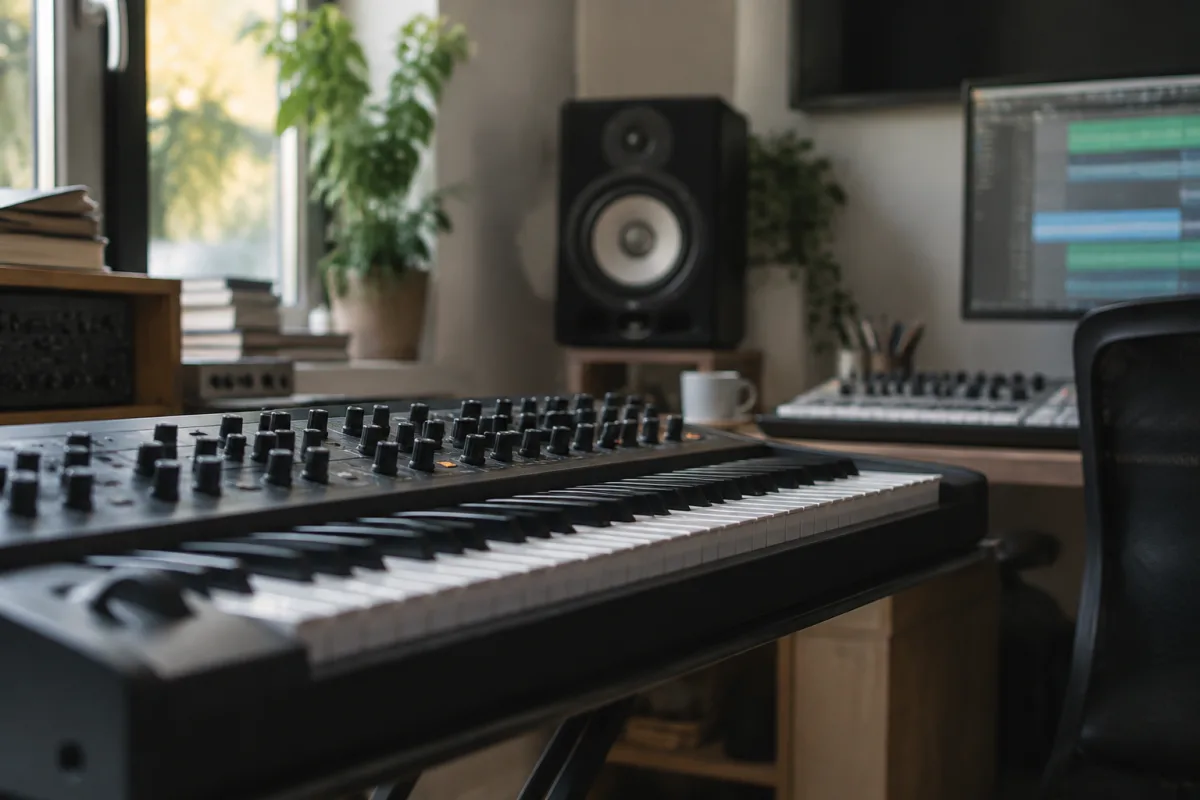
Synthesizers represent one of music's most significant innovations, fundamentally changing how musicians create, perform, and record. From the electronic pioneers of the 1970s to today's bedroom producers, synthesizers music has shaped nearly every musical genre. Whether you're exploring synthesizers music production for the first time or deepening your knowledge of how these instruments work, understanding synthesizers opens up creative possibilities that acoustic and purely digital instruments cannot match.
What Is a Synthesizer?
A synthesizer is an instrument that generates sound electronically using oscillators, filters, and amplifiers controlled by keyboards, sequencers, or other input devices. Rather than recording pre-made sounds like a sampler, a synthesizer creates sounds from first principles. The term encompasses both hardware instruments you hold and play, and software synthesizers running on computers.
The basic concept is straightforward: generate electrical waveforms, shape them with filters to remove or emphasise frequency ranges, and control the volume envelope over time. Combine multiple synthesizers in layers, add effects processing, and you can create sounds that acoustic instruments cannot produce. That creative freedom is what makes synthesis compelling.
How Synthesis Works: The Basics
Every synthesizer relies on a few core components. The oscillator generates basic waveforms—sine waves, square waves, sawtooth waves, and triangle waves. Each waveform has distinctive harmonic content: sine waves are pure, square waves are hollow, sawtooth waves are bright and buzzy, triangle waves are smoother.
The filter removes or emphasises certain frequencies. A low-pass filter removes high frequencies, making sound warmer and duller. A high-pass filter removes low frequencies, making sound thinner and brighter. Band-pass filters isolate a specific frequency range. By moving the filter cutoff over time, you create the classic synthesizer sounds—sweeping filter effects that define electronic music.
The amplifier controls volume. Rather than just turning the sound up or down, synthesizers let you shape how volume evolves—the attack time (how quickly the sound reaches full volume), decay (how quickly it drops from peak), sustain level (where the sound sits), and release (how long it takes to fade after you release a key). This ADSR envelope is fundamental to synthesizer sound design.
These components work together: an oscillator generates a waveform, the filter shapes its timbre, the amplifier shapes its dynamic envelope. Add modulation from a second oscillator or an LFO (low-frequency oscillator), and you have movement and richness.
Types of Synthesizers
Analog synthesizers use voltage-controlled electronics to generate and shape sound. They sound warm and characterful, though they can drift slightly out of tune and require maintenance. Classic analog synthesizers—Moog, ARP, Minimoog—defined the sound of electronic music.
Digital synthesizers use computer processors to generate sound. They're stable, reliable, and can model analog designs or do things analog cannot. Digital synthesis has lower cost barriers and is more accessible than vintage analog equipment.
Software synthesizers run on computers and offer unlimited flexibility. You can have thousands of sounds instantly, tweak parameters precisely, and save every configuration. For recording and composition, software synthesis has largely replaced hardware for many musicians.
Hybrid synthesizers combine analog tone generation with digital control, offering analog character with digital convenience.
Synthesis Techniques and Approaches
Subtractive synthesis—the most common method—starts with harmonically rich waveforms and removes frequencies with filters. This intuitive approach is how most traditional synthesizers work.
Additive synthesis builds sounds by combining multiple sine wave oscillators at different frequencies and amplitudes, recreating complex timbres. It's powerful but requires more work than subtractive synthesis.
FM synthesis uses one oscillator to modulate the frequency of another, creating bell tones, metallic textures, and sounds impossible with subtractive synthesis. It sounds distinctive and characterful, though it's less intuitive to learn.
Wavetable synthesis allows loading or drawing custom waveforms and smoothly morphing between them, offering creativity and unique sonic possibilities.
Synthesizers Music Today
Electronic, dance, ambient, pop, and rock music all rely heavily on synthesizers music. Think of any modern synthesizers music production and synthesizers appear throughout—bass lines, melodies, texture, effects, and rhythmic elements. Understanding synthesizers music is foundational to contemporary music-making.
Bedroom producers can now create professional synthesizers music recordings using only a computer and inexpensive software synthesizers. This democratisation of music production has fundamentally changed how music gets created and distributed.
Learning Synthesis
Begin by understanding the basics—oscillators, filters, envelopes, and modulation. Explore a simple synthesizer, adjust parameters, and listen to how changes affect the sound. Play with filters—the single most important element for shaping synthesizer character.
Study existing sounds you admire—how they're built, what oscillators and filters shape them. Deconstruction teaches more than any tutorial. Experiment fearlessly; synthesis rewards exploring and making mistakes.
Synthesizer Workflow
Creating sounds involves starting with an oscillator, setting up an envelope, adjusting the filter, adding modulation, and layering sounds. You're sculpting sound from basic components. This hands-on workflow is satisfying and encourages creative exploration. Unlike playing pre-made patches, sound design teaches you how music works electronically.
The Creative Power of Synthesis
Synthesizers aren't just instruments—they're partners in creativity. The tactile experience of turning knobs, adjusting parameters in real time, and hearing immediate results encourages experimentation and happy accidents. Many of electronic music's greatest moments came from happy mistakes with synthesizer knobs.
Conclusion
Synthesizers represent one of music's most powerful tools for creating and performing. Whether you're a beginner exploring sound design or an experienced musician refining technique, synthesis offers unlimited creative possibilities. The fundamental techniques—oscillators, filters, envelopes, and modulation—form the language of electronic sound design. Learning to think in these terms opens doors to creating sounds that express your musical imagination in ways acoustic instruments cannot match.


Comments