


P Bass article
P Bass for Beginners: A Complete Guide
The P Bass is the most influential electric bass ever made—and an excellent choice for beginners. This guide explains what makes it special, which versions suit learners, and why starting with a P Bass accelerates your bass journey.
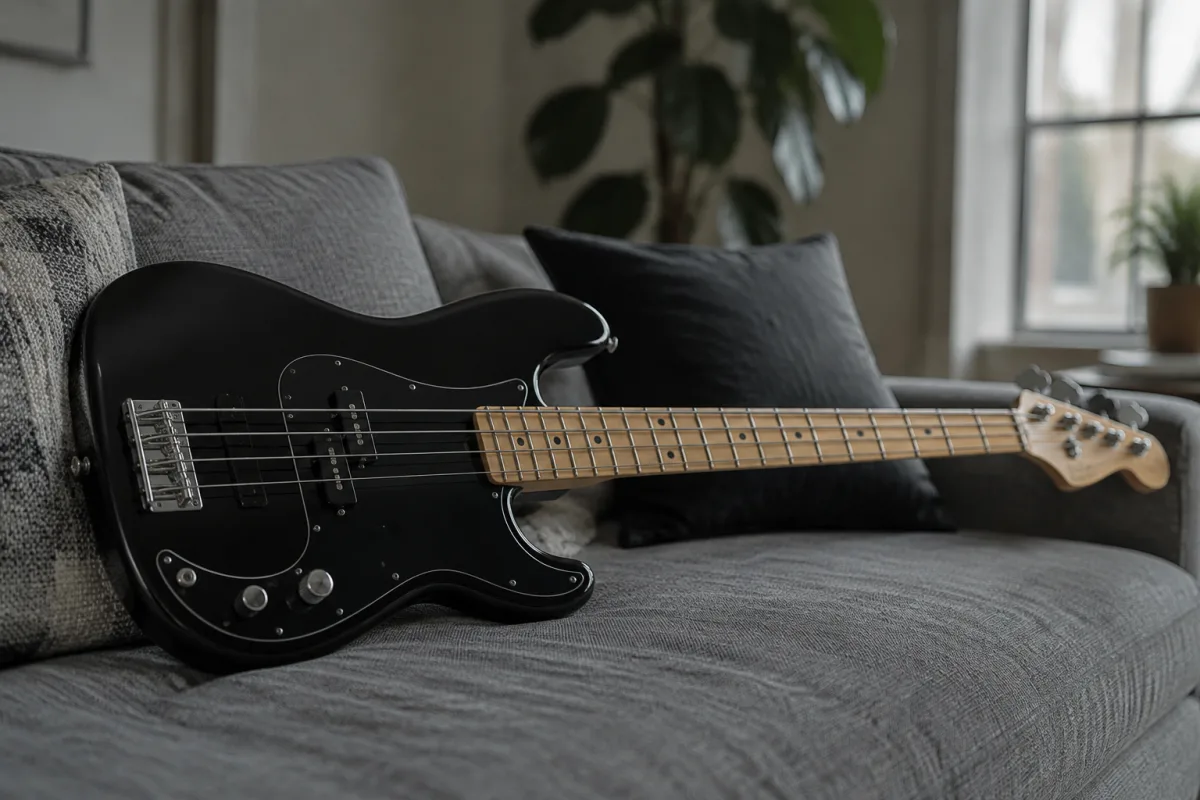
If you're interested in bass guitar and keep hearing the term "P Bass," you've found the right starting point. The Precision Bass—or P Bass—is arguably the most influential electric bass ever made, and it remains an excellent choice for someone learning bass for the first time. This guide explains what a P Bass actually is, why they're so respected, which versions suit beginners, and whether starting with one makes sense.
What Is a P Bass?
The Precision Bass was introduced by Fender in 1951 as a more precise and reliable alternative to upright bass. It was revolutionary at the time because it gave bass players clarity, sustain and an amplifiable sound that upright basses simply couldn't match. Seventy years later, countless songs across countless genres were recorded on P Basses. It's not exaggeration to say the P Bass shaped modern music. As a beginner, starting with an instrument that shaped multiple genres is genuinely smart.
P Bass Design and How It Works
The Precision Bass has a characteristic design: a solid slab body (usually ash or alder), a split-coil pickup positioned at the neck's end, and straightforward electronics. The split-coil design is the "precision" part—it cancels hum and produces fat, punchy tone that sits beautifully in a band mix. The design is deceptively simple, which is precisely why it works so well. There's nothing fancy or trendy to distract from solid bass playing fundamentals.
Why P Basses Are Perfect for Beginners
Four reasons stand out. First, the P Bass neck is comfortable—not too wide, not too narrow, with proper string spacing that feels natural. Second, the pickup and electronics are completely reliable; you pick it up and play without mysterious technical issues derailing your learning. Third, a P Bass teaches proper technique because the tone responds so clearly to how you play—light picking produces light tone, aggressive playing produces drive. This feedback accelerates learning. Fourth, the tone is respected across all genres. You won't feel limited exploring whatever style appeals to you.
P Bass Models and Price Points
Fender makes P Basses at several levels. The Player series (£400–£600) offers excellent value for beginners—it's import construction but consistent quality and playability. The American Professional series (£1,000–£1,300) is domestic manufacture with superior materials and craftsmanship. For a first bass, the Player series is sensible. You're not overinvesting, the instrument is genuinely playable, and if bass doesn't click, you haven't spent a fortune. As your skills develop, you can upgrade to an American model.
The P Bass Tone
A P Bass produces warm, punchy, full-bodied tone. It works for funk (where it originated), rock, R&B, pop, reggae and jazz. The tone is thick and woody, sitting comfortably in a mix without aggressive attack. This versatility is remarkable—compare it to single-coil basses which sound thinner, or active basses which sound more modern and aggressive. The P Bass is deliberately middle-of-the-road tonally, which is precisely why it's survived seven decades unchanged in design.
Neck Profile and Comfort
The P Bass neck is moderately thick and moderately wide—comfortable for most hand sizes without requiring physical adaptation. If you're very small-handed, you might find it slightly wide; if you have large hands, it might feel slightly narrow. Visit a shop and play one before purchasing. The string spacing (distance between each string) is standard across modern basses, so that won't surprise you later.
Common Beginner Concerns
Some beginners worry a P Bass is "boring" or "old-fashioned." It's neither. It's proven and reliable. That's not the same as dated. Think of it like learning to write on paper before attempting calligraphy—the fundamentals are more important than flashy tools. Some beginners also assume they need an expensive American-made P Bass. Incorrect. A Player series P Bass is genuinely excellent and £600 is reasonable for a bass guitar that will last decades.
Amplification Matters
A P Bass rewards a decent amplifier. Don't pair it with a 10-watt practice amp; use at least a 30-watt combo (£300–£600) or a 100-watt head with a cabinet. Underpowering a P Bass makes it sound dull and flat. Proper amplification reveals the fatness and punch the design is famous for. Consider this investment as important as the bass itself.
Long-Term Prospects
A P Bass holds its value exceptionally well. Player series models resell at 60–70% of original cost; American models at 70–80%. This isn't just nostalgia—it's recognition of the design's permanence. You won't feel regret if your bass journey takes a different direction later.



Comments