


Bass Guitar Preamp Pedal article
Bass Guitar Preamp Pedal for Beginners: A Complete Guide
Considering a bass preamp pedal? Discover what they do, whether you need one now, popular models for beginners, and how they shape your tone.
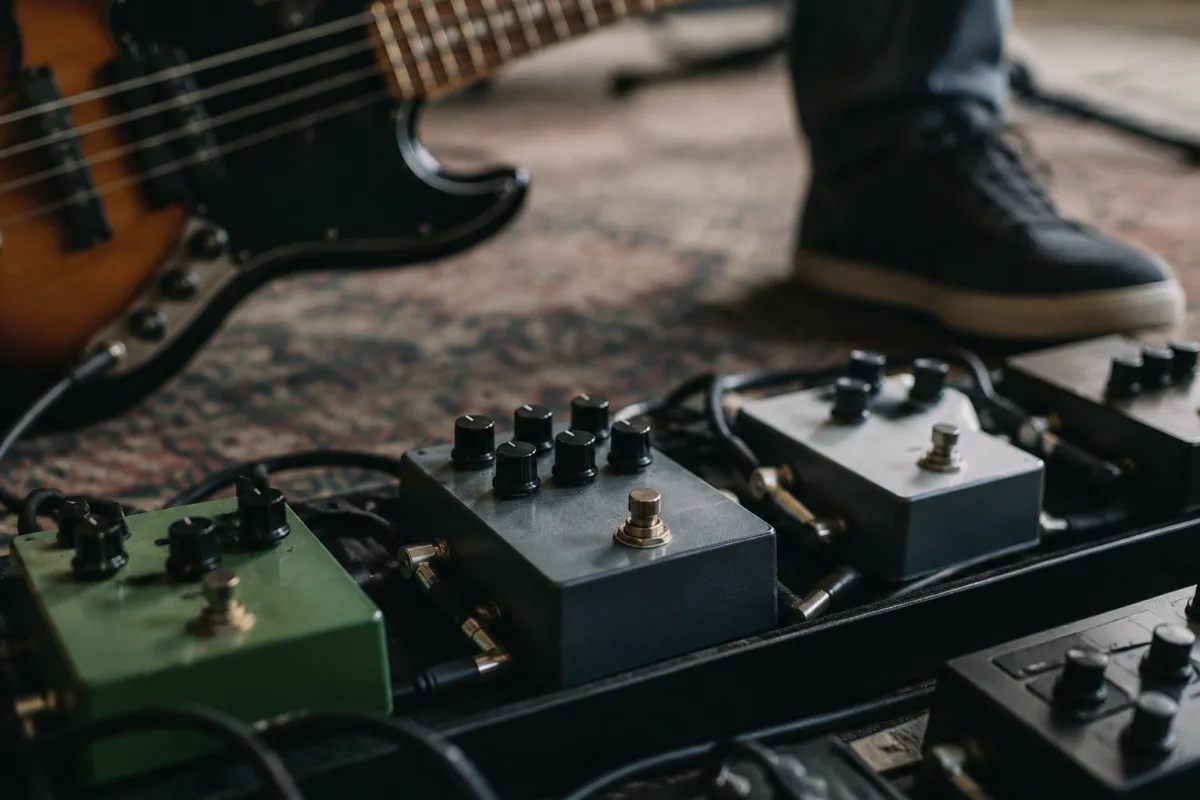
If you've started playing bass and heard experienced players mention preamp pedals, you might wonder what they do and whether you need one. The truth is simple: a bass guitar preamp pedal shapes your tone, adds versatility, and can solve real playing problems. This beginner's guide explains what preamp pedals actually do, why they're worth considering, and how they fit into your developing bass setup.
What Does a Bass Guitar Preamp Pedal Do?
A bass preamp pedal sits between your bass and your amplifier (or directly into a mixer) and processes your signal before it reaches the amp. Think of it as a tone-shaping tool that lets you dial in exactly the character you want. It typically offers controls for treble, midrange, and bass—the familiar EQ adjustments—plus volume and sometimes additional tone-colouring features.
The most immediate benefit: you're no longer reliant solely on your amplifier's EQ controls. A preamp pedal lets you set your tone and carry it with you, plugging into different amplifiers and consistently achieving your sound. For gigging musicians, this is invaluable. For beginners, it's an introduction to serious tone control.
Is a Preamp Pedal Essential for Beginners?
The honest answer: not immediately. You can absolutely develop as a bassist using only your instrument and amplifier. However, a preamp pedal becomes genuinely useful relatively quickly:
Early Stage (First Few Weeks/Months): Focus on learning fundamentals—finger strength, technique, rhythm. Your amp's basic EQ is sufficient.
Intermediate Stage (After a Few Months): Once you're playing songs and exploring your tone, a preamp pedal helps you dial in a sound you love and move beyond your amplifier's limitations.
Gigging Stage: When you start playing different venues with different amplifiers, a preamp pedal ensures your tone remains consistent regardless of the amp you're plugged into.
If you're serious about bass and see yourself developing beyond casual playing, investing in a preamp pedal within your first year is sensible. If you're casually exploring, wait until you feel genuinely limited by your amp's tone.
How a Preamp Pedal Works: The Mechanics Simplified
You don't need deep technical knowledge, but understanding the basic concept helps:
Your bass produces an electrical signal representing your playing. That signal travels directly to your amplifier, which amplifies it. A preamp pedal intercepts that signal and processes it before sending it to the amp. The preamp shapes the tone using EQ (boosting or cutting frequencies), potentially adds compression (evening out volume dynamics), and might add colour through specific circuit designs.
The amplifier then receives the pre-shaped signal and amplifies it. Because the tone is already shaped by the preamp, it reaches the amp in the state you want, regardless of the amp's characteristics.
Common Features on Bass Preamp Pedals
- EQ Controls: Typically three-band (treble, midrange, bass) or more comprehensive. Adjust these to shape your tone. More is genuinely flexible; less is simpler but limited.
- Volume Control: Dial in your output level. Important when matching different amplifiers or adjusting for different bass guitars.
- Compression: Evens out volume variations across your playing. Subtle compression makes your playing sit well in a mix; heavy compression offers a distinct character.
- Tone Switches: Some pedals include buttons selecting different character options—warm, bright, punchy, etc. These shift the overall tone without complex manual adjustment.
- Drive/Saturation: Adds grit or harmonic colour to your tone. Subtle warmth or aggressive distortion, depending on setting.
- Direct Output: Some pedals include balanced XLR outputs for sending signal directly to mixing consoles. Invaluable for live performance with PA systems.
Entry-level preamp pedals focus on EQ and volume. Premium models add compression, drive, and direct outputs. For beginners, basic EQ control is genuinely sufficient to learn how tone-shaping works.
Popular Bass Preamp Pedals for Beginners
- Boss ODB-3 (£60–£100): Compact and straightforward. Simple controls make it beginner-friendly. Overdrive-focused but works as a preamp. Extremely affordable entry point.
- Aguilar Tone Hammer (£200–£280): Excellent EQ controls and tone-shaping capabilities. Not cheap, but genuinely versatile and worth the investment if you're serious about tone.
- Tech21 VT Bass (£150–£200): Solid EQ, compression, and drive options. Well-regarded for clarity and flexibility. Great middle-ground for beginners with a moderate budget.
- MXR M81 (£150–£200): Comprehensive EQ and direct output. Excellent value. Popular with working bass players who need consistency across different venues.
For a first preamp pedal on a budget, the Boss ODB-3 is genuinely capable. If you can invest £150+, the Tech21 VT Bass or MXR M81 offer significantly more flexibility.
Deciding: Is a Preamp Pedal Right for You Right Now?
Ask yourself these questions:
- Am I playing regularly and enjoying bass development?
- Do I feel limited by my current amplifier's tone options?
- Am I playing in different venues or will I be soon?
- Do I want more control over my sound than the amp provides?
- Do I have £100+ to invest in tone equipment?
If you answered yes to three or more, a preamp pedal will add genuine value to your setup. If you answered no to most questions, wait a few months and revisit the decision. You're not behind; you're simply at a different stage.
Using Your Preamp Pedal: Getting Started
Once you have a preamp pedal:
- Start with Neutral Settings: Leave the EQ controls in the middle position initially. This gives you a flat starting point from which to adjust.
- Adjust One Control at a Time: Change the treble, listen, change the midrange, listen. This trains your ear to recognise how each control affects your tone.
- Set Your Volume: Dial the output so your signal isn't too hot or too quiet for your amplifier. The amplifier's input should show a healthy level without clipping.
- Experiment Gradually: Don't overwhelm yourself with all controls at once. Develop familiarity by adjusting slowly and intentionally.
- Reference Good Recordings: Listen to bass tones in songs you admire and try to approximate them with your preamp pedal settings.
Common Beginner Mistakes with Bass Preamp Pedals
- Expecting It to Fix Poor Amplifier Setup: A preamp pedal can't compensate for a broken amplifier. If your amp is fundamentally flawed, the pedal won't help.
- Setting All EQ Controls to Maximum: Boosting everything equally creates an unpleasant, muddy sound. Boost selectively to enhance specific frequencies.
- Not Using the Volume Control: Your preamp's volume setting matters. Too much output clips the amp's input; too little sounds weak.
- Ignoring Cable Quality: A cheap cable between bass and preamp or preamp and amp can degrade your carefully dialled tone. Use quality shielded cables.
- Buying Before You Know Your Tone Goals: Experiment with your amp's EQ for a few months first. Once you understand what you're searching for tonally, a preamp pedal investment makes more sense.
Looking Forward: Preamp Pedals in Your Bigger Setup
A preamp pedal doesn't have to be your only effect. Many bassists eventually add distortion pedals, compression units, or modulation effects alongside their preamp. The preamp serves as your foundational tone-shaping tool, and other effects layer on top. This is completely normal evolution.
For deeper exploration of bass preamp pedals—including specific model reviews, tone-shaping techniques, and integrating preamps into complex pedalboards—the complete guide to bass guitar preamp pedals covers advanced applications and specialist knowledge.
Your Tone-Shaping Journey Begins
A preamp pedal is a tool for intentional tone-shaping. It's not essential immediately, but it's incredibly valuable as your bass skills develop. When you're ready, a quality preamp pedal (£60–£200 depending on complexity) will expand your sonic possibilities and give you control over your sound. For now, if you're just starting, focus on technique. Your preamp pedal is waiting when you're ready to explore deeper into tone.


Comments