


Pedal Chorus Boss article
Pedal Chorus Boss for Beginners: A Complete Guide
If you're thinking about getting your first chorus pedal, a Boss chorus pedal is the perfect place to start. This guide walks you through everything you need to know without the jargon or intimidation.
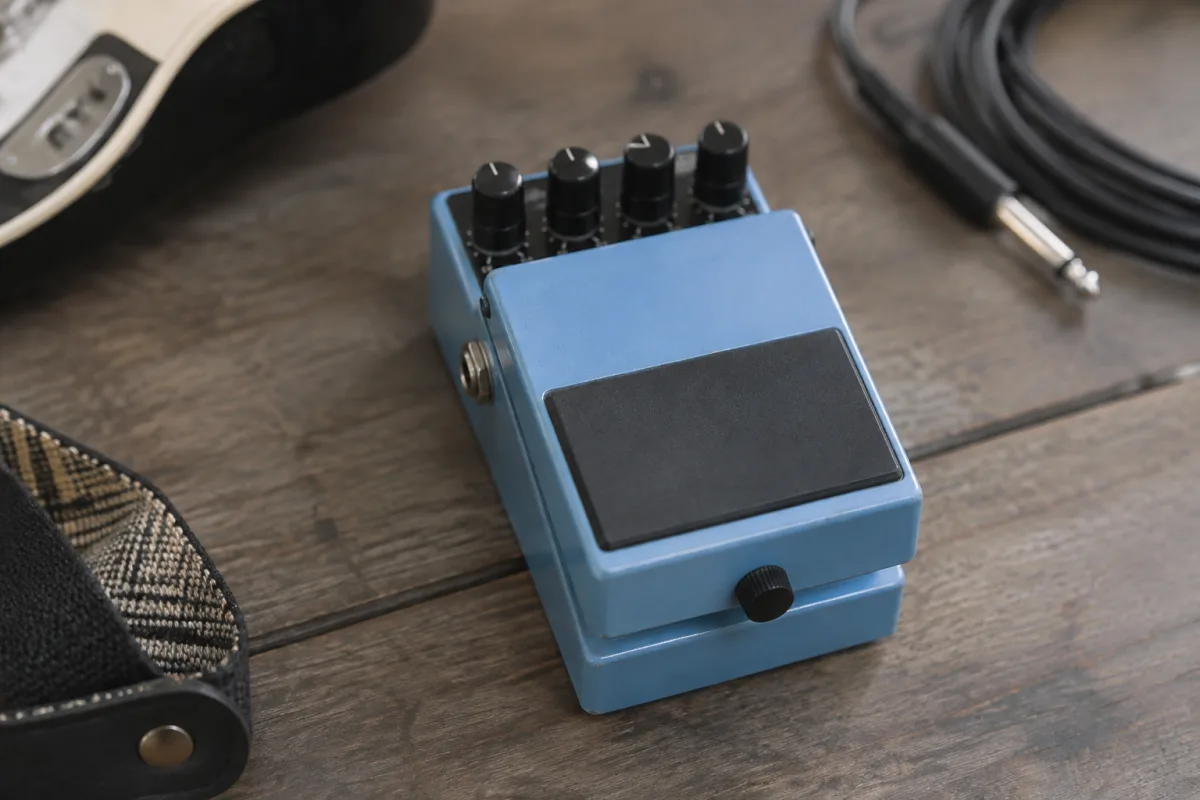
If you're thinking about getting your first chorus pedal, a Boss chorus pedal is the perfect place to start. Whether you've been playing guitar for months or years, adding a chorus effect can open up entirely new textures and possibilities for your sound. This guide walks you through everything you need to know to get started with a chorus pedal, without the jargon or intimidation.
Why Start with a Chorus Pedal?
A chorus pedal is one of the most forgiving effects to learn on. Unlike some other pedals that require careful tweaking or suit only specific genres, a chorus pedal genuinely makes most guitars sound better. It adds width and movement to your tone—think of the spacious, shimmering sound you hear on countless records across rock, pop, country and beyond.
Boss has dominated the pedal market for decades, and for good reason. Their chorus pedals are legendary for reliability, affordability and straightforward operation. You can pick one up second-hand for £30–50 or new for £50–100, making them ideal for trying out the effect without a huge investment.
Understanding What Chorus Actually Does
Before diving into playing, it helps to know what you're hearing. A chorus pedal takes your guitar signal, creates a copy of it, slightly delays that copy, and layers both together. The delay shifts slightly and continuously, which creates that characteristic shimmering, "widened" sound. Think of a choir singing the same note—no two voices are exactly identical, so they blend into something richer and bigger than one voice alone.
The beauty of this effect is that it's nearly impossible to get wrong. Unlike overdrive or distortion, which can sound harsh if you push them too hard, a chorus pedal sounds good across a wide range of settings. This makes it ideal for beginners.
Your First Chorus Pedal: Why Boss?
Boss makes several chorus pedals, but if you're starting out, you'll likely encounter the BF-2, CE-5, or CEB-3. Each is robust, affordable and sounds excellent. Here's what makes them beginner-friendly:
- Simple controls: A Boss chorus pedal typically has just three or four knobs—Rate (how fast the effect wobbles), Depth (how pronounced the effect is), and often a Level knob. No buried menus or confusing parameters.
- Built to last: Boss pedals are famously durable. They're used in studios and live rigs worldwide because they survive being stomped on night after night. You can drop a Boss pedal, and it'll still work.
- Excellent sound out of the box: All Boss chorus pedals ship with sensible default settings. You can plug in and sound good immediately—there's no "correct" starting point you have to hunt for.
- Battery and mains powered: Unlike some boutique pedals, Boss choruses run on batteries or a simple power supply, so you're not hunting for a specific rare adapter.
- Widely available: Walk into any music shop or look online, and you'll find Boss pedals. If you have a question, there's a sea of tutorials and forum posts from other players.
Getting Started: Setup and First Sounds
Setting up a Boss chorus pedal is straightforward. Plug your guitar into the input with a standard 1/4" guitar lead, run the output to your amp or audio interface, power it on (battery or adapter), and you're ready. Press the footswitch to turn the effect on and off.
Your first step is to listen. Leave all knobs at their default middle position and switch the pedal on and off a few times. Hear how your tone opens up and gets wider? That's the chorus doing its job. It's a modest change—not dramatic—which is exactly what you want as a beginner. If the effect sounds too subtle, resist the urge to crank the Depth knob immediately. Your ear will adjust, and subtle is often better for a first-timer than overwhelming.
Play a few open chords or a simple melody and listen to how the chorus sits with your natural tone. Many players find that chorus works beautifully on clean tones and adds character to light overdriven sounds too.
Learning the Three Main Controls
Once you're comfortable with the default sound, the next step is understanding each knob. Boss keeps it simple, which means you can experiment confidently without getting lost.
| Control | What It Does | Beginner Tip |
|---|---|---|
| Rate | How fast the chorus wobbles (cycles per second) | Start around 12 o'clock. Slower rates (7–9 o'clock) are lush and warm; faster rates (2–3 o'clock) are more noticeable and modern. |
| Depth | How intense the effect is | Begin at noon or slightly lower. Higher Depth can be phasey or unnatural; lower Depth is subtle and musical. Most players live at 11–1 o'clock. |
| Level | Output volume when the pedal is on | Match your "dry" (no effect) volume. This prevents a sudden volume jump when you switch on the chorus. |
The key insight: there are no wrong settings. Every combination of Rate and Depth produces a usable chorus tone. Spend five minutes with the Rate knob, then another five minutes with Depth. Your ear will quickly home in on what sounds good for your style and guitar.
Common Beginner Mistakes (and How to Avoid Them)
After helping dozens of first-timers with their pedal chorus boss experience, a few patterns emerge. Watch out for these:
- Turning the Depth all the way up: A chorus pedal set to maximum Depth can sound cartoonish or artificial. Start conservatively; you can always turn it up later if you want more effect.
- Forgetting the Level knob: If your chorus-on tone is suddenly louder or quieter than your dry tone, it will throw off your dynamic playing. Spend 30 seconds matching the Level—it makes a huge difference.
- Expecting chorus to fix a bad tone: Chorus enhances; it doesn't rescue. If your amp or guitar doesn't sound great in the first place, chorus will only make that more obvious. Get your base tone solid first.
- Using chorus on everything: Chorus is fantastic, but it doesn't suit every note or song. A heavily choused ballad verse can sound less intimate than a dry tone. Learn when to switch it on and off for maximum impact.
- Not combining it with other pedals: Chorus pairs beautifully with mild drive and reverb. Don't be shy about stacking—it's one of the joys of pedals once you're comfortable with one effect.
Chorus in Different Styles
As you explore, you'll discover that chorus shines in different contexts. Here's how the pedal chorus boss sound translates across genres:
- Indie rock and alternative: A slower Rate and moderate Depth give indie riffs a dreamy, atmospheric quality. Think My Chemical Romance or The Smiths.
- Soul and funk: A light chorus on clean guitar adds movement without overwhelming the groove. Perfect for supporting rather than dominating.
- Shoegaze and experimental: Chorus is a foundation of the shoegaze sound. Heavier settings, combined with reverb and delay, create walls of texture.
- Country: A subtle chorus on clean electric is a classic country sound, adding warmth and space to leads and rhythm parts alike.
The takeaway: your Boss chorus pedal is versatile. You're not locked into one sound or style.
Maintenance and Care
One reason to love Boss pedals is how bulletproof they are. A few simple habits keep yours in top shape for years:
- If using batteries, swap them annually or when the effect sounds weaker.
- Keep the footswitch clean. A quick wipe with a dry cloth prevents sticking.
- Store it somewhere dry and avoid extreme heat—a cardboard box or soft case is fine.
- Use standard 1/4" guitar leads and a standard Boss power adapter. The pedal is not fussy.
That's genuinely all you need to know. Boss pedals rarely fail.
Next Steps: Building Confidence
Your next move is to play with the chorus pedal for a week or two and let your ear adjust to the effect. Switch it on for entire practice sessions, then off for others. Record yourself—hearing your playing back helps you decide whether you love the tone or want to tweak it.
Many beginners worry they'll "do it wrong," but a chorus pedal is forgiving. There's no wrong setting, only preferences. Trust your ear and don't overthink it.
If you want to dive deeper, check out our complete guide to chorus pedals for more technical detail and advanced tips. For now, plug in, switch on, and enjoy the shimmer.
FAQ
Q: Can I use a chorus pedal on an acoustic guitar?
A: Absolutely. Chorus on acoustic often sounds magical—warm, spacious and organic. Plug an acoustic into an amp and try it.
Q: Will chorus pedal boss make my thin guitar tone sound thicker?
A: Chorus adds movement and width, not thickness in the way gain does. It makes a thin tone sound bigger and more interesting, but it won't turn a weak amp into a powerhouse.
Q: Is a vintage Boss chorus pedal (like the BF-2) as good as a new one?
A: Vintage Boss pedals are excellent buys. The BF-2 is more than 30 years old and players still rave about it. If you find one in working condition at a good price, go for it.
Q: Can I use a chorus pedal with distortion or overdrive?
A: Yes, though the effect is more subtle on heavy distortion. Light to moderate drive stacks beautifully with chorus.
Q: How do I know if my chorus pedal needs repair?
A: If the effect cuts out when you switch it on, the footswitch is stuck, or you hear crackling noise, it needs service. Boss pedals are so durable that this is rare.
Q: What's the difference between Rate and Speed on a chorus pedal?
A: They're the same thing—different Boss models use different labels. Rate and Speed both control how fast the chorus cycles.


Comments