


Bass Drum Mics article
The Complete Guide to Bass Drum Mics
Recording a bass drum requires a microphone engineered for deep, controlled low-end capture. Learn which types work best and how to place them correctly.
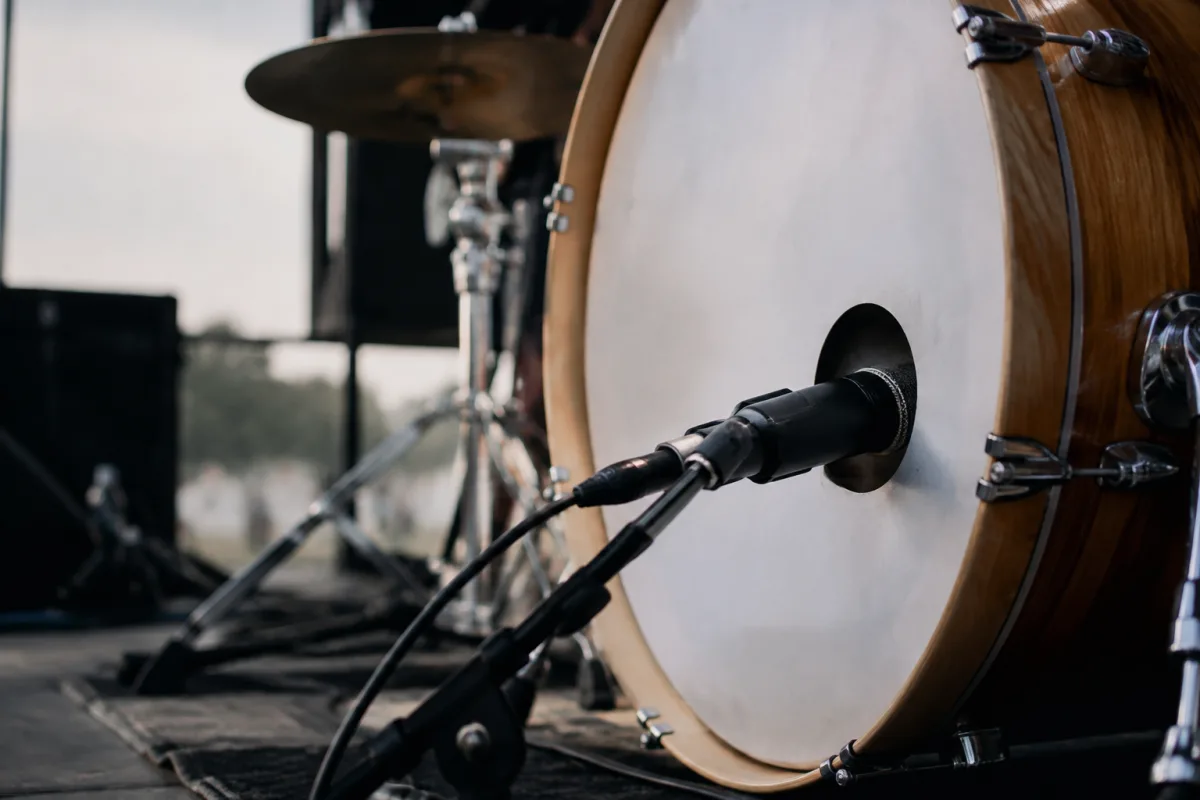
The bass drum is the heartbeat of a song—and it's the hardest drum to record properly. A microphone designed for cymbals will sound thin and boomy on a kick. A microphone designed for vocals will either be undersized for the job or will rattle when the drum hits. Recording a bass drum requires a microphone specifically engineered for deep, controlled low-end capture and a transient response that can handle the impact without distorting.
The Challenge of Capturing Bass Drum Sound
A bass drum produces sound in multiple ways. The beater strikes the head with a rapid, high-amplitude impact. The head resonates and vibrates at frequencies from 60 Hz down to 30 Hz or lower. The shell itself colours the sound with mid-range characteristics. A poorly chosen microphone captures all this and delivers either a thin, boomy, unusable sound or something so coloured by the microphone's character that it doesn't sound like the drum at all.
Bass drum microphones face competing demands. They need to capture the low frequencies that define the drum's character, but too much proximity to very low frequencies creates mud and phase issues when you mix with other instruments. They need to respond quickly to the transient impact of the beater, but not so aggressively that they distort or rattle. They need to be sturdy enough to place inside a drum and potentially take a hit, but sensitive enough to capture subtlety.
Microphone Types and Their Roles
Three broad categories of microphones appear around a bass drum: boundary microphones, directional dynamic microphones, and large-diaphragm condensers. Each approach has evolved to solve different problems and suit different recording scenarios.
Boundary microphones are placed on or near a drum head or floor. The boundary (the flat surface) acts as a reflector, which changes the microphone's frequency response and polar pattern. A boundary microphone inside a bass drum dampens the natural reflections inside the shell and delivers a focused, punchy signal. Examples include the Audix D20, which is specifically designed as an internal bass drum microphone, and clip-on models like the Earthworks or Cad models that clamp directly onto the drum rim.
Dynamic microphones with hypercardioid or supercardioid patterns reject ambient sound and focus on what's happening right in front of them. The Shure Beta 52A and the Audix D6 are genre standards here. These microphones have presence peaks in the mid-range (which adds attack and punch) and gentle presence peaks in the low end (which adds body and weight). They're nearly indestructible, they sound great immediately, and they work in virtually every recording or live sound situation.
Large-diaphragm condensers capture bass drum with more detail and nuance. A Neumann TLM 103 or AKG C414 on a bass drum delivers a three-dimensional picture of how the drum actually sounds. The trade-off is that condensers are more sensitive to handling noise and phantom impact reflections inside a drum. They're ideal for precise studio recording where you have control over the acoustic environment.
Placement and Technique Matter as Much as the Microphone
Where you place a bass drum microphone changes everything. Place it just inside the resonant head (the head facing the room, opposite the beater) and you capture the full complexity—attack and tone and resonance together. Place it near the beater head and you get more attack, more of the initial impact, less of the harmonic ring. Place it outside the drum, pointing at the hole, and you capture what's radiating into the room, which is both direct bass and reflections from the shell.
Inside placement is the standard in studios and on stage. A microphone clipped to the drum head or sitting inside on a small stand captures the maximum bass drum signal and rejects ambient noise and cymbals. This is why internal bass drum microphones—specifically designed to be placed literally inside the drum—became standard. They're short (to fit inside), tough (to handle impacts), and precisely tuned (to sound great in that specific environment).
For live sound, internal placement means you can get a strong bass drum signal without the microphone being visible on stage. For studio recording, it means you control exactly what the microphone hears without worrying about reflections from the room.
Technical Specs That Actually Matter
Frequency response is critical. A bass drum microphone should capture from at least 50 Hz down to 20 Hz (or lower), with a controlled, not exaggerated, response in the low end. Too much sensitivity below 80 Hz creates muddiness; too little misses the drum's fundamental character. The peak around 2–5 kHz (the presence peak) is what makes a bass drum sound punchy and defined in a mix rather than boomy and lost.
Transient response matters for capturing the beater impact. A microphone with a slow transient response will smooth over the quick, sharp attack of the beater; you'll lose the feeling of impact. Faster transient response gives you punch and definition. Dynamic microphones with presence peaks in the mid-range naturally handle transients well; a large-diaphragm condenser might need careful placement to capture the attack without it being too aggressive.
Impedance and sensitivity need to be appropriate for your chain. If you're feeding a bass drum microphone into a live sound console, you need an output level that's strong enough without requiring extreme gain adjustment. If you're recording into an audio interface, sensitivity is less critical because you can adjust digitally.
Common Choices and What They Bring
The Audix D6 is arguably the most common bass drum microphone in live sound and recording studios worldwide. It's reasonably priced, nearly indestructible, has a sound that works immediately, and requires almost no special technique. The presence peak makes it punchy, the low-end response captures weight, and the hypercardioid pattern rejects other drums and cymbals.
The Shure Beta 52A is similar—solid, reliable, familiar to anyone who's worked in live sound, and a sound that's instantly usable. It's marginally less aggressive in the presence peak than the D6, which some engineers prefer for recordings where the bass drum needs to sit rather than punch.
The Audis D20 is specifically designed as an internal bass drum microphone. It's clip-mounted on the drum head, which means it won't get knocked over or buried by the drum shell. It delivers a very focused, controlled sound that works beautifully for recording and for live sound when you're comfortable with placing a microphone inside the shell.
Large-diaphragm condensers (Neumann, AKG, Shure KSM) deliver the most detailed bass drum sound but require more care and aren't ideal for live sound or chaotic sessions. Save these for studio work where you control the acoustic environment and want maximum fidelity.
Practical Decisions: Live Sound vs. Studio Recording
For live sound, you want a microphone that's tough, has a strong output, and works well in any bass drum type without special technique. A dynamic microphone like the D6 or Beta 52A is the practical choice. You can place it consistently, it handles feedback well, it survives abuse, and it sounds good on every stage.
For studio recording, your choices are wider. If you want speed and consistency (especially for commercial music), a dynamic microphone inside the shell is standard. If you have time and control, layering a dynamic (for punch and focus) with a condenser (for detail and body) gives you flexibility in the mix. Many studios mic the bass drum with two microphones—one inside for direct punch, one outside for the room tone and shell character—and blend them.
The Bottom Line
Bass drum microphones are specialist tools engineered for a specific job: capturing the deep, quick, powerful sound of a kick without distortion or mud. Whether you choose a dynamic microphone for its ready usability, a boundary-mounted design for its precision, or a condenser for its detail, the key is matching the microphone to your situation—live or studio, controlled or chaotic—and then placing it with intention. A good bass drum microphone makes recording or amplifying a kick drama-free; a poor choice makes it a perpetual battle.


Comments