


DJ Equipment article
Dj Equipment for Beginners: A Complete Guide
You don't need expensive gear to start DJing. A simple two-channel controller, headphones and speakers will teach you everything that matters. Here's what to buy and how to practice.
If you're thinking about getting into DJing but the whole equipment landscape feels overwhelming, take a breath. You don't need to understand everything on day one. What you need is one simple, straightforward setup that gets you playing music and learning the fundamentals. Most of the complexity can wait.
Start with a Controller, Not Turntables
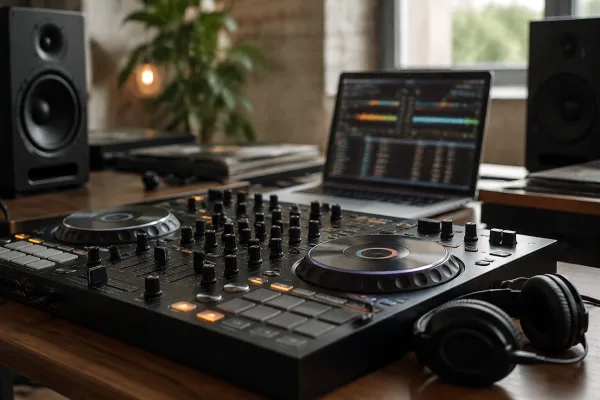
The absolute best path for a beginner is a two-channel DJ controller. It's not because it's the "best" equipment—it's because it's the simplest way to learn. A controller combines everything you need in one box: decks to play music from, faders to mix between them, jog wheels to manipulate tracks, an audio interface so you can hear what you're doing, and headphone controls for cueing. Everything is within arm's reach and labelled clearly.
Start with something like a Pioneer DDJ-200, Numark Mixtrack or Rane One. These cost £150–£300, include DJ software and will teach you everything a turntable setup would—but without the expense, the space requirements or the frustration of fighting with cheap turntables while you're learning.
Add Headphones (Closed-Back, Not Open)
Get a pair of closed-back DJ headphones. "Closed-back" means the ear cups are sealed; this keeps sound from bleeding into your microphone if you're speaking over the mix, and it lets you isolate the track you're cueing from the rest of the room. You don't need anything fancy—£60–£100 is plenty to start. Brands like Audio-Technica, Pioneer and Technics all make solid beginner models.
Comfort matters more than features. You'll wear these for hours, so try them on if you can. A headband that's too tight or ear cups that hurt will make you miserable.
Get Speakers That Actually Work
Powered (active) speakers with built-in amplifiers are essential. Cheap computer speakers or a home stereo won't do—they don't give you an honest picture of your mix. Budget £100–£200 for a pair of small powered monitors. Brands like Yamaha, KRK and Behringer make solid beginner options that won't break the bank and will let you hear clearly.
You need to hear what the room hears, not just what your headphones tell you. This is how you learn to mix properly.
Don't Worry About the Rest Yet
Ignore cables, isolation stands, vinyl, timecode systems and effects processors. You don't need any of that to start. A controller, headphones and speakers—that's genuinely all you need to learn DJing. Get good at the fundamentals first: beatmatching, EQ mixing, cueing tracks accurately and building a set that flows. Everything else builds on these basics.
Learn These Five Things First
Beatmatching is matching the tempo of two tracks so they play at the same speed. Your controller will show you the BPM; learn to hear when two tracks are in time.
EQ mixing means using the channel EQ (high, mid and low) to blend tracks smoothly. Cutting the bass of the incoming track while raising it on the outgoing one is the foundation of clean mixing.
Headphone cueing lets you listen to the next track privately and find the right moment to start mixing it in. Master this and everything else becomes easier.
Fader control is learning to move the channel faders smoothly and confidently. This is pure technique; it takes time but it matters.
Building a set means understanding song selection, energy flow and pacing. Start with tracks you love and learn to mix them together.
Practice Consistently
The biggest difference between beginners who improve and those who don't is consistency. Practise every few days, even for 30 minutes. Record your mixes, listen back and notice what needs work. Join online DJ communities, watch tutorials and get feedback. Your equipment doesn't limit you at this stage—your practice does.
Conclusion
You don't need expensive gear or complicated systems to start DJing. A simple controller setup is perfect for learning everything that matters. Spend your time and energy on developing your ear, your technique and your musical taste. The gear can wait. Once you've been DJing for six months or a year and you know what you actually want from your setup, then upgrade thoughtfully. For now, keep it simple and focus on playing music.



Comments