


Yamaha Hs7 article
Everything You Need to Know About Yamaha Hs7
The Yamaha HS7 is one of the most popular nearfield studio monitors around — here's everything you need to know about how it works and what it can do.

The Yamaha HS7 has become one of the most talked-about nearfield studio monitors in home and project studios alike. If you've been wondering what all the fuss is about, this guide covers everything — the specifications, the controls, how it fits into a real studio setup, and what it can and can't do for your mixes.
What Exactly Is the Yamaha HS7?
The Yamaha HS7 is a powered, two-way nearfield studio monitor — meaning it has its own built-in amplifiers and is designed to sit close to you while you work. The "7" in the name refers to the woofer size: a 6.5-inch cone driver handles the lows and mids, while a 1-inch dome tweeter looks after the upper frequencies. A rear bass reflex port (a tuned vent in the back of the cabinet) extends the low-end response.
It belongs to Yamaha's HS Series, which was relaunched in its current form in 2013 and sits alongside the smaller HS5, the larger HS8 and the matching HS8S subwoofer. It is the middle-ground option — more bass extension than the HS5, but a more manageable footprint than the HS8.
Core Specifications at a Glance
| Feature | Specification |
|---|---|
| Driver configuration | 6.5-inch woofer + 1-inch dome tweeter |
| Amplification | 95 W total (60 W LF + 35 W HF) |
| Frequency response | 43 Hz–30 kHz at −10 dB / 55 Hz–24 kHz at −3 dB |
| Crossover frequency | 2 kHz |
| Inputs | XLR balanced + ¼-inch TRS balanced/unbalanced |
| Dimensions | 210 × 332 × 284 mm |
| Weight | Approx. 8.2 kg |
| Enclosure | Bass reflex (rear port) |
One thing worth clarifying: the 43 Hz–30 kHz figure is measured at −10 dB. The tighter 55 Hz–24 kHz figure is the −3 dB point, which is a more honest reflection of where the monitor is genuinely working. Neither figure means the response is perfectly flat across that range — just that the output is within that tolerance at the measurement boundary.
Bi-Amplification: What It Means in Practice
This monitor uses a bi-amplified design — that is, the woofer and tweeter each have their own dedicated amplifier: 60 W for the low-frequency driver and 35 W for the high-frequency driver. This matters because it avoids passive crossover losses and allows each driver to be optimised independently. The active crossover splits the signal at 2 kHz before amplification rather than after, which is generally considered cleaner and more efficient than a passive approach.
The practical upshot: the Yamaha HS7 can deliver a fairly even, controlled sound at nearfield listening distances without introducing much colouration from the amplifier or crossover network itself. That's exactly what you want from a studio monitor — not flattery, but a clear window into your mix.
The Rear-Panel Controls
Three response-shaping controls live on the back panel:
- Room Control — attenuates the low-frequency output by −2 dB or −4 dB below 500 Hz. Use it when the monitor is near a wall and the bass feels overly thick.
- Mid EQ — a midrange adjustment to compensate for room or placement anomalies.
- High Trim — adjusts the high-frequency output by −2 dB, 0 dB or +2 dB, useful for tailoring brightness to your room and listening preferences.
These are helpful starting points, but they're not a substitute for sensible placement and acoustic treatment. They can reduce obvious tonal problems, but they can't fix strong room modes or nasty early reflections — those need physical solutions.
Placement: Getting the Best from Your Monitors
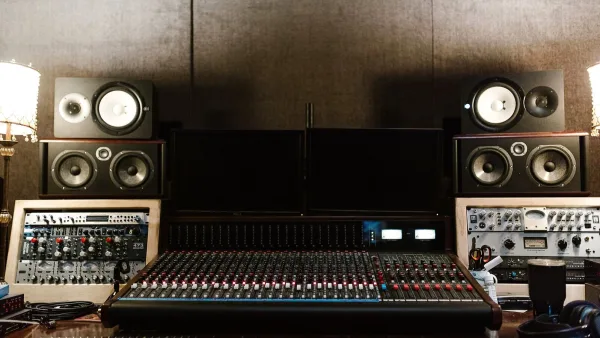
Because this monitor is rear-ported, placement matters more than it would for a front-ported or sealed design. Too close to a wall, and the port can exaggerate bass buildup. Here are the practical guidelines:
- Leave adequate clearance behind the cabinet for the port to breathe.
- Set up both monitors symmetrically around your listening position.
- Aim for an equilateral triangle — both speakers and your ears at equal distances from each other.
- Point the tweeters toward your ears, not over your head.
- Use isolation pads or dedicated stands rather than placing monitors directly on a resonant desk.
- Avoid hard corners, which amplify bass dramatically.
Your room will shape the sound more than almost any other variable. Independent measurements have shown a response tolerance of around ±3.6 dB from 80 Hz to 20 kHz — useful context, though these figures are specific to the test environment and shouldn't be treated as a universal specification for every unit.
Where It Sits in the HS Range
The HS Series is straightforward: bigger woofer, more low-frequency extension and output. The HS5's 5-inch driver is ideal for smaller rooms and those working mainly in the mid-frequency range. The HS8's 8-inch driver reaches further into the sub-bass, but in a small untreated room it can actually reveal less — the room starts to dominate. The HS7 strikes a useful balance.
If you need deeper bass information and your room can handle it, Yamaha's HS8S subwoofer can be added to the monitoring setup. Integration requires careful crossover and level matching, ideally with some measurement, but a well-set-up combined system gives you a genuinely wide-range monitoring environment.
Connections and Signal Chain
The monitor accepts both XLR and ¼-inch TRS inputs. For most home or project studio setups, the signal chain is simple:
Computer → Audio interface → Balanced cables → HS7
Use balanced connections wherever possible — especially over longer runs — as they reject electrical interference. This monitor is line-level and self-powered, so no external amplifier is needed.
What It Is Good For
The monitor suits a wide range of production contexts:
- Recording and editing sessions
- Mixing pop, rock and electronic music
- Podcast and broadcast production
- Home studio nearfield monitoring
- General critical listening
It's honest enough to reveal mix problems — transient smearing, uneven EQ, clashing reverbs — without being excessively brutal. Some listeners find its character slightly forward or revealing, which can feel tiring at high volumes over long sessions. Keep levels sensible, and it rewards you with clarity.
Knowing Its Limits
No monitor tells you everything, and this one is no exception. Its rear port complicates placement close to walls. Its low-frequency reach stops well before the true sub-bass region, so bass-critical work (deep electronic music, hip-hop, film scoring) benefits from either the HS8 or an HS8S subwoofer. And like every monitor, it's at the mercy of your room — a well-treated space transforms what the monitor can do.
Cross-check your mixes on headphones, earbuds, a phone speaker or a car system. No single monitoring source tells the whole story.
The Bottom Line
The Yamaha HS7 is a well-specified, bi-amplified nearfield monitor that offers honest, revealing performance for home and project studio work. Its real strengths are its controlled midrange, useful rear-panel adjustments and sensible sizing for small-to-medium rooms. Treat it well — good placement, adequate clearance, appropriate acoustic treatment — and it'll serve your mixes reliably.
If you're considering a purchase, the Yamaha HS7 buyer's guide covers what to check before you spend, and if you're just starting out with studio monitors, our beginner's guide to the HS7 will walk you through everything from unboxing to your first mix.





Comments