
Monitoring Speakers article
The Complete Guide to Monitoring Speakers
Monitoring speakers reveal the truth about your mix. Discover what makes them essential for accurate recording, mixing, and mastering in any studio.
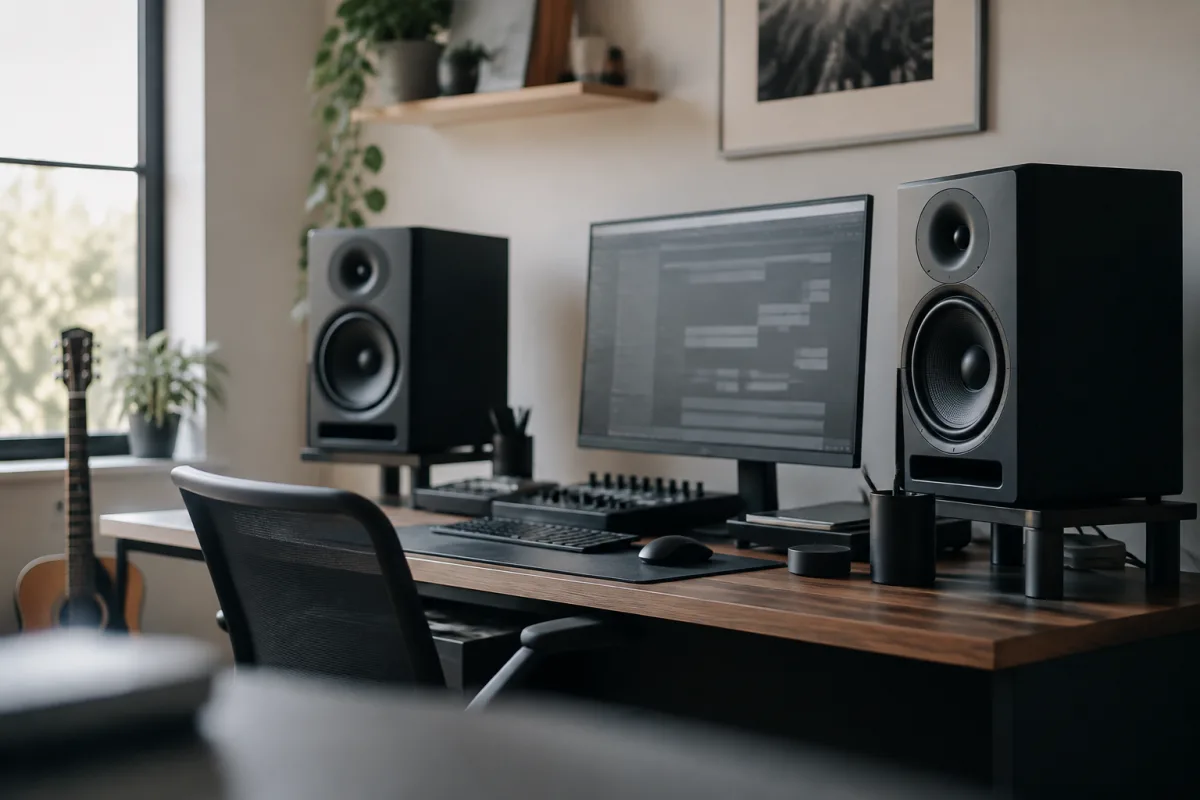
Monitoring speakers are essential tools for anyone producing or recording music. Unlike consumer speakers, which are designed to make everything sound pleasant, monitoring speakers are engineered to reveal the truth about your mix. They let you hear exactly what you've recorded, from the deepest bass frequencies to the highest treble, without colouration or flattering EQ curves. Whether you're recording vocals in a home studio, mastering a track, or simply checking your mixes on accurate gear, a quality pair of monitoring speakers will transform your ability to make better mixing decisions.
What Are Monitoring Speakers?
Monitoring speakers, also called studio monitors or nearfield monitors, are active speakers designed for critical listening in professional and semi-professional recording environments. The term "nearfield" refers to their intended placement close to the listener — typically on a desk or studio shelf at ear level, rather than mounted across a large room.
The key difference between monitoring speakers and regular speaker systems lies in their frequency response and acoustic design. Monitoring speakers aim for a flat frequency response curve, meaning they reproduce all frequencies at roughly equal volume levels. This neutrality allows you to hear precisely what's in your mix without the boost in bass or treble that consumer speakers add to make music more "fun" to listen to.
Most monitoring speakers are active, meaning they have built-in amplifiers. This design simplifies setup — you simply plug them in and connect your audio interface or mixer directly to the speakers. Passive monitoring speakers, whilst less common, require a separate power amplifier.
Why Flat Frequency Response Matters
The most critical specification of any monitoring speaker is its frequency response. A flat response ensures that what you hear in the studio translates accurately to other playback systems — car stereos, headphones, mobile phones, club sound systems, and so on.
When you mix on speakers with coloured frequency response, your mixing decisions are based on inaccurate information. You might add extra bass thinking the mix is thin, when in fact the speakers themselves are suppressing the low end. When your mix plays on other systems, the bass suddenly becomes overwhelming. Conversely, if your speakers boost the treble, you'll under-compensate for brightness, and your final mix will sound dull elsewhere.
Flat monitoring speakers give you the objective starting point you need. Even if your room's acoustics colour the sound, at least you're working with speakers that aren't adding their own problems on top.
Types of Monitoring Speakers
Monitoring speakers come in several configurations, each suited to different spaces and budgets:
- Nearfield monitors. The most popular choice for home studios and control rooms. These compact speakers (typically 5–8 inches woofer size) are designed to be heard from close distances, minimising room acoustic issues. They're affordable, don't take up much space, and work well for vocals, detailed mixing work, and smaller rooms.
- Midfield monitors. Larger speakers (8–10 inch woofers) meant for listening distances of 3–5 metres. They deliver a broader acoustic picture than nearfields and handle lower frequencies more naturally, but require more space and careful placement.
- Soffit-mounted monitors. Professional studio speakers built directly into the control room wall. These offer the most accurate, room-integrated sound but are impractical for home studios and far beyond most budgets.
- Powered subwoofers. Often paired with monitoring speakers to extend the low-frequency response, particularly useful when your main monitors struggle below 50 Hz. Essential for genres heavy on bass, such as hip hop and electronic music.
Key Specifications to Consider
When evaluating monitoring speakers, look at these technical details:
| Specification | What it Means | Typical Range |
|---|---|---|
| Frequency Response | The range of frequencies the speaker can reproduce. Wider is better; aim for at least 50 Hz to 20 kHz. | 48 Hz–24 kHz (typical for nearfields) |
| SPL (Sound Pressure Level) | Maximum volume output. Measured at 1 metre. Higher gives you more headroom and less distortion at loud volumes. | 85–105 dB (typical) |
| Woofer Size | Driver diameter in inches. Larger woofers handle bass better but take up more space. | 5"–8" (nearfields) |
| Driver Configuration | 2-way (woofer + tweeter) is standard. 3-way adds a midrange driver for added clarity. | 2-way or 3-way |
| Acoustic Treatment | Ports or sealed enclosure design affect bass response and room interaction. | Ported or sealed (sealed preferred for small rooms) |
Setting Up Your Monitoring Speakers
Even the best monitoring speakers won't sound accurate if they're positioned poorly. Follow these guidelines for optimal results:
- Place them at ear level when you're seated in your mixing position, angled slightly upward if necessary.
- Position them symmetrically — equal distance from your mixing position and equidistant from side walls.
- Leave at least 1 metre between the speakers so the stereo image has room to develop.
- Keep them away from corners, which exaggerate bass buildup.
- Use isolation pads or stands to decouple the speakers from the desk or shelf, reducing vibration transmission.
- Calibrate the output level to around 85 dB SPL at your mixing position — loud enough to hear detail, gentle enough to work for hours without ear fatigue.
Room Acoustics and Monitoring Speakers
Your monitoring speakers are only half the equation. Room acoustics significantly influence what you hear. Even perfect monitoring speakers will mislead you in an untreated room with hard walls, flutter echo, standing waves, and bass nodes.
For a small home studio, basic treatment — absorptive foam on the first-reflection points (walls beside and above your mix position) and bass traps in room corners — can dramatically improve accuracy. You don't need an expensive full-room build. A few strategic panels make a measurable difference.
Another practical approach is to occasionally check your mixes on other systems: headphones, car speakers, or a friend's studio. This cross-referencing helps you learn what your monitoring speakers are telling you and where your room might be coloured.
Finding the Right Monitoring Speakers for Your Studio
The ideal monitoring speakers balance accuracy, budget, room size, and your specific production work. For a bedroom or small home studio with genre flexibility, a compact 5-inch or 6-inch pair is a sensible starting point. If your room is larger or bass-heavy music is your focus, consider 7 or 8-inch speakers or pair a smaller monitor with a subwoofer.
Budget-conscious producers shouldn't shy away from entry-level monitoring speakers from reputable manufacturers. A £200–400 pair of solid nearfields will outperform consumer hifi speakers costing three times as much. As your needs grow, upgrading to mid-range or professional-grade monitoring speakers (£800–2000+) offers improved accuracy, build quality, and frequency extension.
Ultimately, monitoring speakers are an investment in your ability to make better mixing decisions. The flatter and more trustworthy the sound, the more likely your finished mixes will translate well across all playback systems, and the faster you'll develop your mixing ear.


Comments