
Genelec Studio Speakers article
The Complete Guide to Genelec Studio Speakers
Genelec studio speakers deliver the acoustic accuracy professionals depend on. Learn what makes Genelec speakers essential for critical mixing and which model suits your studio.
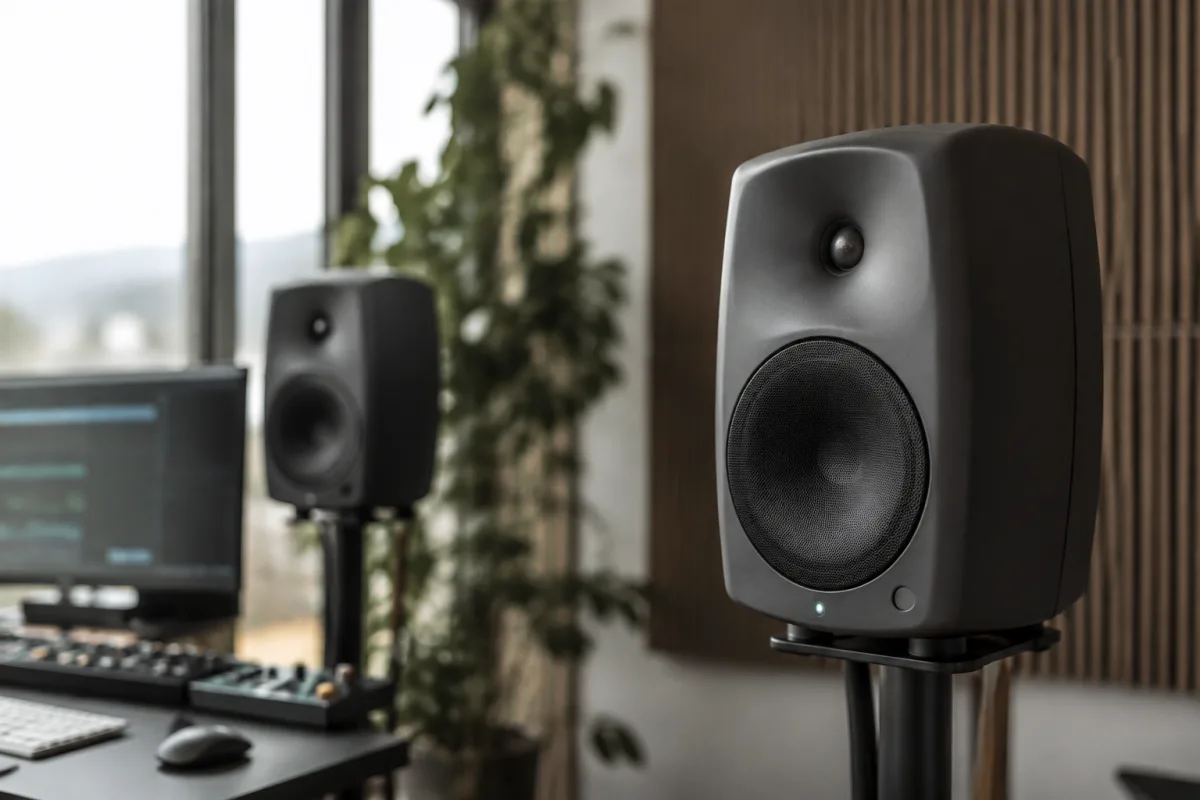
Genelec studio speakers represent the gold standard for critical listening in professional recording environments. Manufactured by the Finnish company Genelec, these monitors deliver uncoloured, accurate sound reproduction that allows mixing engineers to make confident decisions about tone, balance, and spatial imaging. Whether you're setting up a professional mixing suite or upgrading a home studio, understanding what makes Genelec speakers exceptional and which model suits your room is essential knowledge.
Genelec's Heritage and Philosophy
Genelec has manufactured studio monitors since 1978, building its reputation on a single principle: delivering acoustically neutral sound that reveals the truth of a recording rather than adding coloration. This philosophy separates Genelec from consumer loudspeakers, which often emphasise bass or treble to make music sound "better" in living rooms. Professional studio monitors must do the opposite—they must reveal problems as clearly as strengths, allowing engineers to mix mixes that translate accurately to consumer playback systems.
The company's commitment to engineering excellence is evident in every design decision. Genelec doesn't chase fashion; it pursues accuracy. This steadfast approach has made Genelec monitors the first choice in studios worldwide, from major label facilities to home recording operations.
Genelec Studio Speaker Types
Genelec manufactures three primary speaker categories. The 8000 series comprises compact, budget-conscious monitors suited to smaller rooms and home studios. The 1000 series occupies the mid-professional range with larger drivers and enhanced bass extension. The SAM (Smart Active Monitoring) series represents the company's flagship technology, incorporating digital signal processing and room correction algorithms.
Within each series, multiple models offer different sizes—typically ranging from 4-inch to 8-inch woofers. A smaller room might use 5-inch or 6-inch monitors; larger control rooms often employ 7-inch or 8-inch models. The choice depends on room size and acoustic characteristics.
Active Speaker Design
All Genelec studio speakers are active monitors—they incorporate internal amplifiers rather than requiring external power amplifiers. This integration simplifies studio setup; you connect audio directly from your mixing console or audio interface without needing a separate amplifier. The internal amplifiers are carefully matched to each speaker's drivers and cabinet, ensuring optimal performance.
Active design also allows Genelec to implement sophisticated signal processing. The company can apply DSP (digital signal processing) algorithms that a passive speaker cannot achieve. This capability underpins Genelec's SAM technology, which includes digital room correction.
Acoustic Accuracy and Flatness
Genelec studio speakers prioritise frequency response flatness—the degree to which a speaker reproduces all frequencies at consistent volume. A perfectly flat speaker reproduces 20 Hz through 20 kHz at identical levels across the entire range. In practice, achieving perfect flatness is impossible, but Genelec's engineering minimises deviation to ±2–3 dB across the audible range, making their speakers amongst the flattest in existence.
This flatness matters profoundly in professional mixes. When a mixing engineer hears every frequency equally, they can make mixing decisions confident that a mix sounding balanced in the Genelec suite will sound balanced on consumer devices. Speakers that emphasise bass or treble cause mixing engineers to compensate—cutting bass or treble that's actually correct, resulting in mixes that sound thin on consumer systems.
SAM (Smart Active Monitoring) Technology
Genelec's SAM technology represents modern studio speaker design. SAM monitors include a built-in microphone and software that measures the room's acoustic characteristics. The system then applies digital correction that compensates for room resonances and acoustic reflections, resulting in more neutral sound reproduction than passive acoustics alone could achieve.
This technology is genuinely valuable. Even professionally treated studio rooms exhibit some acoustic coloration; SAM technology measures this coloration and corrects for it digitally. Mixing engineers using SAM monitors hear more accurate midrange response than they would without the correction, leading to mixes that translate better to consumer playback systems.
Nearfield Monitoring Setup
Professional studios employ nearfield monitoring—placing studio speakers close to the engineer's head (typically 1–2 metres away) so direct sound from the speakers reaches the ears before reflected sound bounces off room walls. This practice minimises the room's acoustic influence, allowing the engineer to hear primarily what the speakers produce rather than room resonances.
Genelec speakers are designed specifically for nearfield setup. Their dispersion patterns (the way sound spreads across angles) are optimised for listening distances typical in studios. Sitting closer to the speakers increases the proportion of direct sound relative to room reflections, making nearfield monitoring the most accurate listening approach available in untreated or partially treated rooms.
Genelec Versus Other Professional Monitors
Adam Audio produces similarly accurate monitors with distinctive tweeter design and strong midrange character. Focal Professional offers French-engineered monitors with slightly warmer tonal balance. DYNAUDIO manufactures comparably accurate professional monitors. The differences between these brands are subtle—all are professionally acceptable, and choice often hinges on personal sonic preference and budget.
Genelec's advantage lies in decades of proven heritage and nearly universal acceptance in professional studios. A mixing engineer trained on Genelec monitors will likely find unfamiliar brands slightly unsettling. This consistency explains why major label studios worldwide specify Genelec.
Size Selection and Room Matching
Choosing the appropriate Genelec model requires considering room size. Smaller models (4–5 inch woofers) work well in rooms smaller than 20 square metres. Larger models (7–8 inch woofers) suit rooms 30+ square metres. The bass extension of different models varies—larger woofers reproduce lower frequencies more effectively, whilst smaller models may struggle below 100 Hz in untreated spaces.
For home studios, the 5-inch or 6-inch models typically offer the best balance of accuracy and room-appropriate bass response. Professional control rooms often employ larger models because their improved bass extension and higher output capabilities better suit large, professionally treated spaces.
Reliability and Longevity
Genelec monitors are famously reliable. Professional studios operate Genelec speakers continuously for decades with minimal maintenance. The internal amplifiers rarely fail, and the drivers are built ruggedly. A Genelec monitor purchased in 2000 is likely still functioning perfectly today if treated reasonably.
This durability explains why used Genelec monitors remain valuable—a 20-year-old pair of Genelec speakers represents sound investment that will continue functioning for decades more. The company also provides long-term support, including replacement parts if drivers eventually require servicing.
Conclusion
Genelec studio speakers stand as the professional standard for accurate sound reproduction in recording and mixing environments. Their decades of engineering heritage, focus on acoustic neutrality, and innovative SAM technology make them the obvious choice for serious studios at every price point. Whether you're a professional mixing engineer or a dedicated home recording enthusiast, investing in Genelec speakers means making decisions about tone and balance with the confidence that comes from hearing truth.



Comments