
Audiophile Headphones article
Audiophile Headphones: What Actually Sets Them Apart
The word audiophile has come to suggest expense and fussiness. What it ought to suggest is far simpler — headphones built to reproduce a recording faithfully rather than to flatter it.
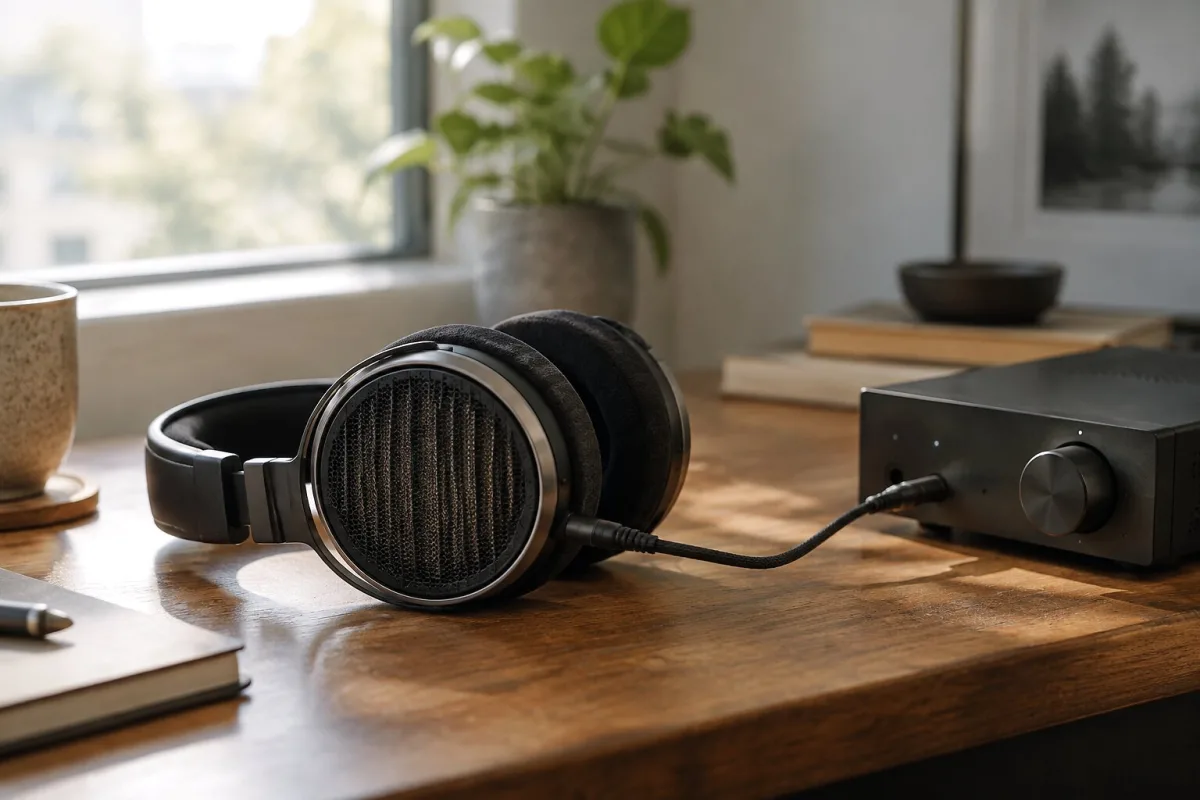
The word audiophile has been doing poor service to the thing it describes. It has come to suggest expense, and fussiness, and a certain kind of person with a spreadsheet. What it ought to suggest is rather simpler: a pair of headphones designed to reproduce a recording faithfully, rather than to flatter it.
That distinction is the whole subject, and it is worth understanding properly before spending anything at all.
What separates audiophile headphones from ordinary ones
An ordinary consumer headphone is voiced. Somebody has decided that the bass should be lifted, the upper treble brightened, and the result made immediately impressive in a shop. It is a perfectly reasonable commercial decision, and it works.
Audiophile headphones aim instead at neutrality: the intention is that what leaves the recording arrives at your ear with as little added as possible. The consequence is that a great recording sounds extraordinary and a poor one sounds poor, which is not always a comfortable trade.
The second difference is mechanical. Audiophile headphones tend to be built to be kept: better materials, tighter manufacturing tolerances, replaceable earpads and cables, and a design life measured in decades rather than seasons.
Open or closed, and why it decides everything else
Every pair of audiophile headphones is one or the other, and this first choice governs more than any other specification.
Open-back designs leave the rear of the driver open to the air. Sound moves freely in both directions, which produces the wider, more natural presentation that most listeners associate with the term. They isolate nothing at all: you will hear the room, and the room will hear you.
Closed-back designs seal the chamber behind the driver. That typically gives 15 to 25 dB of passive isolation and a firmer sub-bass, at the cost of a narrower sense of space and rather more heat against the ears over a long listen.
There is no superior answer, only a correct one for your circumstances. In a quiet room alone, open. On a train, or in a house where somebody else is trying to sleep, closed. Buying an open-back pair for a commute is the most common and most expensive mistake in this whole field.
Dynamic and planar magnetic drivers
Two driver technologies dominate audiophile headphones, and they behave quite differently.
A dynamic driver works like a miniature loudspeaker: a voice coil attached to a cone-shaped diaphragm moves air. It is efficient, it handles low frequencies with real physical impact, and it will run happily from almost anything.
A planar magnetic driver replaces the cone with a thin, flat membrane suspended in a magnetic field, driven evenly across its whole surface rather than pushed from the centre. In practice that tends to mean lower distortion, finer detail and notably better control in the bass.
The cost is efficiency. Planar designs commonly sit around 90 to 95 dB per milliwatt, which is meaningfully less sensitive than a typical dynamic headphone, and they ask for more power to do their work.
The two numbers that actually matter
Specification sheets are long. On audiophile headphones, two entries decide whether you will need to buy anything else.
- Impedance, in ohms — the electrical resistance the headphone presents to whatever is driving it.
- Sensitivity, in decibels per milliwatt — how much sound you get for a given amount of power.
The working rule is straightforward: above roughly 150 ohms of impedance, or below about 100 dB/mW of sensitivity, a headphone benefits significantly from dedicated amplification. Below those thresholds, a phone or laptop will generally do.
This is not audiophile mysticism. An underpowered headphone does not merely play quietly; it loses composure in the bass and flattens the sense of space, which are precisely the qualities one bought it for.
What an amplifier and a DAC actually do
Two separate jobs, frequently confused.
A digital-to-analogue converter turns the file into a voltage. Every phone and computer already contains one, and modern ones are generally competent.
An amplifier supplies the current to move the driver properly. This is the part that a demanding headphone genuinely needs, and the reason a fine pair can sound disappointingly limp straight from a laptop socket.
If a budget must be divided, the amplifier is usually the more consequential half.
Where the money stops helping
Improvement in this field is real but sharply diminishing. The distance between an ordinary headphone and a competent pair of audiophile headphones is large and obvious to anybody. The distance between a good pair and an exceptional pair is small, and hearing it reliably requires a quiet room, a decent recording and some patience.
A sensible order of spending, then:
- The headphones themselves, chosen open or closed to suit where you will actually listen.
- Amplification, but only if the impedance or sensitivity figures call for it.
- Better recordings — which improve every listen you will ever have, and cost less than cable.
- A quieter room, which is free and does more than most purchases.
A closing thought
The purpose of audiophile headphones is not to sound impressive. It is to get out of the way, so that what you hear is the performance rather than the equipment. Judged by that standard, the right pair is the one you stop noticing within a minute of putting it on — and that pair is very often not the most expensive one in the shop.


Comments