
Subwoofer Adam Audio article
ADAM Audio Subwoofers: A Complete Guide
People buy a subwoofer expecting more bass, and more bass is the one thing it should not give them. What it should give them is information.
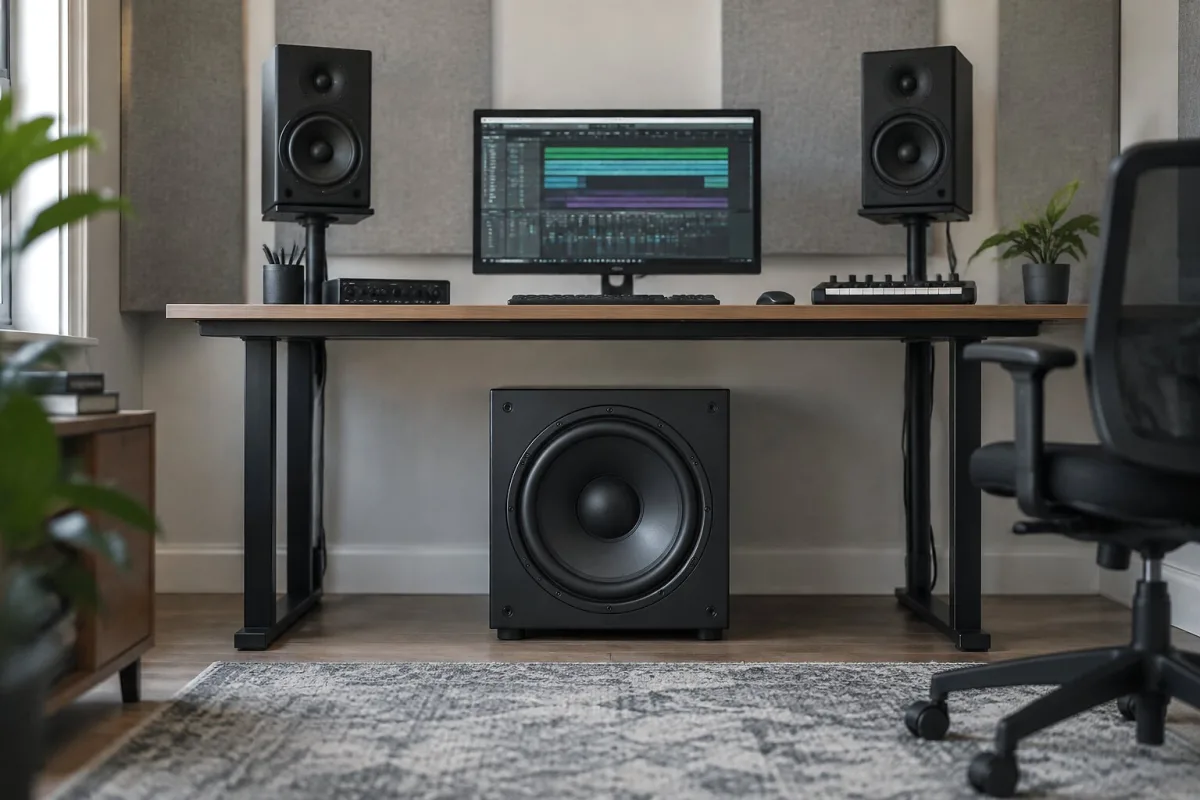
A subwoofer is the most misunderstood box in a small studio. People buy one expecting more bass, and more bass is the one thing it should not give them. What it should give them is information — the ability to hear what is happening below the point where their monitors quietly stop telling the truth.
Get that idea straight and the rest of the decision becomes much easier.
What a studio subwoofer is actually for
Every nearfield monitor has a point where its low-frequency response rolls away. On a five-inch monitor that might be somewhere around 50 Hz; on a smaller one, higher still. Below that point you are not hearing quiet bass. You are hearing nothing, and mixing blind.
This matters because the things hiding down there cause real damage: rumble from a badly sited microphone, a kick drum with far more sub energy than you intended, a synth bass whose fundamental is inaudible on your speakers and deafening in a car.
An ADAM Audio subwoofer, like any studio sub, exists to extend that window downwards so those things become audible decisions rather than unpleasant surprises.
The range, and how the models differ
Each ADAM Audio subwoofer is separated from the next mainly by driver size and how far down they reach, with the manufacturer's stated figures as follows.
| Model | Driver | Stated response | Suits |
|---|---|---|---|
| Sub8 | 8″ | 28–150 Hz | Nearfield systems in small rooms |
| Sub10 MK2 | 10″ | 25–150 Hz, 200 W RMS | Near and midfield |
| Sub12 | 12″ | Down to 22 Hz, 200 W RMS | Midfield systems, larger rooms |
ADAM state the Sub12 at −3 dB at 22 Hz and 115 dB SPL at one metre. The Sub7 was designed for smaller monitors such as the AX series and now sits among the company's archived products, so check current availability rather than assuming.
All of them offer balanced XLR and unbalanced RCA connections in and out, with controls for adapting to the room.
Bass management, which is the real feature
The connection that matters is not simply plugging an ADAM Audio subwoofer in alongside your monitors. It is routing your output through the subwoofer, which then sends the upper frequencies on to your monitors and keeps the low end for itself.
This is why the high-pass filter matters. The Sub8, for instance, applies a high-pass to the connected speakers at a stated 85 Hz, while its own upper limit adjusts between 50 and 150 Hz. The Sub10 MK2 offers crossover frequencies adjustable from 50 to 150 Hz.
Relieving your monitors of bass they were never going to reproduce does two useful things: it lets their drivers work in a range they handle well, and it usually cleans up the midrange noticeably. The improvement people credit to “more bass” is frequently this instead.
Setting it up without wrecking your room
A badly placed ADAM Audio subwoofer is worse than none at all, because it replaces an honest gap with a confident lie.
- Choose the crossover to meet your monitors. Find where they roll off and set the sub to hand over near there. Too high and the sub becomes locatable; too low and you leave a hole.
- Find the position by ear. The old trick still works: put the sub where you sit, crawl the room playing a bass-heavy track, and listen for where it sounds most even. Put it there.
- Check the phase control. If the sub and monitors disagree at the crossover they cancel, and you get less bass than before. Flip it and keep whichever sounds fuller.
- Set the level far lower than feels right. A correctly balanced sub is almost unnoticeable until you switch it off.
- Check your work elsewhere. Car, phone, earbuds. That is what tells you the sub is helping rather than flattering.
Do you actually need one?
Honestly, not everybody does. If your room is small and untreated, a subwoofer will excite room modes that are already your biggest problem, and acoustic treatment would be the better purchase. If you work mainly with acoustic sources that live above 60 Hz, the gain is modest.
But if you produce electronic music, hip-hop, or anything where sub-bass is a compositional element rather than a by-product, working without one is guesswork. An ADAM Audio subwoofer paired sensibly with the monitors you already own is the difference between deciding what happens at 35 Hz and hoping.
The short version
Match the model to your room and monitors rather than to ambition: Sub8 for a small room and nearfields, Sub10 MK2 as the flexible middle, Sub12 where there is genuine space to fill. Use the bass management properly, place it carefully, set it quietly, and treat the room first if it needs it.
Do all that and the subwoofer disappears into the system, which is exactly what you are paying for. The best compliment you can pay one is to forget it is switched on.


Comments