
Guitar Microphone Amplifier article
The Complete Guide to Guitar Microphone Amplifier
A guitar microphone amplifier keeps your acoustic's natural tone intact without the cable and colour-shift of a pickup. Here's how to set one up properly — placement, microphone choice, feedback prevention, and the honest pros and cons.
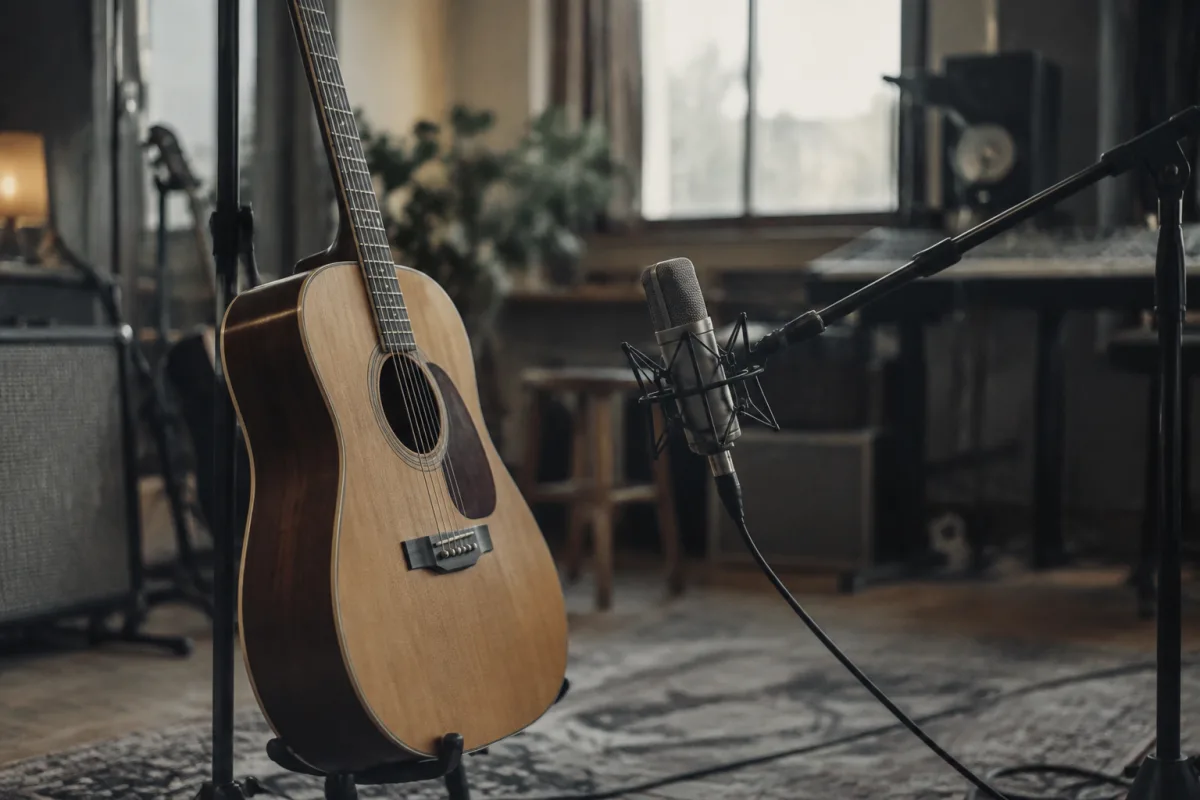
A guitar microphone amplifier system solves a real problem: you've got an acoustic guitar and you need to be heard in a room, at a gig, or in a recording studio. You could use a pickup, but pickups change the tone and need a cable. This approach keeps the natural acoustic sound intact — it's the same guitar, amplified. Done right, nobody listening would know it's miked. Done poorly, you'll get feedback, a nasal tone, or both.
How These Systems Work
Here's the simple bit: a condenser microphone (usually small-diaphragm, mounted near the 12th fret) picks up the guitar's natural acoustic sound and sends it to an amplifier through a cable. The amplifier can be a dedicated instrument combo (like a bass amp or acoustic amp) or a powered PA system. You play; the room hears you at proper volume.
This setup preserves what makes your instrument yours: its resonance, its touch response, its colour. Unlike a pickup system, which magnetically translates string vibrations into an electrical signal, a microphone captures the actual air vibrations. It's sonic authenticity without the connectors and cable runs.
The catch is feedback. If the amplified sound from the speakers reaches the microphone before you've got the levels dialled in, you'll get howling, squealing feedback. That's not a flaw in the concept — it's physics — but it does demand discipline with levels and microphone placement.
Microphone Placement and Technique
Placement makes this system work properly. The golden rule is roughly 12 inches away, pointed at the guitar's body around the 12th fret. This captures the guitar's full voice — the low-end resonance of the body combined with the articulation of the strings.
Distance matters enormously. Too close and you pick up finger noise, pick scrape, and uneven tone. Too far and you get room noise, reflections, and less direct signal. Twelve inches is the sweet spot for most acoustic guitars, though trial and error is your friend — every guitar is different.
Angle also affects the tone. Pointing the microphone directly at the guitar emphasises the strings' attack. Angling it slightly off-axis smooths the tone and reduces pick noise. For fingerstyle playing where sustain matters, a slight angle often sounds better. For a folk-pop player who wants clarity and attack, more direct works.
Microphone Choice for Acoustic Guitar
Small-diaphragm condensers (Shure SM81, Audio-Technica AT25D) are the standard here. They have a presence peak in the 2–4kHz range, which helps the guitar sit forward in the mix and remain intelligible at any volume. They're rugged, reliable, and they work in a band setting where a guitar microphone needs to compete with drums and bass.
Large-diaphragm condensers (Neumann U87, Audio-Technica AT4040) are warmer and smoother — lovely for fingerstyle or classical guitar in a studio or quiet venue. They need more careful gain staging and are more vulnerable to feedback in a loud environment.
Dynamic microphones are not ideal for this type of rig. They're less sensitive and demand more gain, which means more feedback risk. They're fine for live PA where the microphone is metres away and feedback isn't an issue, but for close-miking a guitar, a condenser is the right tool.
The Amplifier Side
You need something to amplify the signal. An acoustic guitar amplifier (Fishman Loudbox, Bose S1 Pro, Roland Street Cube) is the obvious choice — these are designed for this exact job, with feedback suppression built in and optimised EQ curves for acoustic instruments.
A powered PA system works too if you've got one. Any combo amp (bass, keyboard) that takes a microphone input will work. You're not fussy about the sound — you just need clean amplification and enough volume to fill the space.
Your amplifier should have a proper mic input (XLR is professional standard), independent volume control, and ideally a presence or high-mid EQ to shape the guitar's tone in the room. Avoid anything with cheap onboard speaker sets — you need clarity, not hype.
Feedback: Prevention and Control
Feedback happens when amplified sound reaches the microphone, gets re-amplified, and creates a loop. It's the enemy of this setup, and it's entirely preventable with discipline.
Prevention first: position the microphone in front of the speaker system's axis. If the amp is pointing at the audience, angle the microphone so that any sound bouncing back misses it. Use the minimum gain necessary — more gain equals more feedback risk. Keep the guitar between the microphone and the speaker.
If you get feedback, don't panic: turn down the amp volume immediately. Then either move the microphone or the amp, or turn down the input gain slightly. A feedback suppressor (a graphic EQ or a dedicated feedback suppression unit) can help kill the specific frequency, but prevention is always better than cure.
Cable Runs and Practical Setup
A guitar microphone amplifier setup requires good cables. Microphone cables are balanced XLR connectors — they're the same cables used in live sound systems everywhere. Buy decent ones (Canare, Neutrik connectors) because cheap cables pick up interference and eventually fail.
Cable length matters. Keep the microphone cable under 10 metres if you can. Longer runs need an active preamp or an in-line amplifier to maintain the signal. For most gigs, 5–8 metres is sensible — close enough to keep signal strength, far enough to let you move around the stage.
A small mixer or preamp between the microphone and the amplifier gives you more control over levels and lets you add effects if you want. It's not essential for a basic setup, but it's useful if you're recording or playing with other musicians.
Recording vs. Live Performance
In a recording studio, a guitar microphone amplifier setup is different. You can place the microphone closer, dial in lower levels, and use a microphone preamp into an audio interface. The goal is accuracy and capturing the guitar's true tone — no feedback risk because the room is quiet.
Live, you're working with a band and ambient noise. The microphone has to be far enough from the amp to avoid feedback and robust enough to handle bumps and temperature changes. An acoustic amp with a mic input is your simplest, most reliable solution.
Advantages and Trade-offs
A guitar microphone amplifier preserves your guitar's tone in a way that pickups can't match. Every acoustic guitar is unique — its resonance, its sustain, its warmth — and a microphone captures all of that.
The trade-off: cables, setup time, and feedback risk. It's not as simple as plugging in an electric guitar amp. It demands care, placement discipline, and level management. If you're playing electric guitar, you've got built-in pickups — no need for any of this. For acoustic, it's a genuine choice: pickup or microphone.
Making the Choice
Choose a guitar microphone amplifier system if you're serious about your acoustic tone and don't mind the extra setup. Choose a pickup if you're gigging weekly and want simplicity. For studio recording, miking is almost universal — you'll want at least a decent small-diaphragm condenser and a proper preamp. For a one-off gig, a Bose S1 Pro and an SM81 is portable, reliable, and sounds good.
The honest version: there's no perfect answer. A microphone rig is the best-sounding solution for an acoustic guitar that matters to you. A pickup is simpler and more bulletproof. Pick based on what you care about more: tone or convenience.



Comments