


Hardware EQ Buying guide
Hardware Eq: A Complete Buyer's Guide
Buying hardware EQ? Understand the types, essential specs, price tiers, and how to avoid common mistakes. Find the hardware EQ that fits your workflow and budget.
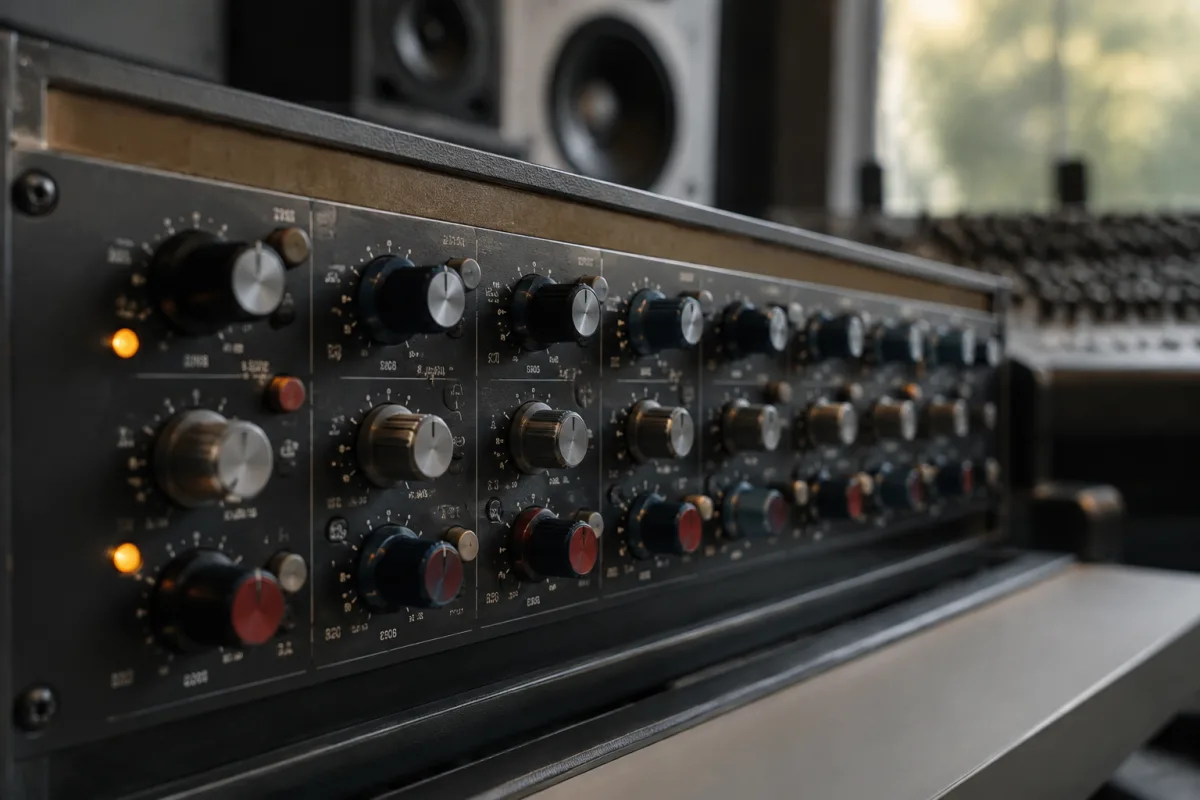
Hardware EQ adds character, precision, and a tactile workflow to your studio. But the options are overwhelming: parametric, shelving, graphic, valve, transformers, Class A, stereo, mono—each type sounds different and costs differently. If you're ready to invest in hardware EQ, this guide cuts through the jargon and helps you choose the right unit for your needs, budget, and workflow.
Types of Hardware EQ: What You Need to Know
Hardware EQ falls into several categories, each with a different job:
- Parametric EQ: The most flexible. Adjust centre frequency, gain, and bandwidth (Q) on each band. Parametric hardware EQ is ideal for surgical fixes and creative shaping. Most recording engineers prefer parametric for versatility.
- Shelving EQ: Boosts or cuts everything above or below a set frequency. Great for broad tonal adjustments (brightening highs, adding warmth to lows). Often paired with parametric bands in mid-range units.
- Graphic EQ: Preset frequency bands (usually 10–31 bands) with fixed Q settings. Graphic hardware EQ excels at shaping room tone and correcting obvious peaks. Less precision than parametric; more visual and immediate.
- Rotary/Variable Inductor EQ: Premium vintage design with a signature smooth, musical sound. Highly sought-after but expensive. Use if you want colour and prestige; avoid if you need precision.
- Valve/Tube EQ: Adds harmonic warmth and compression alongside EQ. Expensive but prized for tracking and bus EQ. Ideal if you want transparent correction plus subtle enhancement.
Key Specs When Buying Hardware EQ
Don't get lost in marketing—these specs matter:
- Number of bands and band type: More bands = more control, but complexity increases. For a first hardware EQ, three parametric bands (low, mid, high) is enough. Advanced users may want four or five bands.
- Frequency range: Check that your hardware EQ covers 20 Hz–20 kHz (human hearing range). Budget units may start at 50 Hz or higher, limiting bass control.
- Bandwidth (Q) range: Wider Q settings are gentler; narrow Q is surgical. Ideally, your hardware EQ offers both. Look for a range from 0.3 to 10 Q or wider.
- Gain per band: Most offer ±12 dB per band, enough for most jobs. Occasionally you'll want more; ±15 dB or ±18 dB adds flexibility.
- Frequency resolution: Parametric hardware EQ with stepped or continuous tuning? Continuous is more precise but also pricier. Stepped tuning is fine if the step size is small (1 Hz or less).
- Input/output impedance: This affects how the unit interacts with your mic pres and compressors. Look for balanced XLR connections and impedance specs around 600 ohms (industry standard).
- Noise floor: Lower is better. Budget hardware EQ can introduce hiss. Reputable manufacturers publish noise specs; units under 70 dB are excellent.
- Metering options: LED or VU meters let you see gain changes at a glance. Not essential, but helpful for consistent tracking.
Form Factor: Rack, 500-Series, or Desktop
Hardware EQ comes in three formats:
- 1U rack-mount: Standard studio format. Takes up minimal space, integrates into any signal chain. Most common and most affordable.
- 500-Series slots: Compact modular format for portable rigs and compact studios. Smaller and pricier per unit; ideal for small setups or travelling.
- Desktop/standalone: Rare for EQ; more common in other studio gear. Takes desk space but offers easy access during recording.
For most home and project studios, rack-mount hardware EQ is the sweet spot: plenty of choice, reasonable pricing, and standard integration.
Price Tiers and What You Get
- Budget (£200–600): Entry-level parametric hardware EQ, usually three bands. Solid sound, no-frills interface. Good for learning and basic tracking. Brands in this tier are often reliable but lack prestige.
- Mid-range (£600–2,000): Three–four parametric bands, better components, optional metering, sometimes a touch of valve colouration. This tier is where most professional studios invest. Performance and value are excellent.
- Premium (£2,000–5,000): Four–five bands, premium components, often valve or transformers, excellent metering, and desirable sonic character. These units are built to last and sound excellent on everything.
- Vintage/Prestige (£5,000+): Classic designs with a strong sonic signature, higher resale value, and collectability. Ideal if you have a specific vintage unit in mind; otherwise, a mid-range modern unit offers better value.
Common Mistakes When Buying Hardware EQ
Avoid these:
- Buying too cheap to save money: Budget hardware EQ often has noisy preamps or weak output stages. The "savings" evaporate when you discover it colours every sound negatively. Spend at least £400–500 for a unit you'll enjoy using.
- Chasing vintage prestige: A 1970s hardware EQ is lovely, but repair costs are high and availability is spotty. Modern builds of classic designs offer the same character with reliability you can depend on.
- Ignoring connectivity: Check that your hardware EQ has the right input/output connectors. If you need XLR and it only offers 1/4" TRS, you'll need adapters that may add noise.
- Assuming more bands = better: A five-band hardware EQ isn't inherently superior to three bands. More bands introduce complexity and can encourage over-processing. Choose what matches your workflow, not the higher number.
- Not considering power consumption: Some tube hardware EQ draws significant power and generates heat. Ensure your rack has adequate power and ventilation.
- Buying without auditioning: If possible, test the hardware EQ on material you know well. Each unit colours sound differently; hearing it in your own studio matters more than spec sheets.
- Neglecting maintenance needs: Tube hardware EQ requires periodic tube replacement and biasing. Factor in long-term maintenance costs and your willingness to service the unit.
Matching Hardware EQ to Your Needs
| Your Need | Best Hardware EQ Type | Typical Price Range |
|---|---|---|
| Surgical tracking/mixing | Parametric, 4+ bands | £800–2,500 |
| Colour and musicality | Tube or valve hardware EQ | £1,500–5,000+ |
| Learning and casual recording | Budget parametric, 3 bands | £300–700 |
| Portable/compact rigs | 500-Series module | £500–3,000 |
| Bus/master processing | Mastering-grade parametric or shelving | £1,000–3,000 |
New vs. Used: A Buying Decision
Used hardware EQ can be a bargain if you know what to look for. Vintage units (especially 1980s and earlier) are less reliable; newer used units (2000s onwards) are solid buys. Always test before buying used, check for noise and intermittent channels, and verify the seller's return policy.
New hardware EQ guarantees warranty and reliability, though the upfront cost is higher. First-time buyers often prefer new to avoid unknown problems.
Integration and Workflow Tips
Once you own hardware EQ, integrate it thoughtfully into your signal chain. Most engineers place hardware EQ after the microphone preamp (for tracking) or on master buses (for mix bus shaping). Avoid over-processing by using gentle, musical adjustments rather than aggressive cuts and boosts. Remember: EQ is correction first, colour second.
For detailed technical knowledge about how different EQ topologies work, their sonic characteristics, and advanced mixing techniques, explore our complete hardware EQ guide.
Bottom Line
A good hardware EQ transforms tracking and mixing. Choose parametric hardware EQ for flexibility, consider tube options for colour, and budget £600–2,000 for a unit you'll use for years. Test before buying if possible, avoid ultra-cheap units and over-complex designs, and match your choice to your actual workflow. The right hardware EQ becomes an extension of your creative vision.


Comments