


And Tape Recorder article
Tape Recorders in Music: Reel-to-Reel and Cassette Explained
A faint breath of hiss, half a second of room, a machine being persuaded into motion. For a long time that sound was simply what recorded music was made of.
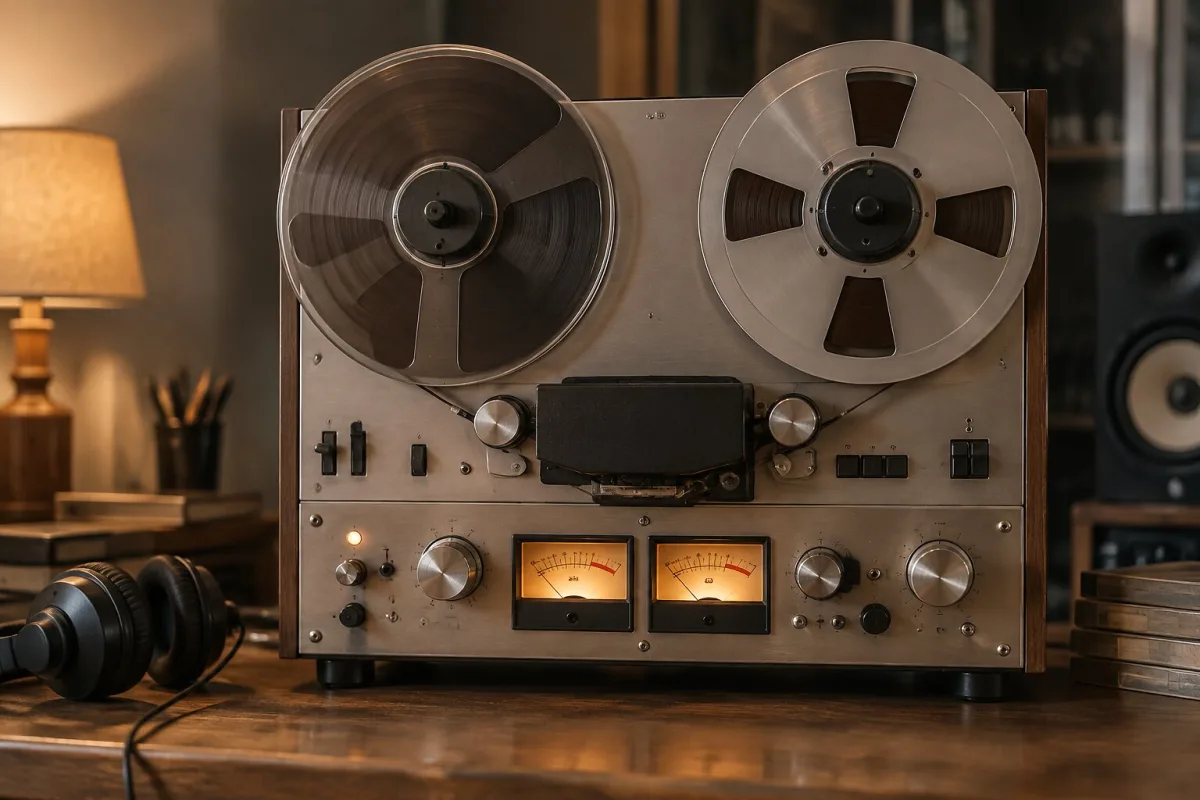
There is a particular sound at the start of some records — a faint breath of hiss, a half-second of room, the sense of a machine being persuaded into motion — and for a long time that sound was simply what recorded music was made of. It came from tape, spooling past a magnetic head at a steady speed, holding an impression of a moment until somebody chose to play it back.
We have not needed tape for decades. Yet the tape recorder refuses to settle quietly into a museum case, and the reasons why are worth sitting with.
How a tape recorder actually works
A length of plastic ribbon is coated with magnetic particles. It is drawn past a record head, which arranges those particles into a pattern matching the electrical signal coming in. Later — a fraction of a second later, or forty years — the same ribbon passes a playback head, which reads the pattern back out as a signal again.
Speed matters enormously. The faster the tape travels, the more physical ribbon is used to store each second of sound, and the better the result. That is why professional machines ran tape quickly and wastefully, and why a cassette running slowly was always fighting uphill.
Two families of tape recorder
Reel-to-reel came first: open spools, wide tape, the machine that furnished every professional studio for a generation. Tape width and speed were both generous, so quality was high, and the medium could be physically cut and joined with a razor blade. Editing was a manual craft performed on the ribbon itself.
Cassette arrived as a convenience format: tape narrow enough and slow enough to fit in a pocket, enclosed in a shell so nobody had to thread anything. It was never meant to rival the studio. It simply turned out that convenience mattered more than specification to almost everybody.
The machine that changed who gets to make records
In September 1979, at the Audio Engineering Society's meeting in New York, TEAC unveiled the 144 Portastudio: the world's first four-track multitrack recorder built around an ordinary compact cassette.
Before it, multitracking meant a professional studio and a large reel-to-reel tape recorder. The 144 put four tracks, overdubbing, equalisation and ping-pong bouncing into a single portable box weighing under nine kilograms, at eight hundred and ninety-nine US dollars. It ran the cassette at 95.25 mm per second — double the normal speed — buying back some of the quality the format gave away.
What followed was not a technical revolution so much as a social one. A songwriter in a bedroom could now build an arrangement alone, at night, without booking anything or asking anyone. Bruce Springsteen recorded Nebraska at home on a 144 in 1982, and released it largely as it was.
Every home studio since descends from that box.
Why anyone still uses tape
Not nostalgia, or not only. A tape recorder does specific, audible things to sound that are difficult to argue with.
- Saturation. Push the level and tape does not clip harshly. It compresses, rounds and thickens, and the effect flatters drums and voices particularly.
- High-frequency softening. Tape gently loses the very top, which takes the edge off digital brightness.
- Wow and flutter. Minute speed variations detune things fractionally, which the ear reads as warmth.
- Commitment. Tape has a fixed number of tracks and no undo. You decide, and then you live with the decision, and a great many musicians find they work better that way.
That last one is the reason most often given by people who have gone back, and it is the only one no plugin can supply.
If you want to try it
- Buy serviced, not cheap. Belts perish, heads wear and capstans seize. A working tape recorder costs a good deal more than a broken one, and for sound reasons.
- Check the heads. Look for visible grooving. Worn heads dull the sound and cannot simply be cleaned back to life.
- Factor in tape. New stock is made again but it is not cheap, and old tape can shed its coating.
- Find your technician first. Ask who services these machines near you before you buy one, not afterwards.
- Be honest about why. If you want the sound, a good emulation costs a fraction and needs nothing. If you want the working method, only the machine will do.
A note on the word
Ask for a recorder in a music shop and you may be handed a woodwind instrument rather than a tape recorder, because English gave the same name to a Renaissance flute and to a magnetic tape machine. Both record something, in their way. Only one of them needs its heads cleaning.
What it leaves behind
The tape recorder's real legacy is not its sound, pleasant as that is. It is the idea that a person could capture a performance without permission from an institution. That idea outlived the format completely, and every phone recording a rehearsal tonight is still working from it.





Comments