
Digital Upright Piano article
The Complete Guide to Digital Upright Piano
A digital upright piano brings the elegance and playability of an acoustic upright into the modern era, offering weighted keys, authentic sound and silent practice with headphones—all without constant tuning.
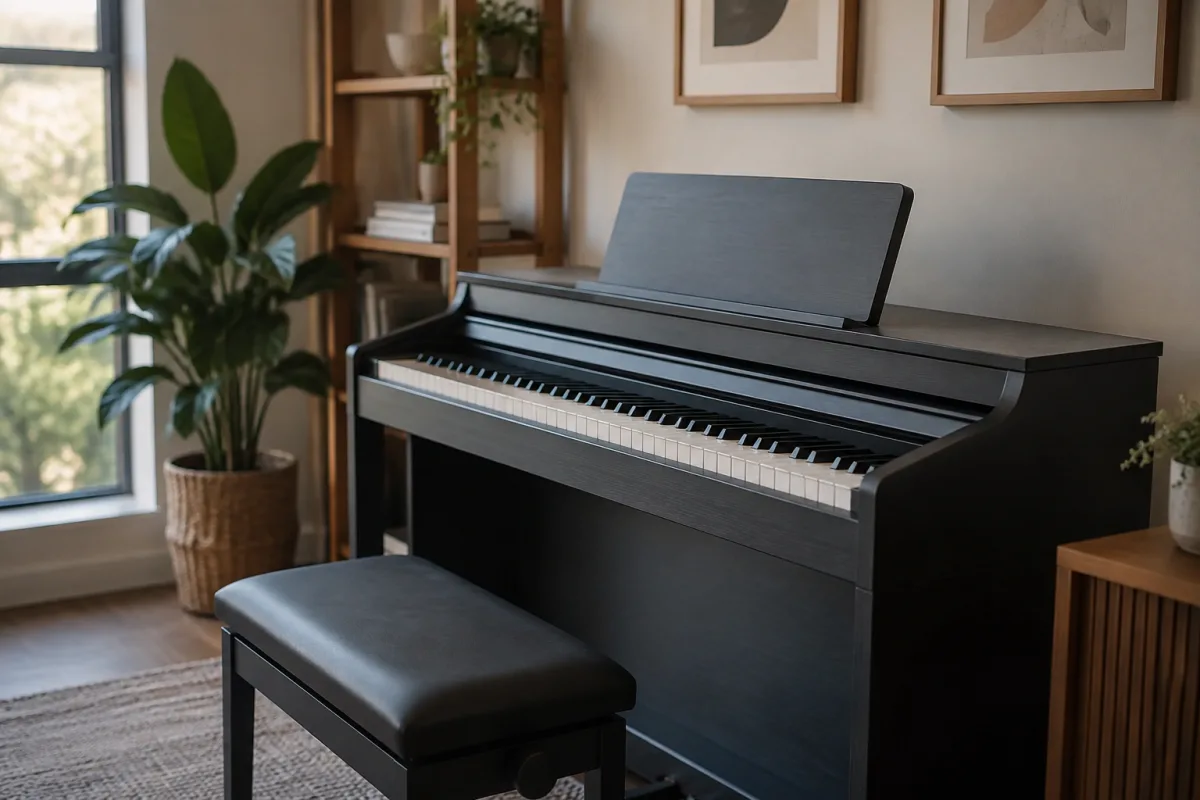
A digital upright piano brings the timeless elegance and playability of an acoustic upright into the 21st century, offering musicians a space-efficient alternative without sacrificing touch or sound quality. Whether you're a serious student, a professional performer, or someone rediscovering piano after decades away, a digital upright piano can deliver the weighted action and authentic tones that matter, combined with modern convenience: headphone capability, MIDI connectivity, volume control, and a footprint that fits any home. This guide explores what makes digital upright pianos special, how they differ from their acoustic cousins, and what to look for when choosing one.
What Is a Digital Upright Piano?
A digital upright piano is an electronic keyboard housed in a cabinet designed to resemble a traditional upright acoustic piano. The key difference is internal: instead of strings and hammers, it uses sampled or modelled piano sounds stored in memory and played through built-in speakers. Most modern digital upright pianos feature weighted or semi-weighted keys that simulate the resistance and "feel" of an acoustic action, making them suitable for classical technique and classical repertoire.
The digital upright piano format bridges the gap between portable digital keyboards and full acoustic uprights. It maintains the upright profile that fits naturally into living rooms, studios, and practice spaces, whilst offering the flexibility that purely acoustic instruments cannot deliver.
Key Advantages of a Digital Upright Piano
Digital upright pianos offer several compelling reasons to consider one over an acoustic instrument:
- Silent practice: Headphone output lets you play without disturbing housemates or neighbours, an invaluable feature for late-night or early-morning practice.
- Consistent sound: No seasonal tuning required. A digital upright piano holds its tone indefinitely.
- Compact footprint: Most digital upright pianos occupy roughly the same floor space as an acoustic upright but require no depth allowance for soundboard expansion or regulation work.
- Portability: Unlike acoustic uprights, which demand professional movers, many digital upright pianos can be relocated with reasonable care.
- Built-in effects and sounds: Reverb, transpose, tempo adjustment, and access to electric piano, harpsichord, organ and other voices enrich your musical palette without extra hardware.
- MIDI connectivity: Connect to music software, recording equipment and other digital instruments for composition and production.
- Lower maintenance: No hammers to regulate, no strings to replace, no action to service.
- Cost: Generally lower upfront investment than a quality acoustic upright, with zero ongoing maintenance expense.
How Digital Upright Piano Sound Is Generated
Modern digital upright pianos use one of two main sound-generation technologies:
Sampling — the instrument plays back high-quality audio recordings of an acoustic piano, captured across the full keyboard and at different volumes. When you strike a key, the appropriate sample plays at the volume corresponding to how hard you struck it. This approach is immediate, transparent and widely used in entry- to mid-range instruments.
Physical Modelling — the piano's processor calculates the behaviour of strings, hammers, dampers and the soundboard in real time, synthesising the sound from first principles. This approach adapts dynamically to your playing and can produce richer, more responsive results, but requires more processing power and is typically reserved for premium models.
Both technologies have matured considerably. A decent digital upright piano now captures the subtlety of pedal resonance, the slight variations in tone as you play up and down the keyboard, and the complexity of hammer release and key repetition that serious players rely upon.
Action and Touch: The Feel of the Keys
The action is where digital upright pianos most noticeably diverge from one another—and where they can either impress or disappoint serious pianists. An acoustic upright's action is mechanical: hammers strike strings and rebound, and the felt and springs introduce friction that pianists instinctively understand. A digital upright piano must simulate this behaviour via its key mechanism.
Quality digital upright pianos employ weighted keys—each key contains a small weight that gives resistance similar to an acoustic action. Premium models add escapement, a mechanism that lets a hammer "reset" even when the key is still held down, enabling rapid repetition of the same note—something pianists training for classical repertoire need to master.
When shopping for a digital upright piano, play one for at least 10 minutes. Does the action feel stiff, hollow, or alien? Or does it respond naturally to your technique, allowing dynamics and expression without fighting you? Touch preference is personal; some pianists prefer a slightly lighter action, whilst others demand the full resistance of an acoustic piano.
Sound Quality and Speaker Systems
A digital upright piano's built-in speakers have an outsized impact on its appeal. Entry-level models may sound thin or boxy; premium instruments invest in multi-speaker arrays, larger cabinets and more power to project piano tone convincingly into the room.
Consider where you'll play. In a living room, a digital upright piano's built-in speakers are usually sufficient for casual playing and listening. For teaching, performance or recording, you may prefer to connect the instrument to external amplification or a mixing console, bypassing the built-in speakers entirely. That flexibility is one of the digital upright piano's greatest strengths.
Connectivity and Features
Modern digital upright pianos typically include:
- MIDI in/out: Connect to DAWs (Digital Audio Workstations), notation software or other MIDI instruments.
- USB audio: Record your playing directly into a computer.
- Bluetooth audio: Play backing tracks from your phone or tablet wirelessly.
- Dual headphone jacks: Useful for teaching or private listening.
- Metronome and built-in effects: Reverb, chorus, and other processing to colour your sound.
- Voice selection: Switch between piano, electric piano, harpsichord, organ and more.
- Transpose and octave shift: Play in any key without re-fingering, or shift octaves for extended range.
Not every digital upright piano offers all of these—check the specifications of models you're considering, as higher-end features justify a premium price and matter most if you're planning to use them.
Choosing the Right Digital Upright Piano
Three main factors distinguish entry-level, mid-range and premium digital upright pianos:
| Feature | Entry-Level | Mid-Range | Premium |
|---|---|---|---|
| Action type | Light or semi-weighted keys | Weighted keys with escapement | Graded hammer action with escapement |
| Key count | 61–76 keys | 88 keys | 88 keys |
| Sound generation | Sampling (basic) | Sampling (high-quality) | Physical modelling or premium sampling |
| Speaker system | Small, single speaker | Dual speakers | Multi-speaker array, larger cabinet |
| Connectivity | Headphones, basic MIDI | MIDI, USB, possibly Bluetooth | Full suite of modern connections |
| Price range (GBP) | £500–£1,500 | £1,500–£4,000 | £4,000+ |
Your choice should reflect your actual needs. A beginner relearning piano may be perfectly happy with an entry-level model. A serious student working toward exams or a professional performer should invest in mid-range or premium, where the touch and sound quality justify the cost.
Conclusion: Is a Digital Upright Piano Right for You?
The digital upright piano is an intelligent choice for anyone who values a space-efficient, low-maintenance instrument with acoustic piano playability. If you live in a flat where noise is a concern, need silent practice with headphones, or want the convenience of electronics combined with the familiar upright profile, a quality digital upright piano delivers all of that without breaking the bank. The best models rival acoustic uprights in touch and tone, and exceed them in flexibility.
Take time to play a few models from different manufacturers. Let your fingers speak for themselves—good digital upright pianos are built to feel intuitive, and you'll quickly sense which one suits your technique and taste.
Frequently Asked Questions
Q: Do digital upright pianos require tuning?
A: No. The sound is generated electronically, so tuning is unnecessary. The instrument holds its tone indefinitely and needs only occasional cleaning and, very rarely, firmware updates.
Q: Can a digital upright piano be used for classical study and exams?
A: Yes, provided it has 88 weighted keys with escapement. Check the exam board's rules (e.g. ABRSM or Trinity), as some specify acoustic pianos, but many accept high-quality digital uprights for practice and performance.
Q: What is the warranty on a typical digital upright piano?
A: Most manufacturers offer 2–5 years' warranty on the instrument and 1–2 years on components like speakers. Read the fine print carefully before purchasing.
Q: Can I record with a digital upright piano?
A: Yes. Use the headphone output into a recorder, connect via USB to a computer, or use Bluetooth to send audio to a phone or tablet. MIDI connectivity lets you record performance data separately and render it with different sounds.
Q: How much space does a digital upright piano take up?
A: A typical digital upright piano measures roughly 150 cm tall, 150 cm wide and 40–50 cm deep—similar to an acoustic upright but often slightly more compact.
Q: Are used digital upright pianos a good buy?
A: Possibly. Older models (10+ years) may have smaller sound libraries or dated actions. Mid-range used instruments from the last 5 years can be excellent value; always inspect the action and keys carefully and, if possible, test it for at least 30 minutes before purchasing.


Comments