
Types of String Instruments article
The Complete Guide to Types Of String Instruments
String instruments form one of music's most diverse families, spanning delicate harps to thunderous double basses. Understanding the different types of string instruments—how they produce sound and what distinguishes them—opens remarkable musical possibilities.
Understanding Types of String Instruments
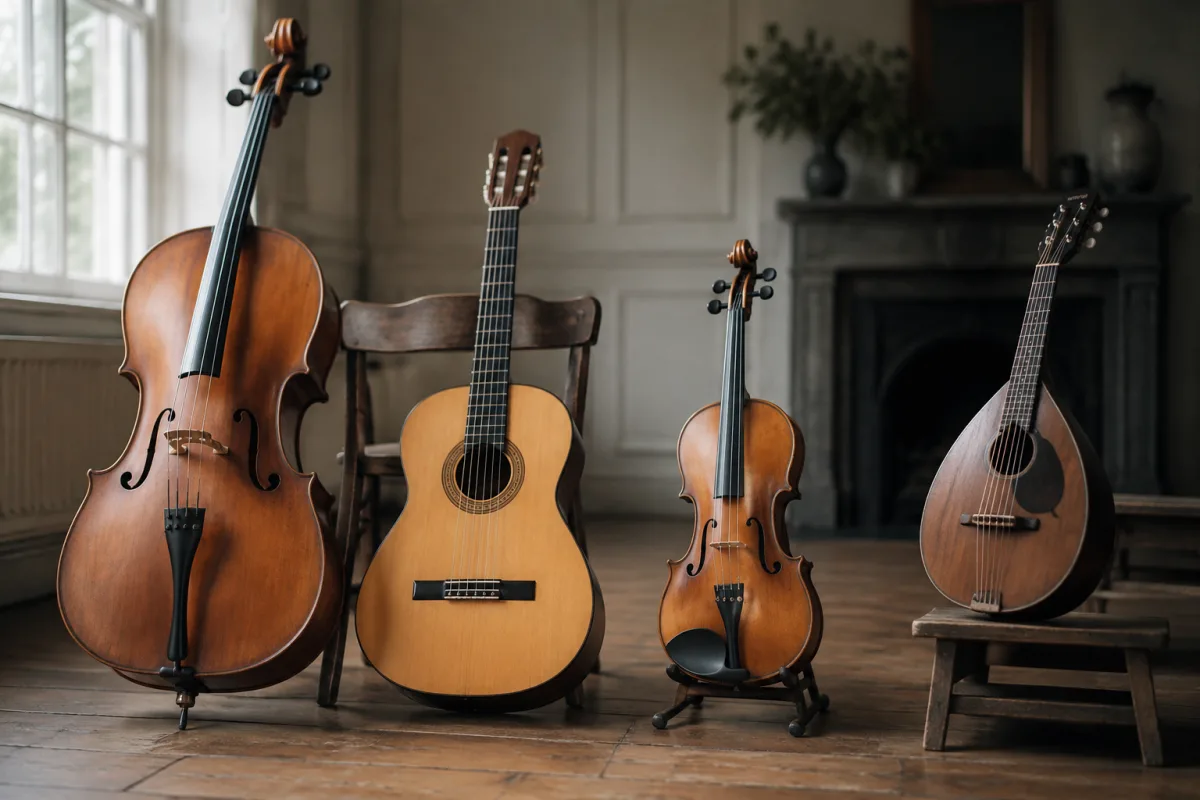
String instruments form one of music's most fundamental and diverse families, spanning everything from delicate acoustic guitars to thunderous double basses. Understanding how different types of string instruments work—and what distinguishes one from another—opens up a wealth of musical possibility. Whether you're exploring which instrument to learn or deepening your knowledge of orchestral and contemporary music, knowing what separates these different types is essential.
The Main Classification: How Strings Produce Sound
String instruments divide into distinct categories based on how sound is produced. Recognising these fundamental types helps you understand why different string instruments sound the way they do and what playing techniques suit each one.
The main classification includes:
- Plucked strings — fingers or a plectrum pull the string, creating vibration (guitars, harps, mandolins)
- Bowed strings — a bow draws across the string to sustain notes (violins, cellos, violas)
- Struck strings — hammers or mallets strike the strings (pianos, dulcimers, hammered dulcimers)
- Keyboard strings — keys trigger hammers or plectra (harpsichords, electronic keyboards)
Plucked String Instruments
Plucked string instruments create sound through manual vibration of the strings. This family includes some of music's most accessible and popular instruments. The plucked string approach produces a natural decay—sound that diminishes after the initial pluck—which gives these instruments their characteristic rhythmic quality.
Guitars are perhaps the most widely recognised plucked string instrument. Whether acoustic or electric, they dominate popular music across countless genres. The guitar's versatility—capable of single-note melodies, complex chords and everything in between—explains its ubiquitous presence from folk traditions to metal and contemporary classical.
Harps occupy a special place in the plucked string family, using perpendicular strings that produce ethereal, shimmering tones. Concert grand harps can contain 40 or more strings spanning several octaves. The harp's historical association with classical elegance persists today, though folk and lever harps offer more accessible entry points for new players.
Mandolins and bouzoukis represent the smaller plucked string end of the spectrum. These instruments employ doubled or tripled strings (courses) to create characteristic bright, bell-like tones. Mandolins originated in Italy and became central to bluegrass and folk traditions, whilst bouzoukis remain prominent in Greek and Eastern European music.
The ukulele—a Hawaiian plucked string instrument with typically four nylon strings—has experienced remarkable popularity growth in recent decades. Its small size, affordability and cheerful tone make it an excellent beginner instrument whilst remaining genuinely expressive in skilled hands.
Bowed String Instruments
Bowed string instruments create sustained notes through the continuous friction of a bow across strings. This continuous sound production capability distinguishes bowed instruments fundamentally from plucked or struck types. The bow's sophistication—pressure, speed, position and angle—gives classical and orchestral musicians extraordinary expressive control.
Violins sit at the heart of classical orchestral tradition. Their bright, soaring tone carries a four-string range spanning nearly four octaves. The violin's technical demands—precise intonation requiring frequent practice, complex bow techniques, reading treble clef—make it challenging but rewarding. Professional violins represent serious financial investment, though student-grade instruments offer accessible starting points.
Violas occupy the middle voice in string quartets, pitched lower than violins but higher than cellos. Viola tone blends warmth and depth with the brightness characteristic of bowed string instruments. The viola's slightly larger size requires adjusted technique compared to violin playing, and viola repertoire often emphasises tone quality over flashy virtuosity.
Cellos provide the foundation of string ensembles, their deep, warm voice capable of both lyrical melody and resonant bass notes. Cello size—physically much larger than violin or viola—means holding technique differs significantly. The cello's expressive range from delicate high registers to sonorous low notes makes it particularly beloved by many contemporary composers.
Double basses represent the string family's deepest voice, anchoring orchestral and jazz ensembles with powerful low frequencies. Their substantial size, complex thumb positioning technique and higher physical demands make them less frequently chosen as beginner instruments, though bass players occupy vital positions in musical ensembles.
Struck String Instruments
Struck string instruments produce sound through hammers or mallets striking strings directly. This mechanism creates percussive attack characteristics and immediate decay, distinguishing them from sustained bowed instruments or the resonant sustain of plucked strings.
Pianos represent the most sophisticated struck-string instrument, using hammers triggered by keys to strike strings with precisely controlled force. The modern piano's 88-key range, sustain and soft pedals, and enormous dynamic range have made it central to classical composition and contemporary music. Acoustic pianos require significant space and investment, though digital pianos offer portable, affordable alternatives.
Dulcimers—struck with mallets rather than plucked—produce warm, mellow tones characteristic of Appalachian and folk traditions. The 36-string+ configuration means dulcimers create rich, complex harmonics when strings are struck. Various dulcimer types exist across world cultures, each with unique construction and playing techniques.
Zithers represent a diverse family of struck string instruments from Central European and Asian traditions. The term encompasses instruments ranging from the simple to elaborate, all sharing the fundamental characteristic of strings stretched across a resonating body, struck with mallets or fingers.
Electronic and Amplified String Instruments
Modern music has introduced electronic string instruments that fundamentally alter how sound is produced and modified. Electric guitars use electromagnetic pickups to convert string vibration into electrical signals—enabling amplification, effects processing and entirely new sonic possibilities unavailable to acoustic instruments.
Electric bass guitars occupy crucial roles in virtually all contemporary musical genres. Their lower register and different playing technique compared to guitar distinguish them functionally and tonally. The electric bass's ability to carry rhythmic content and harmonic information simultaneously makes it foundational to modern music production.
Synthesizers with string simulation capabilities have democratised orchestral sound creation. Modern software and digital instruments convincingly reproduce string instrument characteristics, making full orchestral arrangements possible without acoustic instruments or musicians.
Regional and Specialized String Instruments
World music traditions employ countless specialised string instruments adapted to regional musical aesthetics and playing styles. The oud—an ancient Middle Eastern instrument with a distinctive pear-shaped body and deeply warm tone—influences contemporary world music and jazz fusion contexts.
The sitar, central to Indian classical traditions, employs sympathetic strings alongside played strings to create complex harmonic resonances. Its unique sound, intonation systems and playing techniques represent an entirely distinct approach to stringed instruments compared to Western traditions.
Koto—Japanese plucked string instrument with 13 strings—creates delicate, nuanced tones suitable for traditional and contemporary contexts. The three-fingered plucking technique, moveable bridges and pitch-bending capabilities give Japanese composers and performers sophisticated expressive tools.
Choosing Your String Instrument
Selecting which type of string instrument to pursue depends on several factors: available practice space, physical capabilities, musical goals and whether you prefer solo or ensemble playing. Plucked instruments generally demand less consistent practice initially, whilst bowed instruments reward dedicated technical study. Consider ensemble opportunities in your area—orchestral instruments fit more naturally into established ensembles than some plucked alternatives.
Conclusion
Types of string instruments encompass an astonishing diversity of sound-making approaches and aesthetic traditions. Whether through plucking, bowing or striking, string instruments have remained central to music across cultures and centuries. Understanding how different types of string instruments work helps you select your own musical path and appreciate the remarkable range of human musical expression that string instruments enable.



Comments