
Synthesizer Module article
The Complete Guide to Synthesizer Module
Synthesizer modules offer unlimited sound design possibilities. Explore module types, patch concepts, and how to assemble your own custom modular synthesizer system.
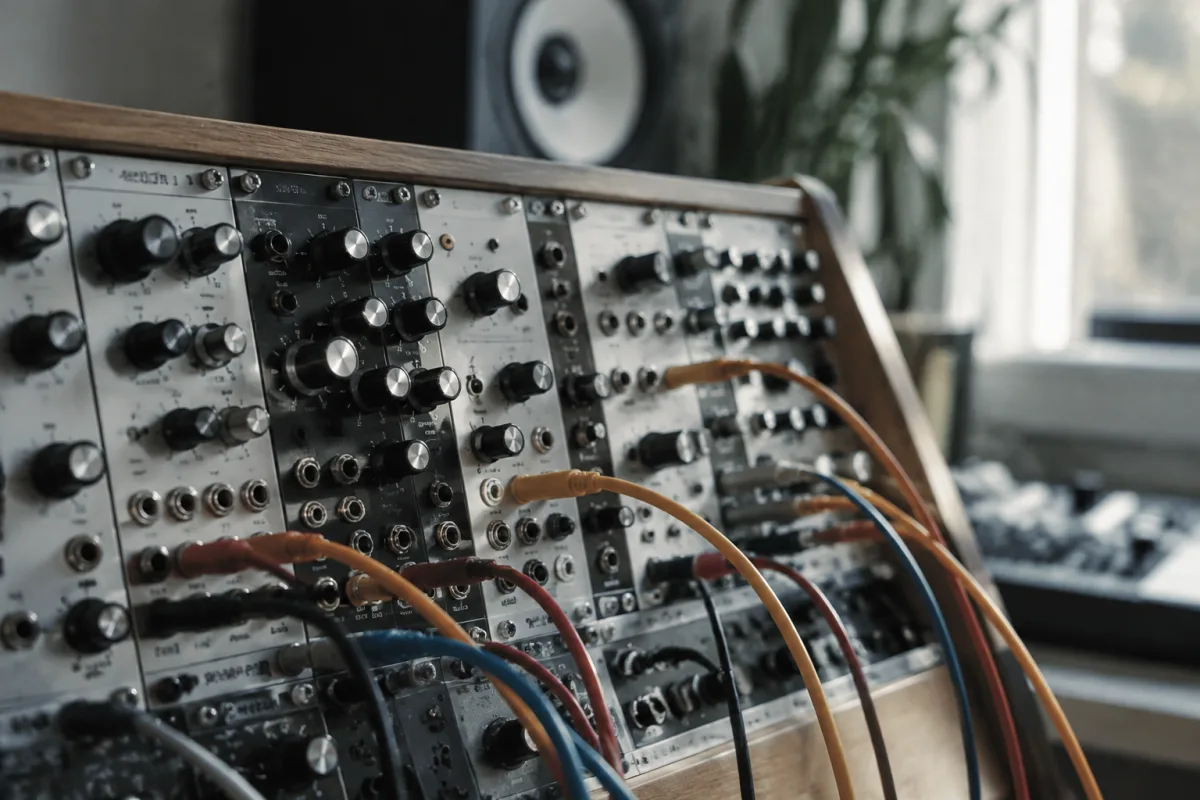
Synthesizer modules represent one of the most powerful and flexible tools available to electronic music producers and sound designers. Unlike fixed synthesizers, modules allow complete customisation—you design your synthesiser from the ground up by choosing individual sound-generation and processing components and patching them together according to your imagination. Whether you're assembling your first modular synthesiser, expanding an existing system, or simply exploring sound design, understanding synthesiser modules opens extraordinary creative possibilities.
What Is a Synthesiser Module?
A synthesiser module is a single sound-processing component designed to slot into a modular synthesiser framework. Unlike a complete synthesiser that bundles everything into one unit, modules are individual specialists: one generates oscillator waveforms, another shapes envelopes, a third filters frequencies. You patch modules together with patch cables, routing audio and control signals through your chosen signal path, essentially building a custom synthesiser tailored to your musical vision.
The modular approach offers extraordinary flexibility. A single module can be used in hundreds of different signal chains. The same oscillator module, in one patch, might generate melodic bass lines; in another, it might modulate filter frequencies to create evolving pads. This flexibility—combined with the satisfying tactile experience of patching cables—has made modular synthesisers endlessly appealing to electronic musicians for over five decades.
Core Synthesiser Module Types
Most modular synthesisers comprise several essential module categories, each serving specific functions:
- Oscillators — Generate basic waveforms (sine, sawtooth, square, triangle). Often include frequency modulation inputs for creating evolving, complex tones. Multiple oscillators can be mixed or modulated against each other.
- Envelope Generators — Create time-varying control signals shaped by attack, decay, sustain and release parameters. Used to modulate volume, filter frequency, oscillator pitch, or any other parameter over time.
- Filters — Remove or boost frequency ranges, fundamentally shaping tone character. Low-pass filters remove high frequencies (making tone duller); high-pass filters remove low frequencies; band-pass filters isolate specific frequency ranges. Modulating filter frequency creates sweeping, expressive sounds.
- Voltage-Controlled Amplifiers (VCAs) — Control audio level using a control voltage, typically modulated by an envelope generator. This creates dynamic shaping—sounds swelling in volume, fading out, or pulsing rhythmically.
- Low-Frequency Oscillators (LFOs) — Generate slow, repeating modulation signals (vibrato, tremolo, filter sweeps). Typically too slow to hear as pitch, LFOs are used to modulate nearly every other parameter.
- Sequencers and Step Sequencers — Generate repeating patterns of control voltages or trigger pulses, driving pitch sequences and timing throughout the synthesiser.
- Mixers — Combine multiple audio or control signals into a single output. Essential for layering sounds and combining modulation sources.
- Utility Modules — Attenuators (reduce signal strength), invertors (flip signal polarity), splitters (send one signal to multiple destinations). Often overlooked but extraordinarily useful.
Patch Cables and Signal Flow
Modular synthesis operates on the concept of "patching"—using coloured cables to route signals between modules. An audio-rate signal (the sound) might flow from an oscillator through a filter to a mixer to a VCA to the output. Control signals (envelopes, LFOs) simultaneously modulate other module parameters. The patch cables are the nervous system; they define how every module communicates with every other, creating the complete signal path.
A single module can simultaneously send and receive multiple signals. An oscillator might be pitch-modulated by an LFO, have its amplitude controlled by an envelope generator, have its waveform shape varied by another control signal, and itself modulate a filter frequency. This dense interconnection is what makes modular synthesis so expressive and why experienced sound designers can create extraordinarily complex tones.
Specifications and Considerations
| Consideration | Why It Matters |
|---|---|
| Rack Format | Modules come in Eurorack (smaller, most popular), 5U, and other formats. Eurorack is best for beginners and offers the widest module selection. Ensure all your modules match the same format. |
| Power Consumption | Each module draws power; your power supply must provide enough current. Undersizing power leads to noise and instability. Most quality power supplies specify available current in milliamps. |
| Frequency Response | Oscillators and filters define the frequency range of your system. Look for modules covering 20Hz–20kHz for full audio fidelity, or specialise intentionally in sub-bass or high-frequency ranges. |
| Control Inputs | More CV (control voltage) inputs on each module means more modulation possibilities. Modules with multiple inputs offer maximum flexibility. |
| Output Options | Separate main and auxiliary outputs allow parallel signal paths. Headphone outputs enable monitoring without additional gear. |
Building Your Modular System
Beginners should start small—a basic system might comprise an oscillator, a filter, an envelope generator, a VCA, a mixer, and a power supply. This minimal set teaches fundamental patch relationships and can create professional-quality sounds. Expand thoughtfully, adding modules addressing specific sonic needs rather than collecting modules indiscriminately.
Consider your musical direction. A bass-focused system might prioritise oscillators, filters, and sequencers. An ambient music system might emphasise envelopes, LFOs, and effects. A percussion-focused rig might focus on AD (attack/decay) envelopes and rhythmic sequencers. Your musical goals should drive module selection.
Budget is realistic. Entry-level modules start around £100; high-end designs exceed £500. Excellent modular systems have been built with £1000 budgets and £10,000 budgets. Start affordably, learn thoroughly, then expand deliberately.
Learning and Experimentation
Modular synthesis rewards experimentation. Patch cables are nondestructive; wrong connections simply produce unexpected sounds rather than damage. Spend time exploring what happens when you route signals in unconventional ways. Patch a sequencer's output into an oscillator's frequency input. Modulate a filter's resonance with an LFO. Layer three oscillators and experiment with detuning them slightly. Through play and exploration, your synthesiser module collection becomes an infinitely expressive instrument.
Conclusion
Synthesiser modules represent a commitment to deep sound design and hands-on creativity. Unlike preset-based synthesisers, modular systems demand active participation—you're constantly designing the signal path, choosing how signals interact, and creating sounds from fundamental principles. This demands more effort than pressing buttons on a fixed synthesiser, but the creative freedom and expressive potential are unmatched. Whether you're a curious electronic musician, an experimental sound designer, or a lifelong tweaker, synthesiser modules offer infinite creative playground.


Comments