
Jupiter 8 Synthesizer article
The Complete Guide to Jupiter 8 Synthesizer
Explore the legendary Jupiter-8 synthesizer—the 1981 Roland classic that defined polyphonic synthesis. Understand its history, sound characteristics and why it still matters today.
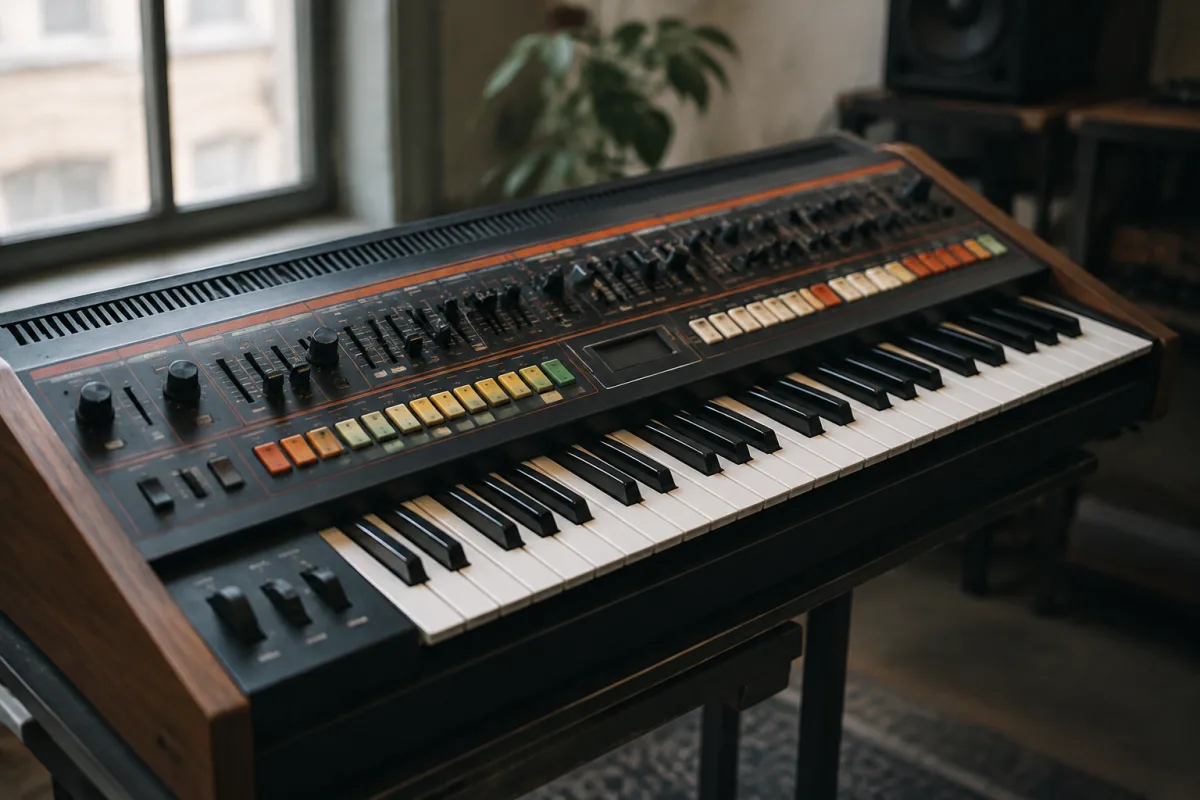
The Jupiter-8 Synthesizer: A Legend in Electronic Music
The Jupiter-8 is one of the most iconic synthesizers ever built. Released by Roland in 1981, this polyphonic powerhouse became a staple in professional studios and touring rigs, shaping the sound of 1980s and 1990s electronic music. Whether you're curious about classic synth design, interested in analogue synthesis, or hunting for one in the secondhand market, understanding the Jupiter-8 is essential music knowledge.
A Brief History of the Jupiter-8
Before the Jupiter-8, polyphonic synthesizers were rare and astronomically expensive. The Jupiter-8 changed that, offering eight-voice polyphonic playability at a price that, whilst still steep for most musicians, was achievable for serious professionals. This combination of capability and (relative) affordability made it instantly popular.
Artists including Giorgio Moroder, Tomita and Phil Oakey of The Human League embraced the Jupiter-8 immediately. It became associated with the analogue synthesizer sound of the 1980s—warm, fat and unmistakably musical. By the time it was discontinued in 1989, the Jupiter-8 had secured its place in music history.
Core Specifications and Architecture
The Jupiter-8 is built on solid Roland analogue synthesis architecture. It features eight voltage-controlled oscillators (VCOs), two filters, two envelope generators and a sample-and-hold section for evolving textures. The keyboard is velocity-sensitive, allowing expressive control over volume and filter cutoff.
The filter section is the heart of the Jupiter-8's sound. A pair of resonant voltage-controlled filters (VCFs) can be tuned individually or linked together for complex filtering. This dual-filter design enables lush, evolving pads and squelchy bass sounds that remain distinctive decades later.
Sound Characteristics
The Jupiter-8 is famous for its warm, full-bodied tone. The analogue circuits impart a slight saturation and harmonic richness that digital emulations struggle to replicate perfectly. Sawtooth and square waves from the VCOs can be freely mixed, allowing endless tonal variation. Add the modulation matrix—which lets you route the envelope generators and LFOs to various parameters—and the Jupiter-8 becomes a deeply expressive instrument.
Lead sounds are bright and cutting; bass sounds are deep and resonant; pads are lush and enveloping. The Jupiter-8 excels at all of these, and the analogue oscillators introduce subtle variations each time you play, lending organic movement to static sounds.
The Polyphonic Advantage
Eight-voice polyphony was revolutionary. Keyboardists could finally play chords expressively on a synthesizer, layering complex harmonic textures instead of playing single melodic lines or monophonic bass. This opened up entirely new compositional possibilities, and the Jupiter-8 became the instrument of choice for keyboardists who needed to play chords live and in the studio.
Building Your Own Sounds
The Jupiter-8 offers extensive parameter editing via its front panel. Over 60 sliders and switches let you sculpt sound from the ground up. The modulation matrix is particularly powerful—you can route the LFOs (low-frequency oscillators) and envelope generators to parameters like oscillator pitch, filter cutoff and amplitude, creating evolving, dynamic textures.
The factory ROM presets are excellent starting points, but most experienced synthesizer programmers dive into manual editing, tweaking the pre-set sounds to fit their specific needs. Learning synthesis on the Jupiter-8 teaches proper analogue principles that transfer to every synthesizer.
Finding and Buying a Jupiter-8 Today
Original Jupiter-8 units are expensive, typically ranging from GBP3,000 to GBP6,000 or more for a functioning example in good condition. Prices reflect the synth's historical significance, collectability and professional reputation. Servicing and repair can be costly, as they require specialist technicians familiar with analogue circuits.
If you want Jupiter-8 sounds without the expense, several manufacturers offer software emulations and hardware recreations. Arturia's Jupiter-8V is a respected software plugin that captures the essence of the original. Roland itself released the Jupiter-X and Jupiter-Xm, modern keyboards with powerful Jupiter-8 sound modelling alongside other engines.
Alternatives and Successors
Roland followed the Jupiter-8 with the Juno-106 (smaller and more affordable) and later the Juno-60. Competing synthesizer manufacturers offered their own polyphonic instruments—the Moog Opus 3, the Ensoniq Mirage, the Oberheim OB-8. Each had its own character, but the Jupiter-8 remains the standard by which 1980s polyphonic synthesizers are judged.
Maintenance and Reliability
An original Jupiter-8 now over 40 years old will likely need maintenance. Capacitors degrade, switches develop crackle, and the keyboard may need calibration. Budget for servicing before purchasing. However, when properly maintained, a Jupiter-8 will last indefinitely, and many professionals still rely on original units in their studios.
Why the Jupiter-8 Matters Today
In an age of unlimited software synthesizers, the Jupiter-8 remains relevant. It represents the pinnacle of 1980s analogue design, embodies classic synthesis principles and produced sounds that still inspire contemporary music. Owning an original Jupiter-8 is a luxury, but understanding its sound and design principles enriches your knowledge of synthesis and electronic music history.
Whether you're collecting vintage gear, learning synthesis, or simply curious about the instruments that shaped modern music, the Jupiter-8 synthesizer deserves your respect and attention.


Comments