
Names of String Instruments article
The Complete Guide to Names Of String Instruments
The names of string instruments encompass a vast vocabulary reflecting centuries of cultural exchange and musical evolution. Discover how instruments are classified, named, and related across Western and non-Western traditions.
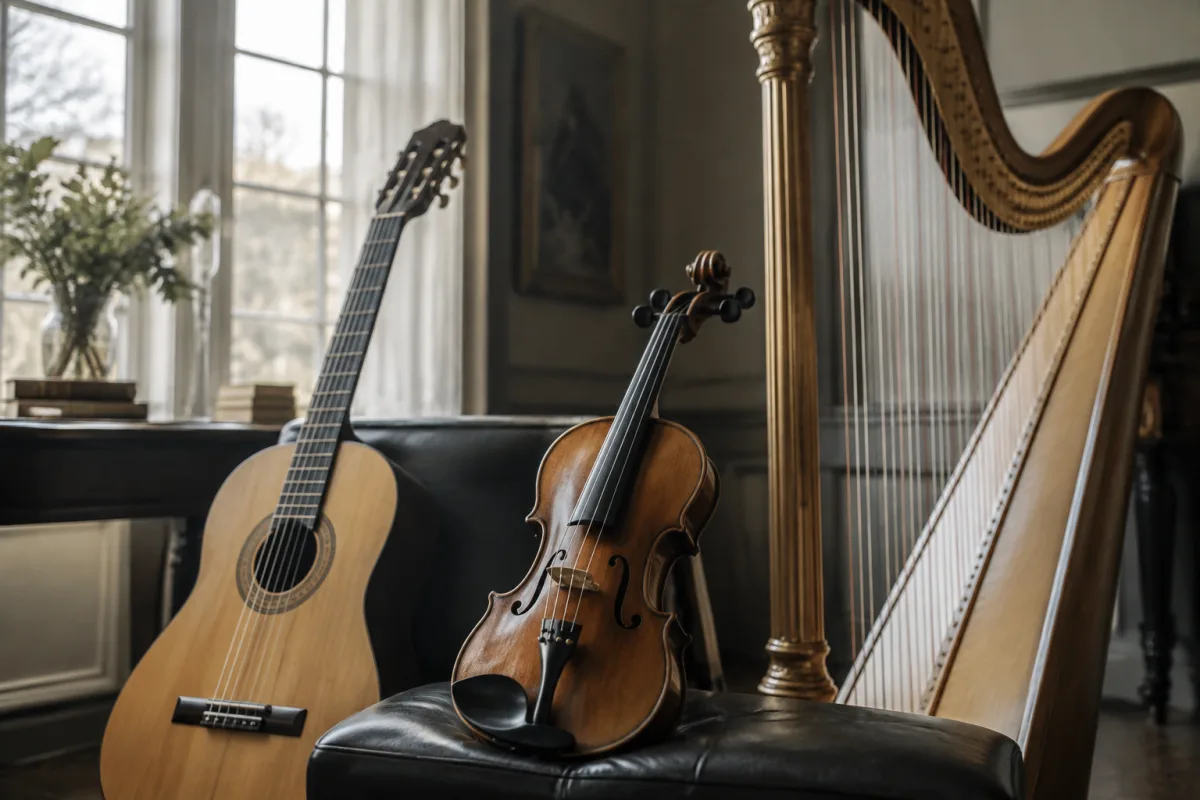
String instruments represent one of the oldest and most widespread instrument families, spanning cultures, centuries, and musical styles worldwide. Understanding the diverse names of string instruments—from regional terminology to technical classifications—helps musicians, students, and enthusiasts navigate the rich landscape of stringed instruments. Whether you're learning music theory, researching particular instruments, or simply curious about instrumental nomenclature, exploring the names of string instruments reveals the fascinating vocabulary that describes this fundamental instrument category.
Classifying the Names of String Instruments
Musicians classify the names of string instruments using several systems. The broadest taxonomy divides string instruments into plucked and bowed categories based on how players excite the strings. Within these categories, further classifications distinguish instruments by construction, playing technique, geographical origin, and musical function. Understanding these classification systems helps decode why the same instrument might have multiple names and how seemingly different instruments relate to common ancestry.
The names of string instruments often reflect geographical origin, construction materials, playing technique, or the musician who popularised or invented them. A single instrument might have entirely different names in different languages and regions—what's called a "guitar" in English becomes a "guitarra" in Spanish, "guitare" in French, or "gitaar" in Dutch, yet all refer to variations on recognisably similar instruments. This linguistic and cultural diversity enriches the names of string instruments worldwide.
Fundamental String Instrument Family Names
The primary names of string instruments establish major family groupings. "Guitar" encompasses a vast family from classical Spanish guitars to electric rock instruments to flamenco models. "Violin" refers to the bowed string quartet family (violin, viola, cello, bass) fundamental to Western classical music. "Mandolin" describes a diverse family of plucked instruments with paired courses of strings. "Harp" represents one of the oldest instrument families with strings parallel to the frame.
The names of string instruments extend to lute (a pear-shaped instrument family including historic lutes, modern classical guitars' predecessors, and contemporary revivals), banjo (a specific construction with a membrane stretched across a circular frame), sitar (Indian classical music's definitive stringed instrument), and ukulele (Hawaiian four-stringed small instrument). Each of these names encompasses variations, regional styles, and evolved forms, yet maintains an identifiable core identity uniting instruments under that name.
Names of String Instruments by Playing Method
Organising the names of string instruments by how players excite the strings reveals fundamental relationships. "Plucked" instruments (guitar, harp, mandolin, banjo) rely on fingers or picks striking strings to create sound. "Bowed" instruments (violin, cello, viol, rebec) use a bow drawn across strings, producing sustained tones impossible through plucking alone. "Struck" string instruments (piano, cimbalom, hammer dulcimer) use mallets or mechanisms to strike strings internally, creating their distinctive character.
The names of string instruments sometimes refer specifically to their playing method. "Lute," "theorbo," and "baroque guitar" all represent plucked, fretted strings instruments with overlapping history and construction. The distinction between "fiddle" and "violin" often relates to playing context rather than construction—"fiddle" suggests folk or traditional playing styles, whilst "violin" implies classical or formal contexts, yet the instruments are essentially identical.
Regional and Cultural Names of String Instruments
Non-Western musical traditions employ the names of string instruments reflecting their cultural context. "Sitar," "sarangi," and "sarod" represent Indian classical music's string families, each with specific construction and cultural significance. "Oud" names the Middle Eastern stringed instrument fundamental to Arabic music. "Erhu" and "pipa" describe Chinese classical instruments. "Shamisen" and "koto" represent Japanese traditions. These names carry cultural weight beyond mere instrumental designation—they connect to entire musical systems, compositional traditions, and cultural heritage.
The names of string instruments sometimes vary regionally within continents or countries. The "balalaika" family encompasses variations across Russia and Slavic regions. Mediterranean countries developed distinctive lute variations, each with regional names reflecting local traditions. African continent features numerous distinctive string instruments—"kora," "talking drum" (though not purely string), "mbira," and others—each name tied to specific cultural contexts and musical practices.
Technical and Morphological Classification of String Instrument Names
Music scholars classify the names of string instruments using technical criteria. Instruments are categorised by number of strings: "four-string" instruments (including violin, ukulele), "six-string" instruments (classic guitar), "seven-string" or more complex string courses (multi-string harps, concert grand pianos). Construction type distinguishes between "acoustic" instruments producing sound naturally through body resonance, "electric" instruments relying on electronic amplification, and "semi-acoustic" or "electro-acoustic" hybrids combining both principles.
The names of string instruments reflect their resonating body style. "Box" string instruments (guitars, mandolins, modern pianos) use enclosed wooden chambers. "Open-frame" instruments (harps) suspend strings on frames without enclosed resonating chambers. "Membrane" string instruments (banjo, some African instruments) stretch membrane across frames. Each construction approach affects tonal character and cultural significance of the names of string instruments.
Historical Evolution of String Instrument Names
Understanding the historical development enriches comprehension of the names of string instruments. "Lute" derives from Arabic "al'ud," revealing how medieval crusades and cultural exchange transformed European musical vocabulary. The modern guitar evolved from medieval "gittern" and Renaissance "vihuela," with names reflecting stages of evolution. The "piano" itself—originally "pianoforte"—means "soft-loud" in Italian, describing the new instrument's ability to produce dynamic variation impossible on harpsichords.
Medieval and Renaissance nomenclature for the names of string instruments often differed from contemporary usage. "Viol" family instruments (distinct from violin family) represented earlier European bowed string instruments. The transition from names like "rebec" (medieval bowed) to "violin" represents historical evolution and cultural shifts in musical practice. Many ancient names of string instruments—"kithara," "lyre"—survive in historical contexts whilst the actual instruments disappeared centuries ago, known only through surviving names and descriptions.
Modern and Electric String Instrument Nomenclature
The twentieth century introduced new categories to the names of string instruments. "Electric guitar" distinguishes instrument using electronic amplification from acoustic varieties. "Bass guitar" represents a string instrument pitched lower than standard guitars, distinct from traditional upright bass. "Synthesiser" and "electronic keyboard" sometimes employ names ambiguously—they're technically string instruments when utilising string-based triggers, yet "string instrument" rarely describes them due to playing method differences.
Contemporary instrument makers continually develop variations on traditional names of string instruments. "Hybrid" instruments blend characteristics of multiple families. "Semi-fretted" instruments occupy middle ground between traditional fretted and fretless playing. "Extended range" instruments stretch traditional pitch boundaries, sometimes requiring new nomenclature as musicians develop novel instruments.
Confusion and Overlap in String Instrument Names
The names of string instruments sometimes overlap or cause confusion. "Harp" often encompasses multiple unrelated instruments—from concert grand harps to smaller harps to instruments that aren't technically harps (Jewish "harp" is actually a mouth harp, not a string instrument). "Fiddle" might reference violin-family instruments, ancient fiddle-specific designs, or even metaphorical meaning in colloquial usage. "Lyre" sometimes refers to specific ancient instruments, sometimes more broadly to any stringed instrument, sometimes to modern revivals barely resembling historical ancestors.
Regional terminology creates ambiguity. What one region calls "violin," another might call "fiddle." Musical terminology evolves—musicians once used different names of string instruments than today's standard classifications. Portuguese colonial influence meant "guitarra" travelled globally with various meanings depending on context and location. Understanding these nuances helps prevent miscommunication when discussing the names of string instruments across cultures and musical traditions.
Learning the Names of String Instruments: Practical Approaches
Musicians develop comprehension of the names of string instruments through multiple approaches. Organising by playing method (bowed vs. plucked vs. struck) provides foundation. Learning major regional traditions—Western classical, Indian classical, Middle Eastern, African, Asian—grounds understanding in cultural context. Studying family trees showing evolutionary relationships between instruments illuminates historical connections and explains nomenclatural patterns.
Experiencing diverse instruments firsthand accelerates learning the names of string instruments. Listening to performances, examining actual instruments, and trying playing techniques builds intuitive understanding no study alone provides. Museums often feature diverse string instruments with clear labelling and descriptions, providing accessible introduction to global instrument diversity.
Conclusion
The names of string instruments comprise a rich, complex vocabulary reflecting centuries of cultural exchange, technological evolution, and human creativity in sound-making. From simple plucked strings to sophisticated electronic innovations, from ancient lyres to modern electric guitars, the names of string instruments tell stories of cultural traditions and musical innovation. Whether exploring Western classical violin families, Indian sitar traditions, African kora heritage, or contemporary hybrid instruments, understanding the names of string instruments deepens appreciation for humanity's ongoing quest to create meaningful sound and musical expression through vibrating strings.


Comments