


Eurorack Synthesizer article
Eurorack Synthesizer for Beginners: A Complete Guide
Eurorack synthesizers seem complex but unlock deep sound design learning. Here's which modules you actually need, how they work together, and how to start patching.
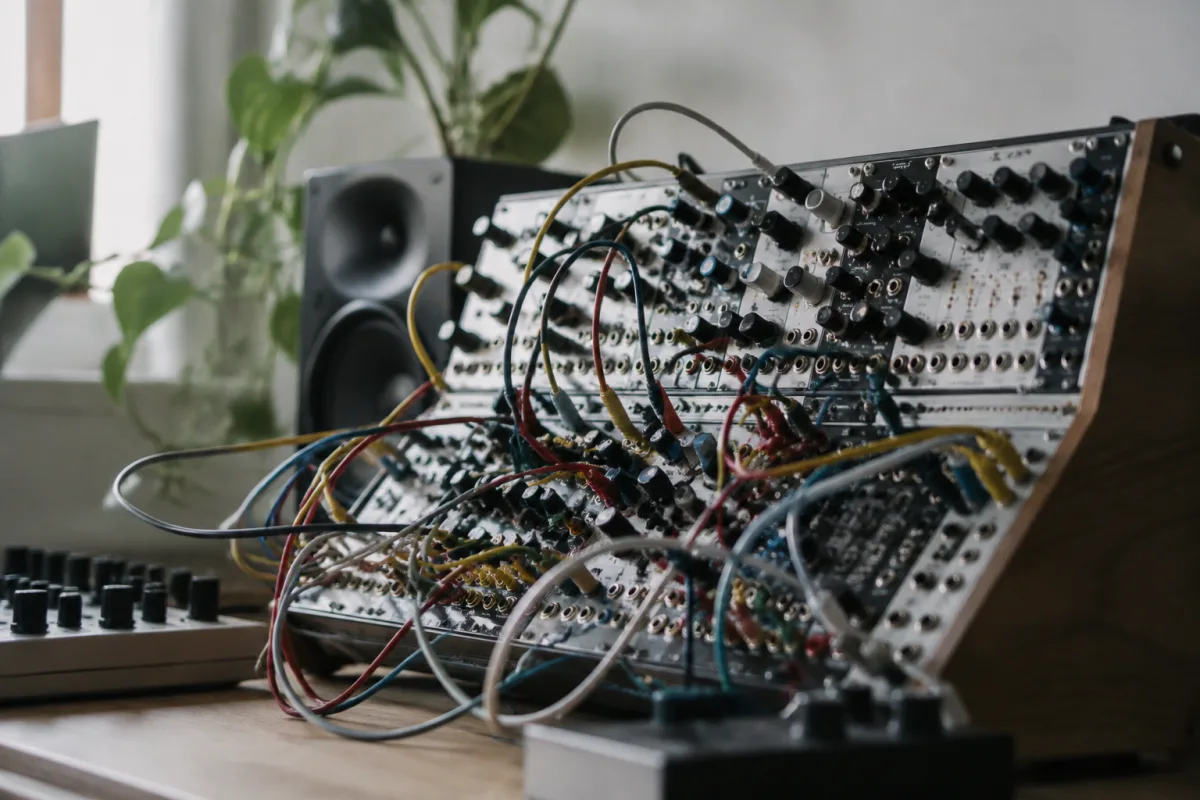
Eurorack synthesizers seem intimidating at first glance—rows of cables, mysterious knobs, no clear starting point. But for a curious beginner who loves tinkering and wants to understand synthesis at a deep level, eurorack offers unmatched creative freedom and learning opportunity. This guide demystifies the basics so you can start confidently.
What Is Eurorack, Really?
Eurorack is a standardised modular synthesizer format where individual sound-producing modules (oscillators, filters, envelopes, mixers) are mounted in a frame and connected with patch cables. Unlike a keyboard synthesizer where every function is built in and you press buttons, a eurorack system grows as you add modules and you create sounds by plugging cables between them in different patterns.
Think of it like building with electronic Lego. Each module does one thing really well. You patch them together to make complex sounds. The flexibility is extraordinary; so is the learning curve.
Essential Modules for a Beginner Eurorack System
Power supply (essential, non-negotiable)
Every eurorack system needs a power supply. The most affordable beginner supplies cost £40–100. This is not optional—running modules without power destroys them. Brands like Tiptop Audio, Intellijel, and Happy Nerding make reliable supplies. Don't cheap out here.
Case (the frame that holds everything)
Eurorack comes in standardised widths measured in "HP" (Horizontal Pitch). A beginner case is usually 84 HP (about 42cm wide) to 104 HP, costing £100–300. Your case size limits how many modules you can fit. Smaller is more portable and cheaper; larger gives you more creative options. Start with 84–104 HP.
Oscillator (the sound source)
An oscillator generates the raw waveforms (square, sawtooth, triangle, sine) that become your sound. Classic beginner oscillators: Mutable Instruments Plaits (multipurpose, £150), Make Noise 0-Coast companion, or a simple VCO (£100–200). You need at least one. Many setups use two or three.
Filter (shape the sound)
A filter removes or emphasizes frequencies, turning a harsh sawtooth into something musical. A Steiner-Parker or Moog-style lowpass filter is the standard. Beginner modules: Intellijel Morgasmbord, Make Noise Mos Def, or simple passive filters (£80–200).
Envelope generator (time-based modulation)
An envelope controls how a sound evolves over time—attack (how fast it turns on), decay (fade time), sustain (held level), release (fade when you stop). A simple ADSR envelope module (£60–150) is essential for shaping notes into playable sounds.
Mixer (combine signals)
You'll have multiple oscillators and modulation sources. A mixer lets you blend them. A simple 4-channel mixer costs £50–100. Essential infrastructure.
VCA (Voltage Controlled Amplifier)
A VCA is a volume knob controlled by patch cables, letting other modules change the loudness of a sound dynamically. Sounds optional but it's crucial for expressive playing. Budget eurorack VCAs cost £60–120.
Sequencer or keyboard interface (how you play it)
Beginner eurorack systems often use external keyboards or step sequencers to send note information. The simplest: plug a MIDI-to-CV converter (£80–150) so you can use a standard MIDI keyboard. Alternatively, buy a sequencer module (Mutable Instruments Grids, £120–300) to trigger notes automatically.
A Minimal Beginner Setup (Budget: £500–1,000)
Case: 84 HP, £150. Power: £80. Oscillator: £150. Filter: £150. Envelope: £100. VCA: £100. Mixer: £80. MIDI-to-CV converter: £100. Output module or audio interface adapter: £50. Total: roughly £960.
This setup is genuinely playable. Plug a MIDI keyboard into the converter, play notes, and route the oscillator through the filter (which is shaped by the envelope controlled by the keyboard). You'll hear synthesis happen in real time.
First Steps: Building Your First Patch
Step 1: Understand signal flow
All eurorack patches flow: sound source → modifier (filter, effects) → output. An oscillator generates sound. A filter shapes it. A mixer combines multiple sources. An output sends it to speakers or recording. Understand this path before patching.
Step 2: Make a simple sine wave
Oscillator output to your audio interface or mixer. Turn up the volume carefully (eurorack signals are loud). You should hear a pure sine tone. This is your foundation. Don't add anything else yet.
Step 3: Patch the filter into the signal path
Oscillator → Filter → Output. Manually turn the filter cutoff knob. Hear how it removes high frequencies and the tone becomes duller. This is the filter effect. Reverse the direction—brighten it by lowering the knob instead. Understand what the filter does before modulating it.
Step 4: Patch the envelope to modulate the filter
Envelope generator output → Filter modulation input. Now play a note on your keyboard. When you press a key, the envelope triggers and automatically sweeps the filter. You just created your first real synth sound.
Step 5: Add a second oscillator and mix them
Route both oscillators into the mixer, then mixer to the filter. Detune the second oscillator slightly (change its pitch a tiny bit). Blended, they create a richer, more alive sound than a single oscillator.
Common Beginner Mistakes
Mistake 1: Plugging patch cables too hard or wrong. Eurorack jacks are fragile. Insert cables gently and straight. Yanking or plugging at angles can break jacks permanently (expensive repair). A good cable makes a soft click when inserted correctly.
Mistake 2: Forgetting patch documentation. After an hour of patching, you won't remember which output goes where. Take photos of your patches or draw simple diagrams so you can recreate them. This becomes essential once you have a functioning patch you like.
Mistake 3: Turning everything up to maximum volume. Eurorack signals are line-level (loud). Plugging a raw oscillator into headphones or into a line input at full volume is painful and can damage equipment. Always start with low volumes and patch through attenuators.
Mistake 4: Buying modules without understanding signal flow. Eurorack veterans often buy exotic modules before they understand basic synthesis. A beginner should focus on solid fundamentals: oscillator, filter, envelope, mixer, output. Fancy effects modules are fun but come later.
Mistake 5: Feeling overwhelmed by possibilities. The beauty and curse of modular synths is infinite patching possibilities. A beginner can feel paralysed by choice. Counter this: start with one simple goal ("make a bass sound") and complete it. Then move to the next goal. Bite-sized learning is the only way.
Getting Help and Learning Resources
Eurorack communities are incredibly helpful. Subreddits like r/modular, forums like muffwiggler, and Discord servers connect you with experienced users. Ask questions freely—the community welcomes genuine curiosity.
YouTube channels like patch&tweak magazine, Cuckoo, and Look Mum No Computer feature modular patching tutorials. Start with videos on basic signal flow and simple patch types.
Finally, befriend experienced users at local synthesizer meetups if your city has them. Hands-on learning accelerates vastly when you can actually touch and hear modules.
Long-Term Growth: Thinking Beyond the First Modules
After three months with your beginner setup, you'll know what's missing. Maybe you want more modulation sources (LFOs, random generators). Maybe you want effects (delay, reverb). Maybe you want sequencers or more oscillators. This is when you add modules strategically rather than randomly.
The modular journey is truly a journey. You're not trying to build the perfect complete system; you're learning synthesis incrementally, one module and one patch at a time.
For a comprehensive guide to eurorack synthesizer modules, history, and advanced techniques, see our complete overview.


Comments