
Digital to Analog Converter article
The Complete Guide to Digital To Analog Converter
A digital to analog converter transforms digital audio data into analogue signals that speakers can reproduce. This guide explores how digital to analog converters work, their role in audio systems and when upgrading matters.
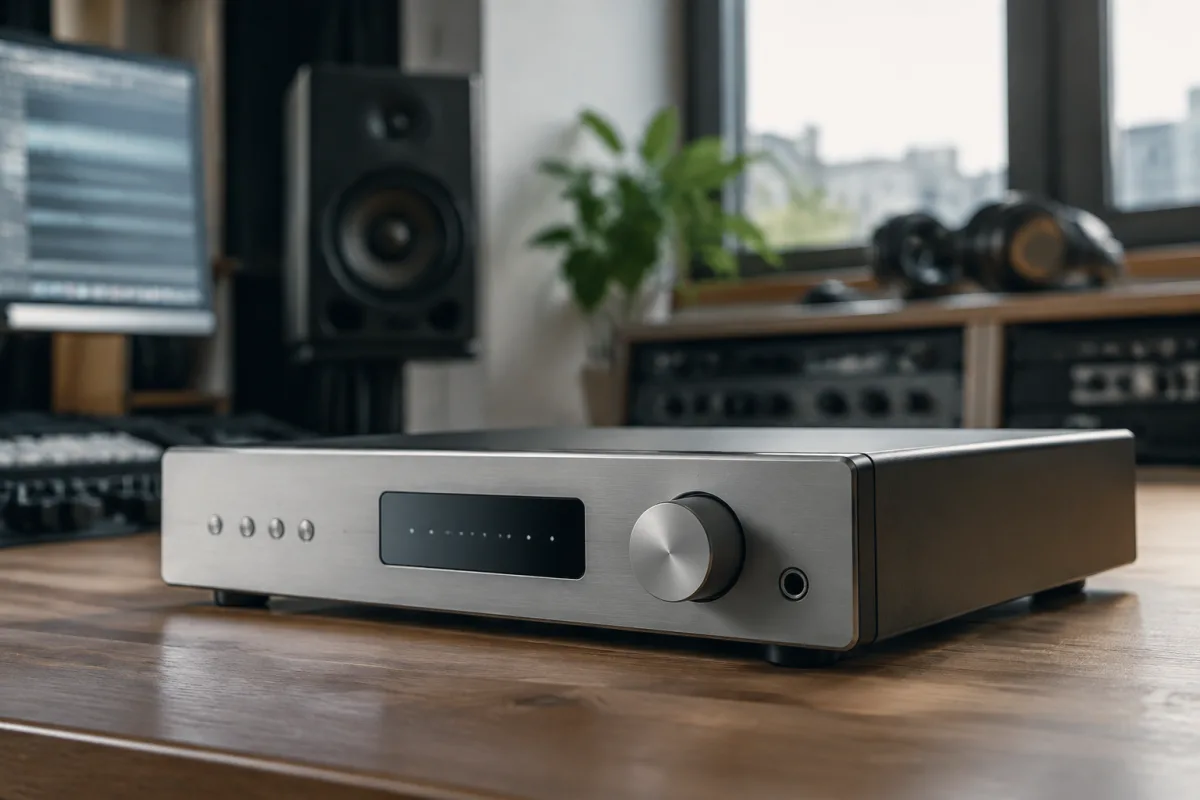
A digital to analog converter (DAC) transforms digital audio data into the analogue electrical signals that speakers and headphones can reproduce as sound. For musicians, producers and serious audiophiles, understanding DACs and choosing a quality converter elevates listening experience and recording quality significantly. This guide explores how digital to analog converters work and why they matter for your music.
Understanding Digital to Analog Conversion
All music in your computer, streaming service or digital device exists as numerical data—binary information representing each sound wave's shape. A digital to analog converter reads this data and outputs a continuously varying electrical voltage that mirrors the original sound wave. Your speakers then vibrate in response to this electrical signal, creating the acoustic sound you hear.
The quality of this conversion process directly affects the sound you experience. A basic digital to analog converter follows a direct path: read data, output voltage, done. Quality converters employ multiple stages of filtering, amplification and error correction that smooth the conversion process, resulting in clearer, more accurate sound with less noise and distortion.
Key Performance Specifications
Understanding digital to analog converter specifications helps you evaluate quality. Bit depth (16, 24 or 32 bits) indicates how many discrete voltage levels the converter can output. Higher bit depth means finer resolution and lower distortion floor. Sample rate (44.1kHz, 96kHz, 192kHz) indicates how many times per second the converter samples the data. Higher sample rates capture more detail, particularly important for music with significant high-frequency content.
Signal-to-noise ratio (SNR) measures how much background noise the digital to analog converter introduces. Higher SNR means quieter operation and clearer sound. Professional-grade converters achieve 120dB SNR or better; consumer models aim for 100dB. The difference is perceptible when listening to quiet passages.
Total harmonic distortion (THD) quantifies how much unwanted harmonic content the converter adds to the signal. Lower THD (typically under 0.1%) means cleaner sound. Frequency response indicates the range of frequencies the converter reproduces accurately—ideally flat from 20Hz to 20,000Hz (the full range of human hearing).
Where Digital to Analog Conversion Happens
| Device | DAC Quality | Sound Impact | Typical Use |
|---|---|---|---|
| Smartphone/tablet | Basic consumer-grade | Acceptable for casual listening | Portable music consumption |
| Desktop sound card | Consumer to mid-range | Good sound quality for most uses | Computer audio, gaming, production |
| Dedicated DAC device | Professional-grade | Excellent sound quality, transparent | Serious listening, studio reference |
| Audio interface (recording) | Professional-grade | Clean, accurate conversion for tracking | Music production and recording |
| Hi-fi amplifier | High-end professional | Exceptional clarity and musicality | Reference listening, mastering |
Every device playing digital audio contains a digital to analog converter. Your smartphone's internal DAC produces acceptable sound for casual listening but can't match a dedicated converter. Professional studios invest in high-end converters ensuring accurate translation of digital data to sound, critical when mixing and mastering.
Standalone Digital to Analog Converters
A dedicated digital to analog converter connects between your computer (or streaming player) and your speakers or headphones. This simple device isolates conversion from computer noise and interference, delivering cleaner audio signals to your listening system. Quality standalone converters range £200–£2,000 depending on features and performance.
Benefits include galvanic isolation (electrically disconnecting from your computer to eliminate ground loop noise), multiple input options (USB, optical, coaxial, AES/EBU), and design optimised purely for clean audio conversion without computer compromises. Musicians often use standalone converters in recording studios to serve as the master reference for mixing and mastering.
USB Digital to Analog Converters
USB DACs plug directly into your computer, drawing power and data from a single connection. They simplify setup—no additional cables or power supplies—making them ideal for portable listening and home setups. Quality USB DACs handle high-resolution audio (24-bit/192kHz), delivering significantly better sound than your computer's built-in converter.
Professional USB DACs include asynchronous transfer modes that disconnect from your computer's clock, preventing timing jitter (small timing inaccuracies) that degrades sound. This technical refinement dramatically improves audio quality, particularly noticeable on high-resolution audio files.
The Audibility Question: Do DACs Matter?
Does upgrading your digital to analog converter improve sound quality perceptibly? Professional listeners and trained ears hear clear differences between basic and high-quality converters. The improvement is most obvious through quality speakers or headphones—poor DAC limitations are masked by poor speakers, so upgrading a DAC into a cheap speaker system yields minimal benefit.
Through good speakers or headphones, quality converters reveal cleaner, more detailed sound with lower noise floors and less distortion. The improvement is real but not transformative—upgrading other components (better headphones, room acoustics, audio files) typically delivers greater impact than DAC upgrades alone.
Digital to Analog Conversion in Recording Studios
Professional recording interfaces include high-quality digital to analog converters essential for monitoring (hearing what you're recording as you track). Quality monitoring converters reveal mixing decisions accurately, preventing surprises when you playback on consumer playback systems.
Mastering studios employ reference-grade converters with exceptional accuracy ensuring mixes translate well to playback systems worldwide. The digital to analog converter remains one of the most critical components in mastering chains, directly affecting how music sounds to every listener.
Factors Affecting Conversion Quality
Component selection matters enormously. Premium converters use precision clocks reducing timing jitter, ultra-stable power supplies preventing noise transfer into the audio signal, and careful circuit design optimising every stage of conversion. Shielding prevents electromagnetic interference from affecting the delicate audio signals.
The digital to analog converter operates at the intersection of digital and analogue domains. Any imperfection—ground loops, power supply ripple, component tolerances—affects sound quality. Professional designs minimise every source of degradation, explaining why quality converters cost more but sound demonstrably better.
Choosing Your Digital to Analog Converter
If you're happy with your current sound quality, no upgrade is necessary. If you notice harshness, fatigue, lack of detail or background noise, your converter might be limiting your system. Test different converters carefully—listen on familiar music through quality speakers, critical listening in a quiet environment.
For mixing and mastering, invest in a quality converter and reference monitor system as a unit. They work together—a great converter feeding poor speakers provides little benefit. For casual listening, mid-range converters deliver excellent value; high-end converters offer refinement rather than transformation.
The Role of Source Files and Conversion
A quality digital to analog converter only improves sound if your source material is clean. Compressed audio formats (MP3, AAC) discard information before reaching the converter, limiting improvement potential. Lossless formats (FLAC, WAV, Apple Lossless) preserve complete digital data, letting quality converters reveal maximum detail and clarity.
Your digital to analog converter transforms digital data into the analogue signals that create music. Investing in quality conversion unlocks the potential of good speakers, headphones and room acoustics, revealing the detail, clarity and nuance inherent in well-recorded music and carefully mastered mixes.



Comments