


Korg Pianos article
Korg Pianos for Beginners: A Complete Guide
Begin your piano journey with Korg pianos. Find encouragement, learn first steps, and discover the easiest path for nervous beginners.
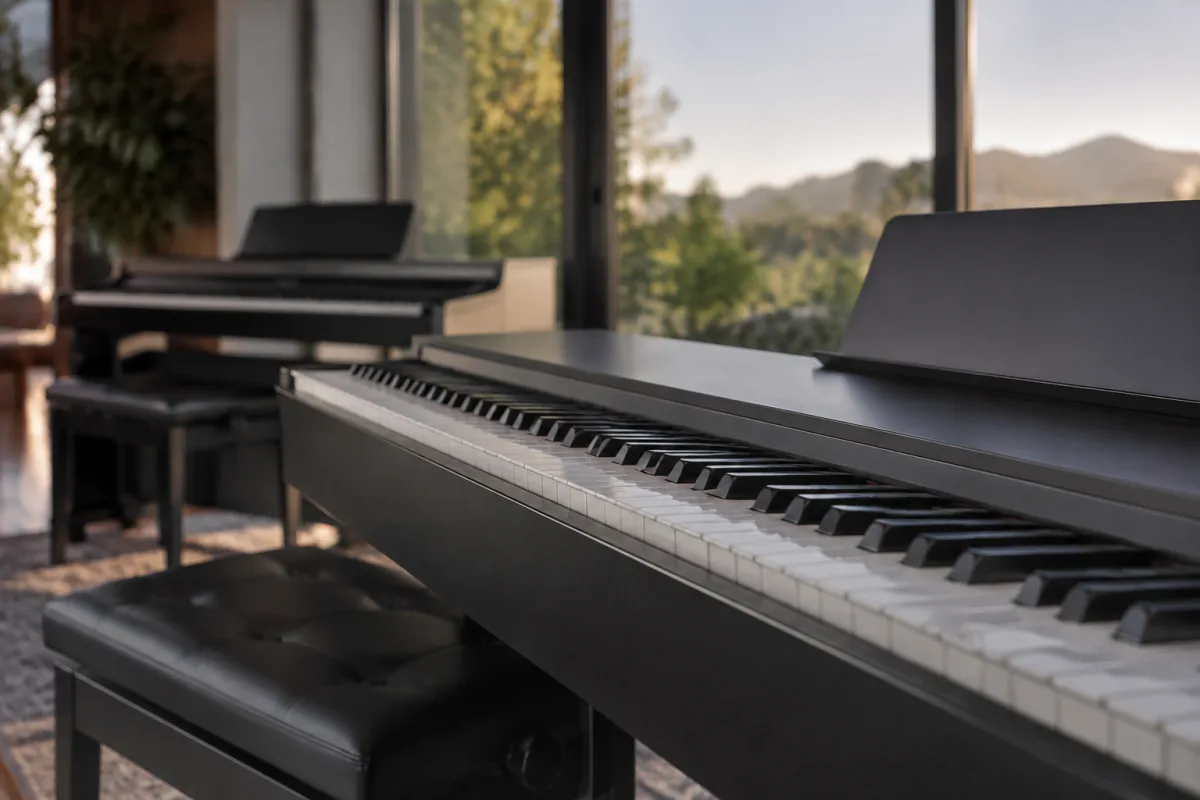
Starting piano as a complete beginner can feel overwhelming, but Korg pianos make the journey surprisingly approachable. If you're nervous about beginning your piano education on a Korg piano, you're in the right place. This guide walks you through your first steps with Korg pianos, shows you the easiest path forward, and addresses the common mistakes that derail beginner pianists before they've started.
Why Korg Pianos Are Beginner-Friendly
Korg pianos offer several advantages for nervous beginners starting their piano journey. The keyboard action responds intuitively to touch—you don't need perfect technique to produce pleasant sounds from Korg pianos. Unlike acoustic pianos that demand correct posture and precise finger strength from day one, Korg pianos forgive technical imperfections while you're developing fundamentals.
Many beginner pianists feel intimidated by the complexity of traditional acoustic pianos. Korg pianos eliminate this barrier by offering smaller, more manageable instrument sizes and digital features that support learning. Your Korg pianos doesn't require tuning, the tone remains consistent regardless of room temperature or humidity, and built-in learning features encourage progress without hiring an expensive teacher immediately.
Choosing Your First Korg Pianos
Your first Korg pianos doesn't need to be expensive or fully featured. A modest entry-level model serves beginners perfectly and prevents the waste of money on features you won't use initially. Here's what to prioritise as you select your Korg pianos for learning:
Weighted Keys on Korg Pianos
Start with Korg pianos that feature weighted or semi-weighted keys. These keys resist your finger pressure like acoustic piano keys do. Beginners playing Korg pianos with unweighted keys develop poor finger technique because the keys respond too easily. This bad habit becomes difficult to unlearn when upgrading to better instruments later.
Full 88-Key Korg Pianos
Commit to an 88-key Korg pianos from the beginning rather than starting with smaller models. Piano repertoire quickly requires the full 88-key range. Your Korg pianos investment feels wasted when you outgrow a 61-key model within months of serious study.
Built-in Learning Features
Many Korg pianos models include demonstration songs, rhythm accompaniment, and learning software integration. These features provide motivation between lessons and help you understand musical concepts through playing along. Beginners appreciate the encouragement that Korg pianos learning features provide.
Setting Up Your Korg Pianos Properly
An awkwardly positioned Korg pianos creates physical tension that develops into bad habits. Your keyboard stand or desk should position the Korg pianos key surface at the same height as your elbows when sitting upright. Your bench should support your thighs whilst allowing your feet to reach the floor comfortably.
Poor posture at your Korg pianos causes wrist and shoulder tension that prevents smooth playing technique. Good posture feels slightly unnatural initially but becomes comfortable quickly. Spend time adjusting your Korg pianos setup until sitting feels relaxed—this investment prevents physical strain from derailing your progress.
Taking Your First Lessons on Korg Pianos
Beginners benefit enormously from instruction tailored to Korg pianos specifics. Finding a teacher experienced with digital pianos who understands Korg pianos particularly is ideal. A good teacher accelerates your progress far beyond what self-teaching achieves, particularly during the foundational months.
Look for teachers who accept Korg pianos as legitimate learning instruments rather than insisting students must use acoustic pianos from day one. Your Korg pianos fully supports proper technique development when a competent teacher guides your learning. Bad teachers are counterproductive regardless of instrument—find one experienced with Korg pianos and your progress will flourish.
Initial lessons on Korg pianos should address proper hand position, finger curvature, and posture. Master these fundamentals and everything else becomes significantly easier. Rushing into pieces without solid foundational technique leads beginners astray.
Understanding Your Korg Pianos Control Panel
| Feature | What It Does | Beginner Use |
|---|---|---|
| Reverb/Effects | Adds ambient space to your tone | Use minimal reverb initially to develop clarity |
| Metronome | Keeps steady tempo during practice | Essential for all beginner practice sessions |
| Recording | Records and playback your performances | Invaluable for identifying problem areas |
| Drum Accompaniment | Provides rhythm and harmonic support | Motivating but use sparingly to avoid relying on it |
| Transpose Function | Shifts all notes up or down | Rarely needed for beginners |
| Touch Sensitivity | Controls how the Korg pianos responds to velocity | Keep at default whilst learning |
Creating a Sustainable Practice Routine with Korg Pianos
Consistency matters infinitely more than duration. Twenty minutes daily on your Korg pianos outperforms two-hour weekend sessions. Beginners should commit to at least four practising days weekly to develop muscle memory and progress steadily. Three days produces slower progress, whilst five or six days accelerates your advancement.
Start each Korg pianos practising session with scales or finger exercises to warm up your hands. These exercises feel tedious but develop the finger independence and coordination that piano playing demands. Ten minutes of daily scale practice transforms a beginner's capability within weeks.
Structure your Korg pianos practice into technical work, pieces you're learning, and exploration time. Technical work builds capability, pieces apply that capability to actual music, and exploration time keeps piano fun. Beginners often abandon Korg pianos study when practice becomes monotonous—balance and variety prevent this trap.
Avoiding Common Beginner Mistakes on Korg Pianos
- Skipping hand position fundamentals: Beginners rush toward playing pieces without establishing proper hand position on Korg pianos. This creates tension and limits technique development. Spend months on fundamentals before advancing.
- Practising faster than your capability: A common Korg pianos beginner error involves speeding up pieces before mastering them slowly. Accuracy matters far more than speed. Play at whatever tempo allows perfect execution on your Korg pianos.
- Neglecting the metronome: Beginners often feel confined by metronome discipline on their Korg pianos. Consistent rhythm is absolutely fundamental. Your Korg pianos progress stalls without metronome usage.
- Repeating difficult passages carelessly: Beginners tend to play through entire pieces rather than isolating and drilling challenging sections. You learn mistakes deeply this way on Korg pianos. Work problem areas methodically.
- Expecting perfection immediately: Beginner pianists become discouraged when initial attempts on Korg pianos sound rough. This is completely normal. Progress takes months of patient practising.
- Ignoring posture and tension: Many beginner pianists develop wrist and shoulder tension on their Korg pianos because of poor posture. Correct this immediately—tension becomes deeply ingrained if allowed to persist.
Building Musical Understanding as You Learn Korg Pianos
Reading music becomes essential quickly in piano study. Beginners often feel anxious about music literacy, but learning to read notation happens naturally alongside learning Korg pianos. Don't let unfamiliarity with music notation delay starting your Korg pianos journey—the symbols make sense once you see them applied on your keyboard.
Study chord construction alongside learning scales and pieces. Understanding how chords work opens musical doors and helps you improvise on your Korg pianos. Your comprehension of piano music deepens tremendously when you understand underlying harmonic structure.
Keeping Practice Engaging on Korg Pianos
Motivation determines whether you persist with your Korg pianos study or abandon it. Set specific realistic goals—learning a particular piece, mastering a scale set, or maintaining consistent daily practice. Celebrate progress by recording yourself regularly on your Korg pianos to hear improvement that daily practising masks.
Learn pieces you love on your Korg pianos rather than trudging through technically demanding classical music you find boring. Your enthusiasm for pieces drives practising discipline. A mediocre Korg pianos arrangement of a song you love beats a technically superior arrangement of music that doesn't inspire you.
Your Journey with Korg Pianos Begins Now
The barrier to starting piano isn't talent or age—it's willingness to invest time in consistent practising. Your Korg pianos supports every step of your learning journey if you commit to regular practice and fundamental development. Every accomplished pianist began exactly where you are now, as a nervous beginner making their first sounds on their first keyboard.
To deepen your understanding of Korg pianos and their technical specifications, explore our complete guide to Korg pianos.


Comments