


Piano Practice Time article
Piano Practice Time for Beginners: A Complete Guide
Piano practice time means understanding rhythm and keeping a steady pulse. This beginner's guide explains time signatures, metronomes and practical strategies for developing a solid internal sense of timing.
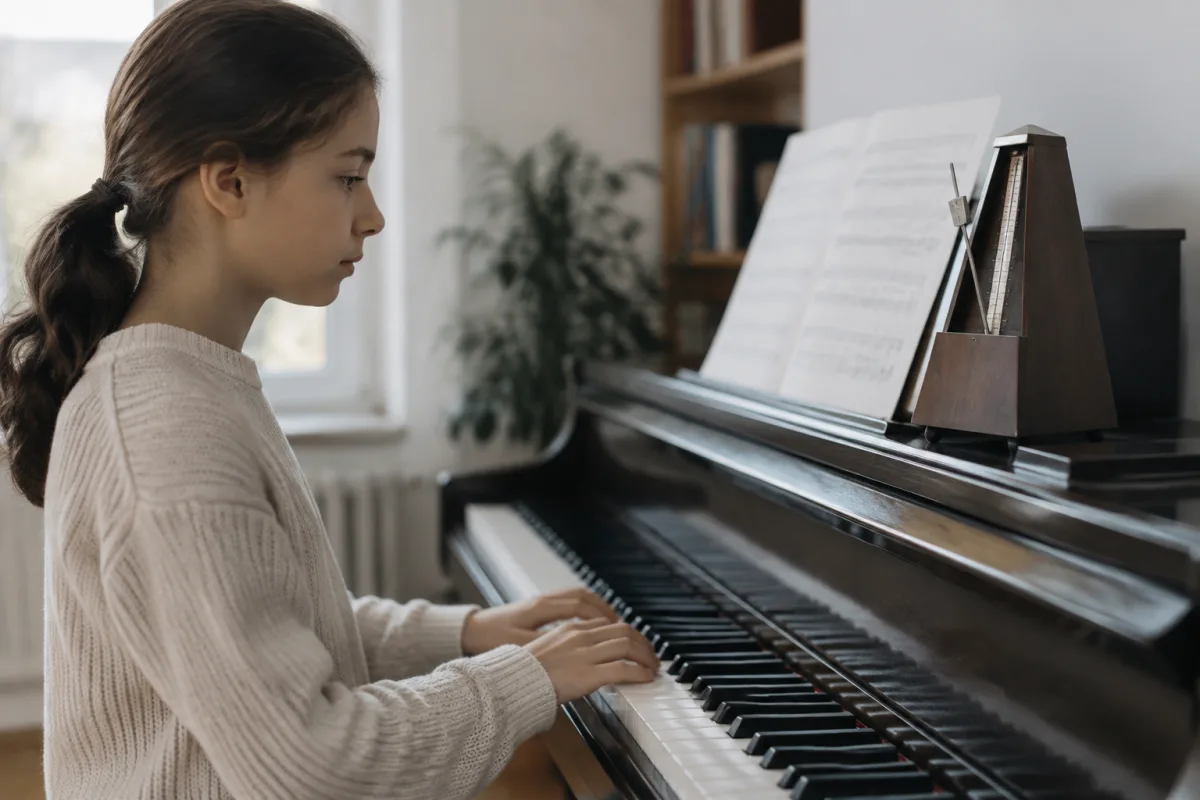
Learning piano practice time—understanding rhythm, time signatures and how to stay in time—feels abstract at first, but it's the foundation that separates musicians who play freely from those who sound confident and grounded. As a beginner pianist, you'll encounter time signatures, metronomes and phrases like "keeping time" almost immediately. This guide demystifies piano practice time, explains what those odd numbers at the start of sheet music mean, teaches you how to use a metronome effectively and shows you practical strategies for developing a solid internal sense of timing without frustration or panic.
What Piano Practice Time Actually Means
Piano practice time is simply the rhythmic organisation of music. Every piece of piano music has a consistent pulse—a steady beat underneath everything you play. That pulse is piano practice time. When musicians talk about "staying in time," they mean keeping that pulse steady and clear. When a conductor waves a baton, they're marking time—showing musicians where the pulse is and keeping everyone together.
For a piano learner, time means two things: understanding the written time signature (those numbers at the start of staff), and developing your own internal sense of pulse so you can play in time without a metronome clicking constantly.
Understanding Time Signatures: The Numbers Explained
Time signatures look like fractions: 4/4, 3/4, 6/8. The top number tells you how many beats are in each measure (bar). The bottom number tells you what kind of note gets one beat. Don't overthink it; the top number is what matters for beginners.
4/4 (four-four time, "common time") is the most common. It means four beats per bar, and each beat gets one quarter note. Count: one, two, three, four, one, two, three, four. Most pop songs, folk music and beginner pieces are in 4/4.
3/4 (waltz time) is three beats per bar: one, two, three, one, two, three. Waltzes, many traditional folk songs and some pop songs use 3/4. It has a "lilting" feel—one, two, three repeated.
6/8 is six beats per measure, a quick pulse often felt as two main beats with three subdivisions each. It sounds "jumpy" compared to 4/4. You'll encounter it less often as a beginner but should recognise it.
For now, 4/4 and 3/4 are enough. Master those and other signatures become clear naturally.
Developing Your Internal Sense of Pulse
The biggest breakthrough for beginner pianists is moving from "I need the metronome" to "I can feel the pulse myself." This takes weeks of practice but happens faster than you'd expect if you're intentional about it.
Start by counting aloud while playing. Say "one, two, three, four" out loud, letting the numbers guide your fingers. Your brain starts connecting the count to the physical sensation of playing on the beat. After two weeks of this, you'll find yourself naturally tracking the beat even without speaking it.
Next, try playing simple pieces (like "Mary Had a Little Lamb") and tapping your foot on the beat while playing. Foot tapping is powerful; it anchors your sense of time physically and makes it nearly impossible to rush or drag.
Using a Metronome Effectively
Metronomes are tools, not obstacles. Many beginners hate them—the clicking feels restrictive. But a metronome teaches you what steady really means. A human pulse naturally speeds up in moments of excitement and slows in moments of hesitation. A metronome never wavers; matching it trains discipline.
Start slow. If a piece feels comfortable at 100 BPM (beats per minute) in your head, start the metronome at 60 BPM and play at that slower pace. Yes, it feels sluggish. That's the point—you're developing accuracy without pressure. Once you play perfectly at 60, increase to 70. Gradually speed up over weeks. By the time you reach your target tempo, playing in time is second nature.
Most phone metronome apps are free and work fine. Ignore the cost myths around expensive metronomes; a basic one teaches you everything you need.
Common Time-Keeping Mistakes to Avoid
Rushing during exciting passages is the most common mistake. When you hit notes you love or a section you're comfortable with, your tempo tends to accelerate unconsciously. The metronome catches this immediately. Play the metronome as a teacher—when it sounds like you're dragging ahead, slow down deliberately. Your brain learns the correction.
Another error: speeding up sections you're uncertain about. Nervousness makes players rush; a metronome forces you to stay steady despite nervousness. This is valuable training for performance.
Finally, many beginners turn the metronome so loud they can't hear their own playing. Set it audible but not jarring. You should hear yourself primarily; the metronome is backup reference, not a dominating click.
Practicing with Time: A Simple Strategy
Warm-up: Play simple scales to a metronome at a moderate tempo (say, 90 BPM) for two minutes. This establishes your internal pulse.
Focus piece: Pick one short piece you're learning (maybe 16–32 bars). Set the metronome 20–30% slower than you eventually want to play it. Play through three times at that tempo, aiming for zero mistakes.
Incremental speed: Increase the metronome by 5–10 BPM and play three times again. Repeat until you've reached your target tempo or until mistakes start appearing. Stop there; continue tomorrow at this new tempo.
This approach—slow, accurate, gradual speed increase—builds time sense and muscle memory simultaneously. It takes longer than rushing through pieces at performance tempo, but you'll progress faster overall because you're ingraining correct timing, not sloppy habits.
Reading Complex Rhythms: Building Confidence
Dotted notes, triplets, rests—they look confusing on paper. The solution is practice and understanding. A dotted quarter note is a quarter note plus half its value (so a dotted quarter is 1.5 beats in 4/4 time, lasting as long as a quarter plus an eighth). Triplets divide a beat into three equal parts instead of two.
Clap these rhythms before playing them on piano. Clapping isolates rhythm from the complexity of coordinating both hands. Once your body understands the rhythm, hands follow more easily.
Playing without a Metronome: The Goal
Eventually, you'll be comfortable enough to play without constant metronome clicking. This is liberation. But it takes time. Most piano learners need 3–6 months of regular metronome practice before they can reliably play pieces in time without one.
When you do remove the metronome, you'll notice: are you speeding up? Slowing down? That awareness is the entire point. You've trained your sense of time; now you can course-correct deliberately rather than unconsciously.
Conclusion
Understanding piano practice time and developing a solid internal sense of pulse transforms your playing from scattered to grounded. Time signatures are simple once you understand the top number. Metronomes are teachers, not enemies. Foot-tapping and counting aloud are free, powerful tools. With a few weeks of intentional practice, piano practice time stops feeling abstract and becomes something you feel, not think about. For deeper exploration of rhythm, time signatures in different musical traditions and advanced timing concepts, see the complete guide to piano practice time.


Comments