


Folding Piano article
The Complete Guide to Folding Piano
A folding piano combines full-sized keyboard functionality with innovative compact design, solving space constraints without sacrificing playing feel. Ideal for students, travelling musicians and anyone balancing serious practice with limited space.
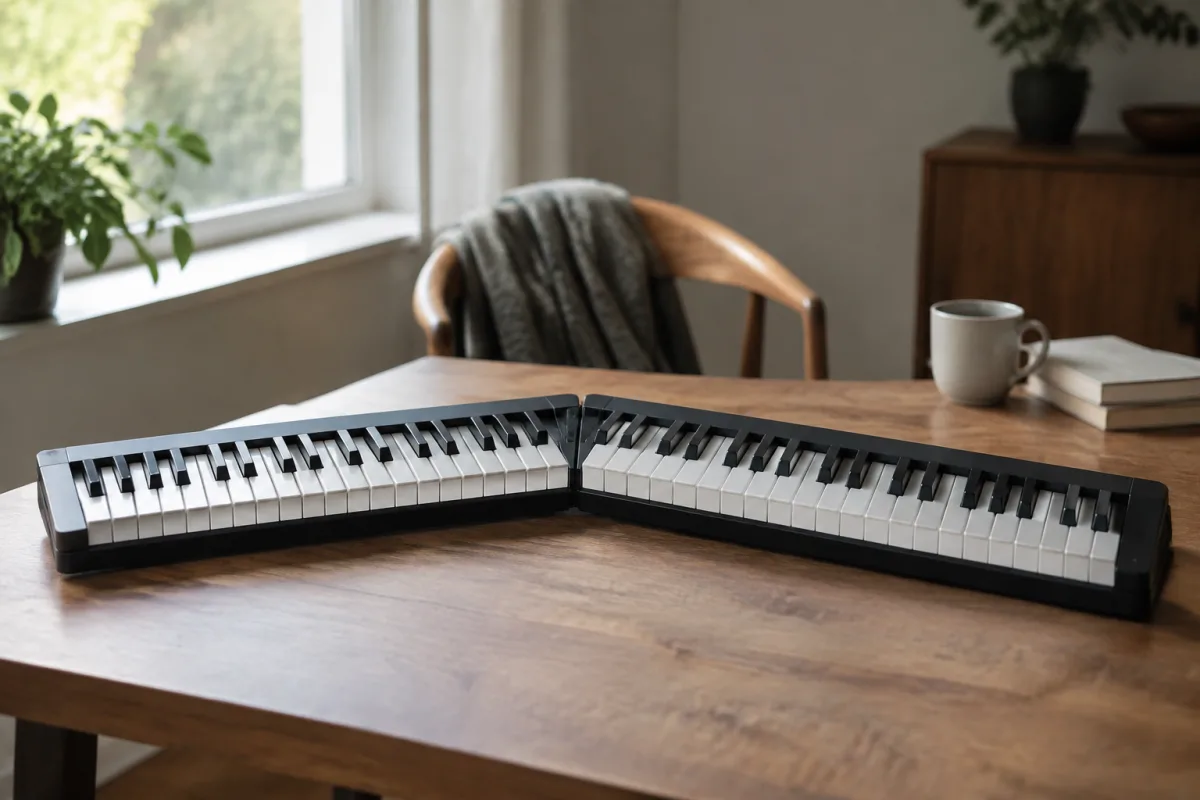
A folding piano is a portable digital keyboard with a flexible or rollable design that transforms flat or compact when not in use, then unfolds or extends into a full-sized playing surface. These innovative instruments solve a genuine problem for musicians with limited space or frequent travel requirements: the desire for full-sized, 88-key piano keyboard functionality without the substantial footprint and weight traditional pianos and full-sized digital keyboards demand. Folding pianos suit practice pianists, students, gigging musicians and anyone balancing serious musical ambitions with real-world space constraints.
What is a Folding Piano?
A folding piano combines a standard digital keyboard with an innovative mechanical design that allows portability without sacrificing functionality. Some models feature rollable rubber keys that collapse into a compact storage footprint; others employ hinged keyboard sections that fold into a smaller profile when not in use. Beneath the space-saving design lies genuine piano-quality sound synthesis and touch response, making folding pianos legitimate musical instruments rather than mere novelties.
The fundamental appeal is straightforward: a conventional 88-key keyboard occupies roughly 1.5 metres of width and 0.3 metres of depth—substantial space in small flats, dorm rooms or touring musician's vans. A folding piano compresses to perhaps one-third that footprint whilst maintaining full-sized key dimensions and genuine playing feel when extended.
Design Types and Mechanical Approaches
Rollable Keyboards
Rollable folding pianos feature flexible rubber or silicone keys that roll up tightly when not in use, resembling a yoga mat when stored. When powered on and pressed into use, the rolled keyboard can be spread flat across a desk, table or your lap. Rollable models offer the most compact storage and the lightest weight, making them genuinely portable for musicians who travel frequently or live in tight quarters. The trade-off is tactile feel: whilst modern rollable keyboards have improved dramatically, the flexible key surface lacks the weighted resistance and stability of traditional rigid keyboards.
Hinged or Folding Keyboards
Some folding pianos employ rigid keyboard sections connected by hinges, allowing the keyboard to fold accordion-style or into a wedge profile when not in use. This approach maintains traditional key feel and resistance whilst still reducing overall footprint substantially. Hinged keyboards occupy more space than rollable alternatives but offer superior playing experience for serious pianists who prioritise touch and technique.
Detachable Keyboard Sections
Certain premium models allow complete keyboard separation, letting you remove the keyboard from its base station for practice whilst keeping the sound module and control circuitry in a fixed location. This approach offers maximum flexibility, allowing you to use just the keyboard for intimate practice or connect it to external amplification for performance.
Sound Quality and Digital Piano Technology
Quality folding pianos employ real sound sampling—recordings of actual acoustic pianos captured across their full range and dynamic spectrum. This results in genuinely piano-like tone, not digital approximations or synthesised imitations. The better models include multiple sampled pianos (grand pianos, upright pianos, historical instruments) providing tonal variety for different musical styles.
Touch response is crucial. Quality folding pianos employ weighted or semi-weighted keys that simulate the hammer action of acoustic pianos, providing proper resistance and allowing genuine technique development. Budget rollable keyboards often omit weighting for ultimate portability; serious pianists should prioritise weighted keys regardless of the space-saving appeal.
Pedal Systems
Acoustic pianos use three pedals for expressive control: the sustain pedal (extends note duration), the soft pedal (changes timbre) and the sostenuto pedal (sustains selected notes). Quality digital folding pianos incorporate proper three-pedal systems, either built-in or as attachable units. This is essential for serious pianists—the pedal system is not optional complexity but fundamental to authentic piano playing.
Connectivity and Integration
Modern folding pianos include MIDI connectivity (USB, Bluetooth and traditional five-pin MIDI), allowing integration with digital audio workstations and music production software. This transforms a folding piano from a standalone practice instrument into a powerful production tool, letting you record performances directly into your DAW or trigger virtual instruments.
Audio outputs (headphone jack and line-level outputs) let you monitor silently for practice or connect to amplification and venue sound systems for performance. Some models include built-in speakers, useful for casual practice but usually inferior to external amplification for serious performance.
Portability and Practical Considerations
Weight and Dimensions
Rollable keyboards typically weigh 3–5 kilograms and compress to roughly 100 cm × 15 cm × 10 cm—easily fitting backpacks or suitcases. Hinged folding keyboards weigh 5–15 kilograms and fold to perhaps 100 cm × 50 cm × 10 cm—larger than rollable models but still genuinely portable. Compare this to a full-sized 88-key keyboard (typically 15–30 kilograms and 150 cm × 30 cm × 10 cm) and the portability advantage is clear.
Power Requirements
Folding pianos generally run on standard USB power, rechargeable batteries or AC adapters, making them practical for practice anywhere. Battery-powered models suit practice on the go; USB-powered models work with laptop connections or standard USB power supplies; AC-powered models offer reliable power for consistent practice without battery management concerns.
Who Benefits from Folding Pianos?
Music students in small flats or dorm rooms find folding pianos invaluable for consistent practice without space compromise. Gigging pianists and touring musicians appreciate the portability and ability to maintain practice routines whilst travelling. Parents seeking instruments for developing children benefit from the reduced space footprint and lower investment compared to full-sized keyboards.
Serious pianists training for concert work should consider whether the portable design compromises the touch responsiveness necessary for advanced technique development. Folding pianos suit serious practice, but a full-sized weighted keyboard remains preferable for pianists preparing for professional performance.
Sound Quality and Touch Comparison
Premium folding pianos—those costing £400–800 with weighted keys and sampled piano sounds—offer playing experience approaching full-sized keyboards. Budget models (£100–200) with unweighted rollable keyboards feel substantially different and may frustrate pianists with advanced technique training. The price-to-quality relationship holds: budgeting appropriately ensures your folding piano feels like a genuine instrument rather than a novelty.
Conclusion
Folding pianos solve a real problem for musicians balancing space constraints with serious musical practice. Modern folding pianos offer genuine piano-quality sound and touch response whilst maintaining portability acoustic pianos and full-sized keyboards cannot match. Whether you're a student in cramped accommodation, a touring musician requiring practice capability or simply someone seeking flexibility without space compromise, a quality folding piano merits serious consideration as a legitimate musical instrument.


Comments