


Folding Piano Keyboard Buying guide
Folding Piano Keyboard: A Complete Buyer's Guide
Buying a folding piano keyboard means balancing portability with playability. This guide covers key action, build quality, price tiers and the common mistakes to avoid.
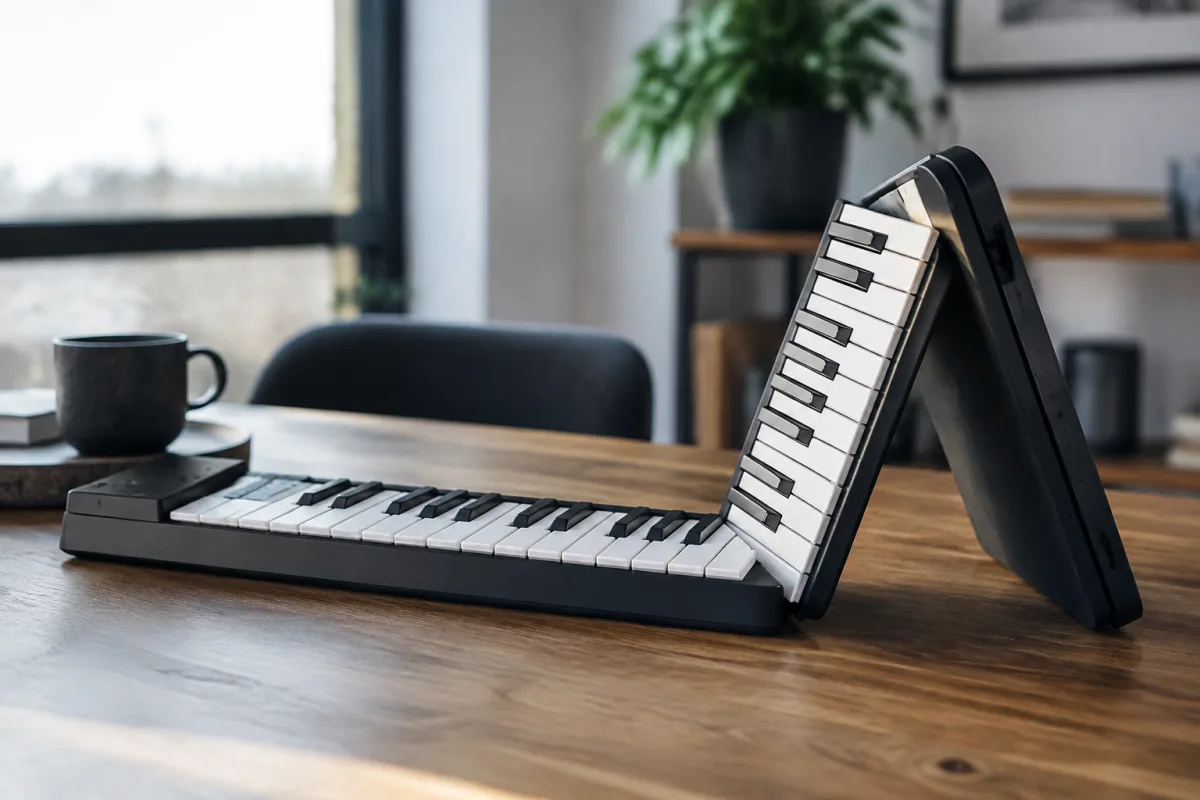
Folding piano keyboards offer portability without sacrificing much playability—but choosing the right one means understanding the trade-offs and knowing what specs matter. Whether you're a gigging musician, a traveller, or someone with limited space at home, this guide walks you through what to look for when buying a folding piano keyboard, from key action and weight to build quality and price tiers.
Why Folding Piano Keyboards Are Different
A folding keyboard folds in half to reduce its footprint for storage or transport. This convenience comes with compromises: they're heavier than traditional portable keyboards of the same length, the action often feels slightly different, and you lose a bit of stability compared to a full-size stand.
These trade-offs are absolutely worth it for the right use case. A musician who gigging at multiple venues, practising in different spaces, or moving between rooms finds a folding keyboard indispensable. Someone with limited space at home benefits hugely. But if your keyboard lives in one place permanently, a full-size keyboard or even a standard portable keyboard might serve you better.
Understanding Keyboard Key Action
Key action—how the keys feel and respond—is the most important factor when choosing any keyboard, especially folding models. Poor action will frustrate you every time you play.
Action Types
Unweighted keys are the standard on portable and folding keyboards. They respond to your touch but don't simulate the weight and resistance of acoustic piano keys. They're lighter, less tiring for long sessions, and perfect for electronic music, pop, and performance-oriented playing.
Semi-weighted keys add resistance to the lower keys, mimicking acoustic piano slightly. They're a compromise—more piano-like than unweighted but not fully weighted. Good for someone who wants some piano feel without full weight.
Weighted keys fully simulate piano action, with heavier resistance and realistic touch. They're essential for classical training or if you want authentic piano practice. However, very few folding keyboards have true weighted action—most that claim it are semi-weighted. This is one area where full-size keyboards excel.
Testing Action in a Shop
Never buy a folding keyboard without testing it. Play a few chords and scales. Feel whether the keys respond predictably. Good action feels responsive and consistent across all keys. Poor action feels mushy, uneven, or laggy—keys respond differently depending on velocity or position.
Try playing fast passages. Do the keys keep up? Or do they lag behind your playing? Fast passages reveal action quality immediately.
Portability vs. Playability: Finding Your Balance
Lighter folding keyboards are more portable but often feel flimsy when playing. Heavier models are sturdier and more stable but harder to carry. Understanding this trade-off helps you choose wisely.
Weight
Most folding keyboards weigh 5–15 kg. At the light end (5–8 kg), they're genuinely portable—you can carry one one-handed or in a backpack for an hour or two. At the heavy end (12–15 kg), portability becomes marginal; you're essentially carrying a full keyboard.
For genuine portability, look for 7–10 kg. Below 7 kg usually means compromised build quality or fewer features; above 10 kg and you're not really gaining much in playability while sacrificing portability.
Folding Mechanism
Check how the keyboard folds. Some fold in the middle (splitting the keys). Others have a separate stand that folds under. Test the folding mechanism several times. It should fold smoothly and lock securely. A stiff or wobbly fold defeats the purpose.
Mid-split keyboards fold in the center, dividing the keys. Quick to fold but less ergonomic—both halves are narrower than normal, which can feel cramped if you're used to full-width keys.
Separate folding stands keep the keyboard at full width but fold the stand underneath. More ergonomic but slightly bulkier when folded.
Test which feels better for your playing style. Some musicians prefer the compactness of mid-split; others want full-width playability and accept a chunkier folded package.
Key Count and Octave Range
Most folding keyboards come in 61, 73 or 88 key configurations.
61 keys cover 5 octaves—enough for most playing but limiting for classical repertoire or full piano pieces. They're the most portable. Good if you play pop, electronic music, or just want learning-friendly size.
73 keys cover 6 octaves—a practical middle ground. Enough for most music without being overwhelming. Less portable than 61-key but still genuinely moveable.
88 keys are full piano range. No limitations, but genuine 88-key folding keyboards are rare and heavier. If an 88-key folding exists, it's either heavy or a compromise in build quality. For full piano repertoire, a standard 88-key keyboard or digital piano is usually better.
For a folding keyboard, 61 or 73 keys makes practical sense. 88-key models sacrifice the main advantage of folding: portability.
Sound Quality and Internal Speakers
Built-in sounds on folding keyboards range from excellent to mediocre. Most have decent piano, strings, and electric piano sounds. Niche sounds (organs, synths) vary widely in quality. Test the sounds you'll actually use.
Internal speakers are convenient but limited. Most folding keyboards have small built-in speakers adequate for practising alone at moderate volume. For performance or teaching, external speakers or headphones are essential.
Headphone output is crucial. You'll practice silently on headphones; make sure the headphone jack is solid and the audio level is strong. Test it in the shop if possible.
MIDI connectivity matters if you plan to use the keyboard with a computer or recording equipment. Check whether it has USB MIDI and whether drivers are available for your operating system.
Build Quality and Durability
Casing material. Plastic is standard and fine; metal reinforcement at stress points (hinges, feet) is better. Avoid keyboards that feel flimsy or creak when you press keys hard.
Keys and mechanism. Look closely at the key construction. Are keys thick plastic or thin? Do they make noise when depressed? Do they return smoothly? Budget keyboards have thin, noisy keys; quality keyboards have solid, quiet key action.
Durability of the fold mechanism. The hinge or fold point is the most likely failure point. It needs to be solid. Sit at the keyboard, press hard on the keys, and see if the structure flexes or moves. A stable keyboard shouldn't twist or flex under normal playing pressure.
Cable and power connections. Check the quality of the power adapter and input jacks. Cheap connectors loosen and fail. Quality connectors feel snug and held. This seems minor but failed cables are frustrating and expensive to replace.
Price Tiers and What You Get
Folding keyboards vary wildly in price, and understanding what each tier offers helps you make smart choices.
| Price Range | What You Get | Best For | Common Compromises |
|---|---|---|---|
| £200–£400 | 61 keys, basic unweighted action, 100+ sounds, MIDI, basic speakers | Beginners, casual players, learners | Action can be mushy; build quality is plasticky; speakers are weak |
| £400–£800 | 73 keys, better action, more polished sounds, good MIDI, better speakers | Intermediate players, regular practice, some gigging | Still limited portable speaker; not fully weighted action |
| £800–£1,500 | 88 keys (rare), semi-weighted action, excellent sounds, robust build, strong MIDI | Professional use, touring, serious practice | Limited availability in true folding 88-key; weight increases |
| £1,500+ | Full specs, weighted action, premium sounds, pro-grade build | Professional touring, recording, classical study | At this price, a full-size digital piano may offer better value |
Most players get excellent value in the £400–£800 range. Below £200, corners are cut that affect everyday playability. Above £1,500, you're paying for professional durability and features you might not need.
Common Buying Mistakes
Prioritizing portability over playability. The lightest keyboards are often the worst to play. A keyboard that's unpleasant to use won't get played. Find the balance—light enough to carry, solid enough to enjoy.
Ignoring action quality. You'll press the keys thousands of times. Poor action is immediately frustrating and never improves. Test the action thoroughly before buying.
Assuming 88 keys always better than 73. For a folding keyboard, 88 keys usually means heavier, bulkier, and not genuinely foldable in a practical way. 73 keys is often the sweet spot for portability and playability.
Underestimating the importance of build quality. Cheap folding keyboards flex and creak. This destroys the experience and the keyboard degrades quickly. Better to pay more for solid construction.
Not testing the fold mechanism. Fold it multiple times in the shop. Does it fold smoothly? Lock securely? Is it intuitive or awkward? A fold mechanism you hate will annoy you constantly.
Forgetting about portability realities. A 12 kg keyboard is genuinely portable for car transport but not backpack-portable. Be honest about how you'll actually move it.
Folding Keyboard vs. Standard Portable Keyboard: When to Choose Each
Choose folding if: You move your keyboard between multiple locations weekly or more. You have limited space at home. You gig or perform regularly. You travel with your keyboard.
Choose standard portable if: Your keyboard stays in one place mostly. You want the best playability possible without compromise. You plan to use weighted action. You're not carrying it much.
The folding feature is genuine convenience, but it's not the best solution for everyone. Be honest about your use case.
Testing Before You Buy: A Practical Checklist
- Play scales and chords at various speeds. Does action feel responsive and consistent?
- Play fast passages. Do keys lag behind your playing?
- Press keys hard. Does the keyboard flex or make creaking sounds?
- Test the sounds you'll actually use. Are they pleasant and usable?
- Fold and unfold the keyboard several times. Is it smooth and intuitive?
- Check all connectors and jacks for solid construction.
- Test headphone output if applicable.
- Consider weight and portability realistically. Can you actually carry this regularly?
- Play for at least 10 minutes. How does it feel after extended playing?
Key Takeaways for Buyers
- Key action is the most important factor. Test it thoroughly.
- Find the balance between portability and playability for your actual use.
- 61–73 keys makes practical sense for folding keyboards; 88-key folds rarely deliver true portability.
- Build quality and durability are worth paying more for.
- Test the fold mechanism carefully; it should be smooth and intuitive.
- Best value is usually £400–£800. Below that, playability suffers; above £1,500, you might be better served by a full-size keyboard.
- Know your actual use case. If your keyboard lives in one place, a folding model might be unnecessary.
- Test before you buy. Play scales, chords, and fast passages to reveal action quality.
Buying a folding piano keyboard is about balancing genuine portability with the playability you need. Test thoroughly, understand your use case, and you'll find a keyboard that serves you reliably for years. Prioritize action quality and build durability over size and price—those factors affect your daily playing experience most.


Comments