
Violin Size Chart article
The Complete Guide to Violin Size Chart
A violin size chart helps parents and teachers select properly fitted instruments. Discover how to use a violin size chart's fractional sizes and measurements to ensure comfortable playing.
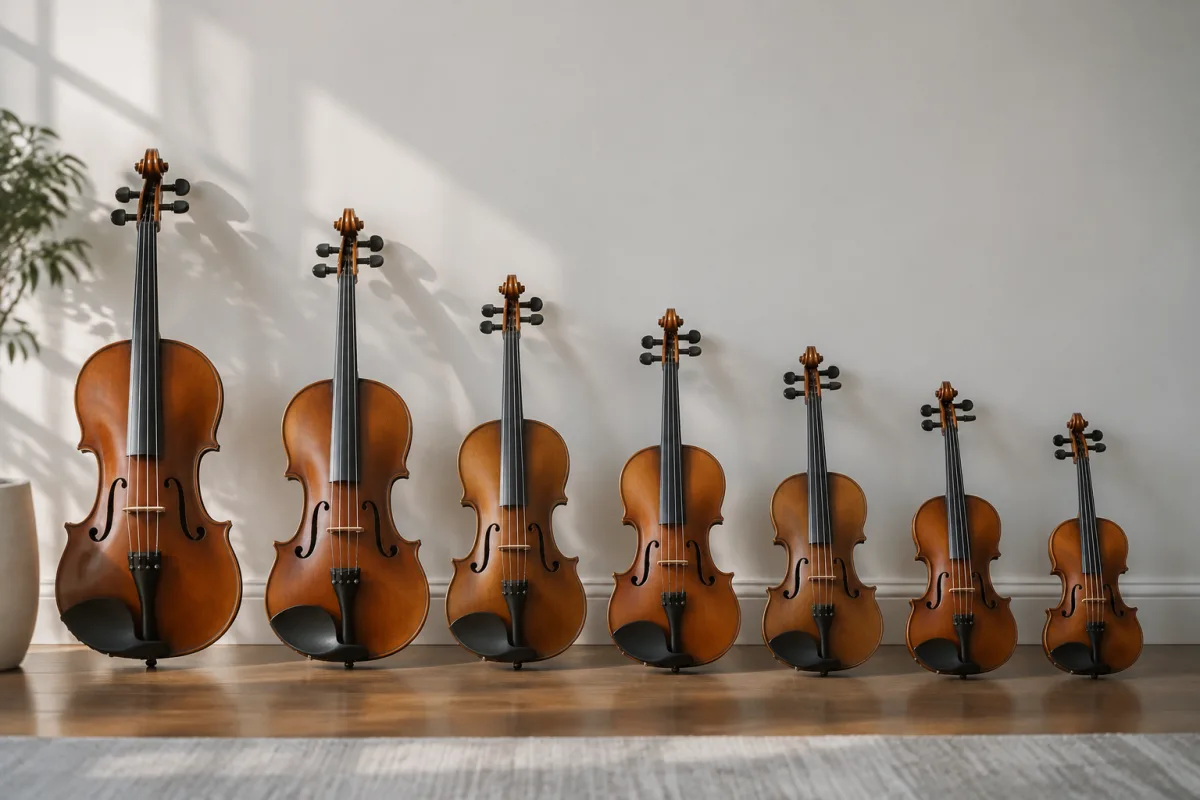
Choosing the correct violin size is fundamental to successful learning and performance—a violin size chart helps parents and young musicians make informed decisions about instrument selection. An inappropriate violin size chart can result in poor technique development, discomfort during playing, and diminished motivation. Understanding what a violin size chart reveals, and how to apply these measurements to individual students, ensures that every musician has an instrument properly fitted to their body and developmental stage.
Understanding the Violin Size Chart System
The violin size chart expresses instrument sizes as fractions: 1/4, 1/2, 3/4, 7/8, and full-size (4/4). A violin size chart's fractional designation refers to the instrument's body length, not a precise mathematical ratio—a 1/2 violin size chart instrument isn't exactly half the length of a full-size violin. Rather, the violin size chart offers a practical categorisation system that music teachers and instrument makers use to ensure proper fit. Understanding how a violin size chart works prevents confusion when purchasing or renting an instrument.
The violin size chart system has remained remarkably consistent across decades, making it a reliable standard for instrument selection. A student using a violin size chart from a reputable teacher or shop can trust that the recommended size will suit their physical proportions and developmental stage.
Sizing According to Age: The Violin Size Chart
A typical violin size chart correlates age to instrument dimensions. Children under four years old rarely progress on violin—their physical development makes even a 1/4 size challenging—so the violin size chart doesn't typically address this age group. The violin size chart recommends a 1/4 size for children aged four to six years old. A 1/2 size violin size chart is appropriate for children aged six to nine. The violin size chart recommends a 3/4 size for children aged nine to twelve. Ages twelve and up typically fit a 7/8 or full-size instrument according to the violin size chart.
These age ranges on a violin size chart are guidelines, not absolutes. Individual variations in physical growth mean some children need a larger or smaller violin size chart recommendation. A tall eight-year-old might benefit from a 3/4 violin size chart instrument; a smaller nine-year-old might remain comfortable in 1/2 size according to a violin size chart assessment.
Arm Length: The Primary Violin Size Chart Measurement
The most reliable violin size chart measurement is the student's arm length—the distance from the shoulder to the fingertips when the arm is extended horizontally. Place a measuring tape from the shoulder joint to the tip of the extended middle finger. A violin size chart uses this measurement to determine proper fit more accurately than age alone. This violin size chart approach accounts for individual variation better than age-based recommendations.
A 1/4 size violin size chart suits arm lengths under 50 cm. The violin size chart recommends 1/2 size for arm lengths 50–55 cm. A 3/4 size violin size chart is appropriate for arm lengths 55–60 cm. The violin size chart suggests 7/8 size for arm lengths 60–65 cm, with full-size (4/4) appropriate for arm lengths over 65 cm. Using this violin size chart measurement method improves instrument fit significantly.
Bridge and Chinrest Considerations in the Violin Size Chart
Beyond overall instrument size, a violin size chart should account for bridge and chinrest compatibility. A child with a smaller frame might need a smaller chinrest even if their arm length suggests a larger violin size chart size. Similarly, the bridge on a violin size chart instrument must be proportioned correctly for the student's neck and jaw configuration. A properly fitted violin size chart instrument involves these smaller adjustments alongside overall size selection.
Quality violin dealers understand that a violin size chart is just the starting point. A teacher or instrument specialist should verify that the specific instrument—not just its size category per the violin size chart—fits the individual properly.
Finger Spacing and Violin Size Chart
A violin size chart doesn't directly address finger span, yet it remains important for technique development. A child's fingers must be able to comfortably reach adjacent strings and finger positions. If a violin size chart-recommended instrument requires excessive finger stretching, the child might develop tension or poor technique. Conversely, if the strings are too close together per a violin size chart guideline, clean intonation becomes difficult.
Playing a few notes on an instrument recommended by a violin size chart reveals whether finger spacing feels natural. If the child must strain to reach positions, reconsider the size despite what the violin size chart suggests.
Fractional Sizes Beyond the Standard Violin Size Chart
Beyond the basic violin size chart categories, some manufacturers produce intermediate sizes like 5/8 or 6/8. A violin size chart might not address these sizes, but they can be valuable for children between standard sizes. A student whose arm length falls between 1/2 and 3/4 according to a violin size chart might benefit from a 5/8 or 6/8 instrument, avoiding both undersizing and oversizing.
When considering intermediate sizes not on a standard violin size chart, consult directly with the teacher or manufacturer. A violin size chart serves as a guideline; professional consultation refines that recommendation.
Rental vs Purchase and the Violin Size Chart
Most beginners rent instruments based on a violin size chart recommendation from their teacher. Rental terms typically allow size exchanges as the student grows, which makes perfect sense per a violin size chart's age-based progression. A child might start in 1/4 per the violin size chart, move to 1/2 after two years, and progress to 3/4 within five years according to the violin size chart developmental progression.
Purchasing an instrument based strictly on a violin size chart's current recommendation risks buying an instrument the child outgrows quickly. Rental preserves flexibility and aligns with the violin size chart's developmental approach.
Common Mistakes With Violin Size Chart Selection
Parents sometimes choose a larger violin size chart size assuming the child will "grow into it." This backfires—an oversized instrument per a violin size chart recommendation causes poor posture, neck strain, and frustration. A violin size chart exists to prevent this. Similarly, keeping a child in an undersized instrument longer than the violin size chart recommends limits their technique progression and comfort.
Another error is ignoring a violin size chart entirely, assuming the child's "interest level" matters more than fit. An uncomfortable instrument per a violin size chart makes practice unpleasant, regardless of enthusiasm. Physical comfort according to a violin size chart assessment directly influences motivation and progress.
Transitioning Through Sizes per the Violin Size Chart
As a student grows, the violin size chart progression typically unfolds over several years. A 1/4 size might serve for two to three years before upgrading to 1/2 according to a violin size chart assessment. A 1/2 size often suffices for three to four years before transitioning to 3/4 per a violin size chart recommendation. These timelines vary; a violin size chart serves as a general guide rather than a strict schedule.
Transitioning to a new violin size chart size can actually benefit progress—the child has outgrown their instrument's limitations and discovers new possibilities on a properly-fitted instrument per the violin size chart's guidance.
Using a Violin Size Chart for Long-Term Success
A violin size chart represents accumulated knowledge from generations of violin teachers and makers—it exists to ensure every student has an instrument suited to their body and developmental stage. Using a violin size chart properly, combined with professional fitting guidance, maximises the chances of comfortable playing, good technique development, and sustained musical enjoyment. Whether you're selecting your first violin per a violin size chart or helping your child progress through sizes, the violin size chart remains your most reliable starting point for ensuring proper fit and lasting musical success.


Comments