


Violin Tuner article
Violin Tuners: A Complete Guide
A violin tuner is both the electronic device that guides you and the mechanical system built into your instrument. Master this essential skill and discover how strings, tension, and pitch work together.

A violin tuner is both a device and a skill—it refers to the tools that help a player reach and maintain the correct pitch, and the understanding of how the instrument responds to adjustment. Whether electronic or mechanical, a violin tuner is essential to the instrument's voice, and mastery of tuning is the first step towards confident playing.
Two meanings of violin tuner
The term violin tuner encompasses two distinct but related concepts. The first is a reference device—something that tells you whether a string is sharp (too high) or flat (too low). This might be a chromatic electronic tuner, a clip-on tuner, a tuning app, a pitch pipe or a tuning fork. The second is the mechanical system built into the instrument itself: the pegs in the pegbox and the fine tuners attached to the tailpiece, which actually change the string's pitch by altering its tension.
For most players, the practical reality is both: you use a reference tool to check your work, and you adjust the pegs and fine tuners to match that reference. This combination—electronic guidance and mechanical control—forms the foundation of reliable violin playing.
How a violin tuner works
A violin string's pitch depends on three physical properties: its vibrating length, its mass per unit length, and the tension holding it tight. When you turn a peg or twist a fine tuner, you are changing the string's tension, which raises or lowers the pitch in response. This is why every adjustment, no matter how small, shifts the sound.
The four open strings of the violin have specific targets. Using equal temperament (the standard system used by electronic tuners), they are:
- G string: G3, approximately 196 Hz
- D string: D4, approximately 294 Hz
- A string: A4, approximately 440 Hz (the conventional reference)
- E string: E5, approximately 659 Hz
These strings are separated by perfect fifths—an interval that has been the foundation of string tuning for centuries. A violin tuner, whether human ears or an electronic display, measures whether each string matches its target frequency.
Types of violin tuner: choosing the right tool
A chromatic electronic violin tuner identifies the note being played and shows whether it is sharp, flat, or centered. Unlike a device designed for only the four open strings, a chromatic tuner works with alternate tunings and other instruments, making it versatile for players at any level.
Clip-on tuners attach directly to the instrument—often at the scroll or pegbox—and detect vibration through the wood rather than relying on airborne sound. This makes them invaluable in orchestral rehearsals, lessons, and noisy environments where a microphone-based app would struggle. They are also inexpensive and portable.
Microphone-based tuning apps offer low-cost access and are convenient when a smartphone is already in hand, but they are vulnerable to background noise and the limitations of phone microphones. Strobe tuners provide high-resolution pitch measurement and suit advanced players doing detailed intonation work, but their sophistication often exceeds what a beginner needs.
Tuning forks and pitch pipes are traditional reference tools that encourage listening and develop the ear, but they require the player to judge pitch by comparison rather than receiving automatic sharp/flat feedback.
The pegs and fine tuners: the mechanical violin tuner
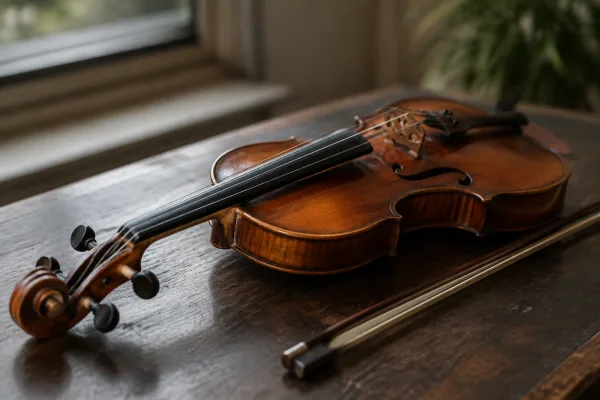
The pegs, located in the pegbox near the scroll, provide the main range of pitch adjustment. They require controlled movement because even a small rotation produces a noticeable pitch change. Fine tuners, located at or near the tailpiece, make smaller corrections by turning a screw. Clockwise generally raises pitch; counterclockwise generally lowers it. The best practice is to use the pegs for substantial corrections and the fine tuners for precision work.
A traditional violin has one fine tuner, usually on the E string. Four fine tuners are common on student instruments because they simplify rapid adjustment, though some advanced players prefer fewer fine tuners because added hardware can affect the tailpiece's weight and the instrument's response. This is partly a matter of personal preference and setup philosophy.
Starting your tuning: the A string and the reference pitch
The A string is the conventional starting point because orchestras commonly tune to an oboe or another instrument sounding A. A standard reference is A4 = 440 Hz, though orchestras and ensembles may agree on a different pitch. After establishing A, the other three strings—D, G, and E—are either tuned with the tuner as reference or checked acoustically as perfect fifths.
The basic workflow is straightforward: place the violin tuner where its display is visible, set the reference pitch, play each string gently, and adjust the pegs or fine tuners until the display shows the target note. Then recheck every string, because adjusting one string can shift the overall tension and slightly affect the others.
Tuner accuracy and musical accuracy
An electronic violin tuner is a calibration tool, not a substitute for the ear. It measures deviation from a reference system—typically equal temperament—but it does not determine every musically appropriate pitch. Professional and advanced players often adjust intervals by ear according to the ensemble's needs, the key of the music, or expressive intent. For open-string tuning, however, the tuner provides reliable, objective guidance, especially for younger players developing their sense of pitch.
The combination of electronic reference and acoustic listening is ideal: use the tuner to confirm that the open strings match their targets, and then trust your ear to shape the stopped notes and passages where musical flexibility matters most.




Comments