


MIDI Guitar article
The Complete Guide to Midi Guitar
MIDI guitar converts your playing into MIDI data, letting you trigger virtual instruments and integrate your guitar with digital music production. Explore hardware and software options.
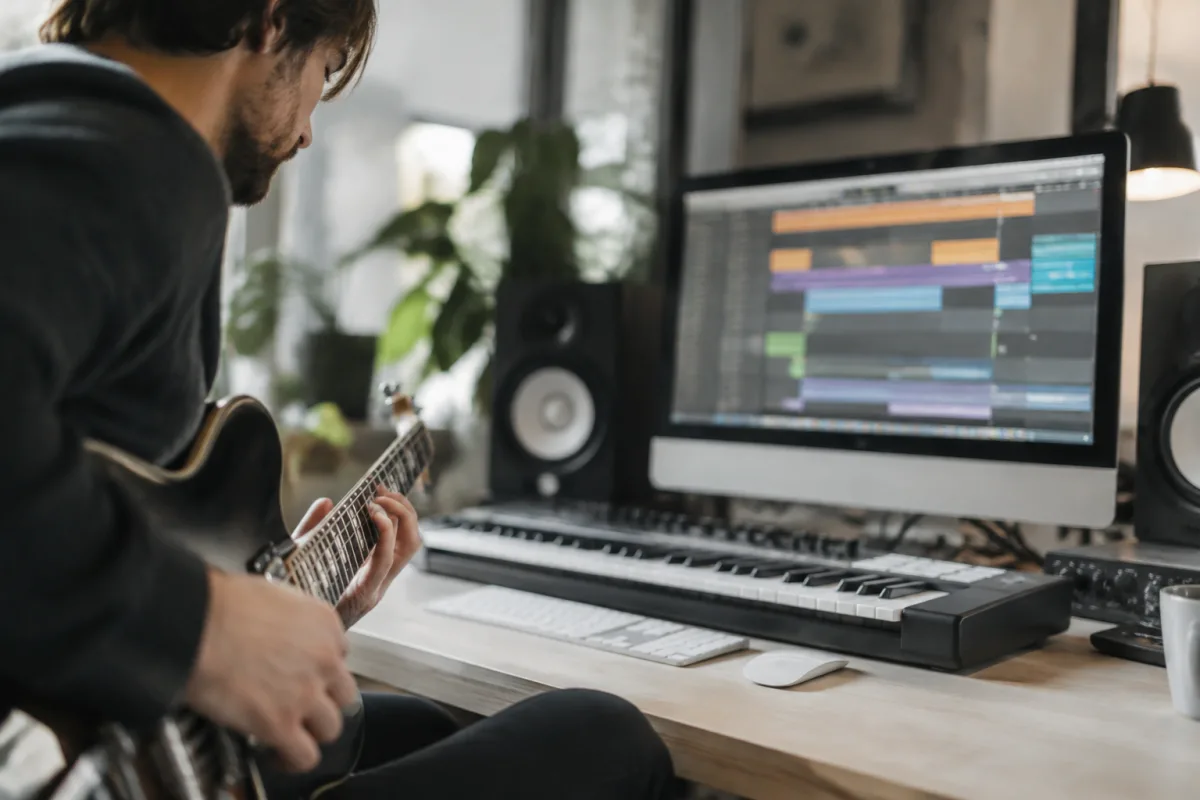
MIDI guitar technology translates your guitar playing into MIDI data, letting you trigger virtual instruments, loop records, and integrate your guitar seamlessly into digital music production. It's not new technology, but modern implementations are far better than earlier attempts. If you compose with virtual instruments or want to use your guitar as a controller, understanding MIDI guitar opens creative possibilities.
What Is MIDI Guitar?
MIDI guitar converts the audio signal from your guitar into MIDI messages—digital note data. Instead of hearing your guitar's natural sound, you hear whatever instrument is triggered by those MIDI notes: a piano, strings, synth, or any virtual instrument in your DAW. This separation of performance from sound opens creative options unavailable on traditional guitar.
The advantage is obvious for composers: play guitar fingerings but hear orchestral strings, piano, or synth. The disadvantage is latency—a slight delay between playing a note and hearing it trigger the MIDI instrument. This delay, however small, affects your playing feel. Modern MIDI guitar systems minimise latency, but it's never completely eliminated.
How MIDI Guitar Works
MIDI guitar systems work in two ways. The first: a software algorithm listens to your guitar's audio and converts it to MIDI in real time. The second: a special pickup or device hardware-converts your playing to MIDI data. Software is more affordable and doesn't require hardware modification; hardware is faster and more reliable but costs more and requires installation.
Types of MIDI Guitar Systems
Software-Based MIDI Guitar
Programs like GarageBand, MainStage and dedicated software like MiDi Listen or Jam Origin listen to your guitar audio and output MIDI. They work with any guitar and any audio interface. The advantage is flexibility and low cost. The disadvantage is latency and occasional tracking errors (the software misinterpreting your playing).
Hardware MIDI Pickups
Special hexaphonic pickups (one magnet per string) send individual string data to a MIDI converter. This hardware approach is faster and more accurate than software. Brands like Roland and Fishman make hardware MIDI systems. The downside is cost (£500–£2000) and the need to install a pickup on your guitar.
USB Digital Interfaces
Some guitar interfaces include MIDI conversion software. Kemper, Helix and other amp modelers include MIDI guitar functions. If you're already using one of these devices, MIDI guitar is a built-in bonus feature.
Practical Applications of MIDI Guitar
Composition and Arranging
Composers use MIDI guitar to sketch arrangements. Play guitar fingerings, hear orchestral strings trigger those notes. It's faster than learning piano or typing MIDI by hand. The finished arrangement is in MIDI, ready for editing and refinement.
Live Performance and Looping
A MIDI guitar pedalboard can trigger loops, effects and instruments during performance. Your guitar becomes a compositional tool, not just a sound source. This opens possibilities for solo performers to layer and build arrangements in real time.
Integration with DAW Workflows
If you're recording in a DAW, MIDI guitar lets you trigger virtual instruments without switching to keyboard or pad controller. Your natural performance gesture (guitar playing) triggers whatever instrument you've selected in your DAW.
Drum Triggering
A guitarist can use MIDI guitar to trigger drums or percussion loops. Mute the strings, play rhythm, and hear drums sync to your playing tempo. This works better with hardware systems (lower latency) than software.
Challenges and Limitations of MIDI Guitar
Latency
The delay between playing and hearing the triggered sound affects your feel. Professional systems minimise latency to 5–15ms, which is noticeable but manageable. Budget software systems may have 50ms or more latency, making accurate playing difficult.
Tracking Errors
Software MIDI guitar can misinterpret fast passages or unusual guitar techniques (muting, bending, harmonics). These techniques don't always translate cleanly to MIDI. Hardware systems are more reliable but not perfect.
Learning Curve
Using MIDI guitar effectively requires learning your system—adjusting sensitivity, mapping MIDI channels, understanding how your guitar's playing technique affects MIDI interpretation. It's not plug-and-play.
Popular MIDI Guitar Systems
Roland and Fishman make professional hardware systems (expensive but very accurate). Jam Origin MIDI Guitar is affordable software (around £40). GarageBand includes basic MIDI conversion for free. Kemper, Helix and other modelers include MIDI functions. MainStage (Mac) includes excellent MIDI guitar conversion.
Is MIDI Guitar Worth Learning?
If you compose, arrange or perform with loopers or trigger systems, MIDI guitar is valuable. If you're a traditional guitarist playing standard guitar, it's an optional creative tool. The barrier to entry is low (free software options exist), so experimentation is affordable. Try it with free tools before investing in hardware or premium software.
Conclusion
MIDI guitar is a bridge between traditional guitar playing and digital music production. It lets you play guitar naturally while triggering any virtual instrument or effect. Modern MIDI guitar systems have improved dramatically—latency is lower, tracking is more reliable. Whether you're composing, performing or recording, MIDI guitar opens creative possibilities that pure acoustic guitar doesn't offer. For many modern musicians, it's an essential tool.


Comments