
Drum Set Amp article
Drum Amps: How to Amplify an Electronic Kit
An electronic kit makes almost no sound of its own. How you turn that signal into air is most of what your kit will sound like — and it is the decision people most often get wrong.
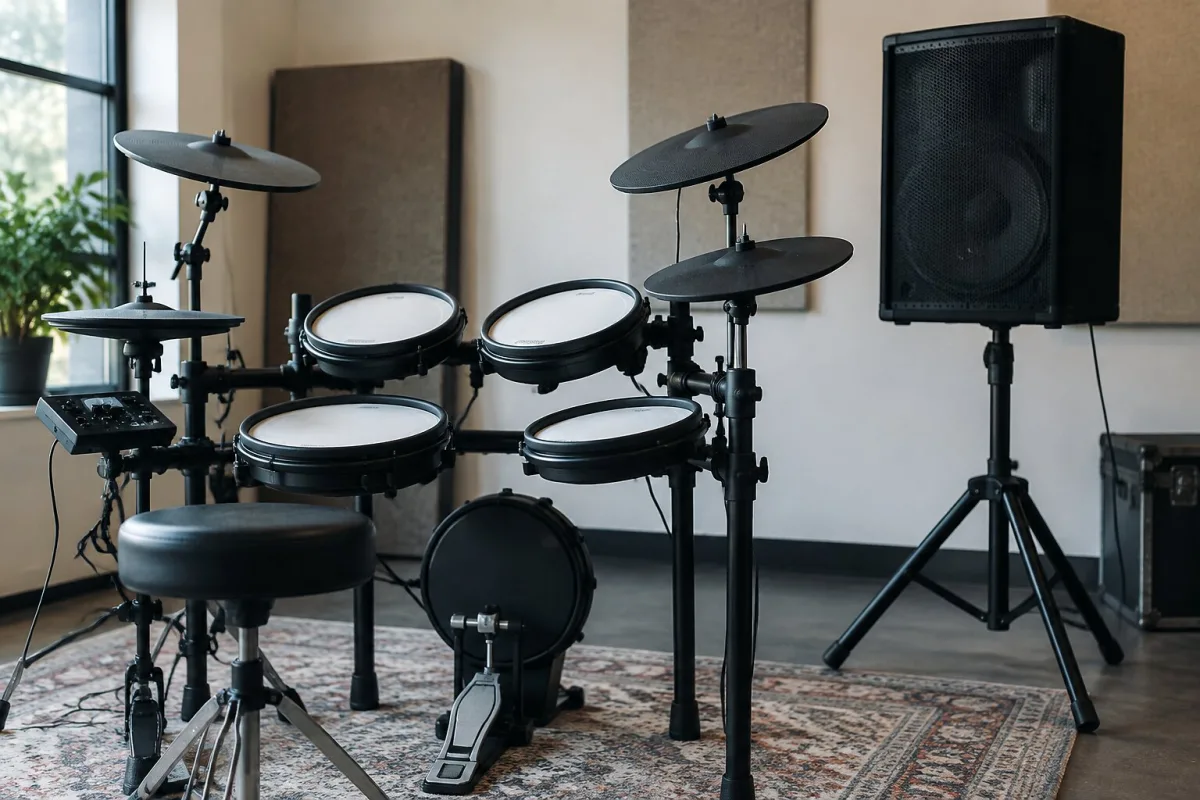
An electronic kit makes almost no sound of its own. Everything you play exists as a signal inside the module, and how you choose to turn that signal into air is not a detail — it is most of what your kit will sound like to anyone listening, including you.
This is the decision people most often get wrong, usually by reaching for an amplifier they already own.
Why a guitar amp is the wrong tool
A guitar amplifier is deliberately not neutral. It is voiced around the midrange, where a guitar lives, and it is designed to colour what passes through it. That is precisely why guitarists buy them.
A drum kit occupies the entire frequency range at once. A kick drum's weight sits far below where a guitar amp is built to go; a cymbal's shimmer sits far above it. Play a kit through one and you lose both ends — the kick turns to a thud and the cymbals to a lisp.
The requirement is the opposite of a guitar amp: reproduce everything, add nothing.
The three sensible options
A dedicated drum amp
Purpose-built units designed around exactly this problem. They typically offer several input channels, dedicated equalisation and effects intended for drum modules, and a cabinet voiced to handle low frequencies without complaint.
For home practice this is usually the most straightforward answer: one box, the right connections, and controls that assume you are plugging in a drum module rather than guessing.
A keyboard amplifier
Keyboard amps solve a very similar problem and solve it well. They are built for a wide, flat frequency response, and are almost always combination units pairing a full-range speaker with a horn-loaded tweeter in a single cabinet.
That combination reproduces a kit honestly, and a keyboard amp is often the better value if you find a used one, since the requirement overlaps so heavily.
A PA speaker or FRFR cabinet
FRFR stands for full range, flat response, which is a description of exactly what an electronic kit needs. An active PA speaker will generally give the best sound quality of the three and will go considerably louder, which is what makes it the usual answer for playing live.
The trade-off is the low end. A PA top will not deliver the physical weight of a kick drum the way a dedicated drum amp does, unless you add a subwoofer — at which point you have bought two things.
Choosing by what you actually do
| Situation | Sensible choice |
|---|---|
| Practising alone at home | Headphones, honestly — or a modest drum amp |
| Rehearsing with a band | A drum amp or keyboard amp with enough power to be heard |
| Playing live | Into the PA, with an FRFR wedge or in-ears for yourself |
| Teaching or demonstrating | A keyboard amp, for the flat response and multiple inputs |
How much power do you need?
More than instinct suggests, and for a reason that is easy to miss. Drums are percussive, and percussive signals have very high peaks relative to their average level. An amplifier comfortable with a sustained keyboard chord can be driven into distortion by the transient of a rimshot at the same apparent volume.
Headroom is therefore the specification that matters. A drum amp running at half its capacity sounds clean and controlled; the same amp at its limit sounds harsh and compressed, and no equalisation will repair it.
Practically: for bedroom practice a modest unit is plenty. For rehearsing against a live drummer's worth of volume from guitars and bass, you need considerably more than seems reasonable on paper.
Getting the best from it
- Lift it off the floor. A stand or even a sturdy box brings the cabinet closer to ear height and stops the floor exaggerating the bass.
- Set the module's output properly. Run it fairly high and the amp's input lower, rather than the reverse, which keeps the noise floor down.
- Start flat. Set every tone control to neutral and only then correct what the room is doing. The kit was voiced by people who knew what they were doing.
- Mind the placement. A cabinet in a corner gains bass you did not ask for and cannot easily remove.
- Use headphones for detail. For quiet practice and for hearing exactly what your playing is doing, a good pair beats any drum amp at any price.
The short answer
Buy a drum amp, a keyboard amp or an active FRFR speaker — anything built to reproduce the whole frequency range honestly. Do not use a guitar amplifier, whatever is currently sitting unused in the corner. Then buy more headroom than feels necessary, keep the tone controls flat until the room tells you otherwise, and get the cabinet off the floor.
Do that and the kit will finally sound the way it does in your headphones, which is what you paid for in the first place.


Comments