
Guitar Music Notes Chart article
The Complete Guide to Guitar Music Notes Chart
A guitar notes chart displays where each musical note appears on the fretboard, helping guitarists of all levels learn note positions, read music fluently, and develop solid fretboard knowledge.
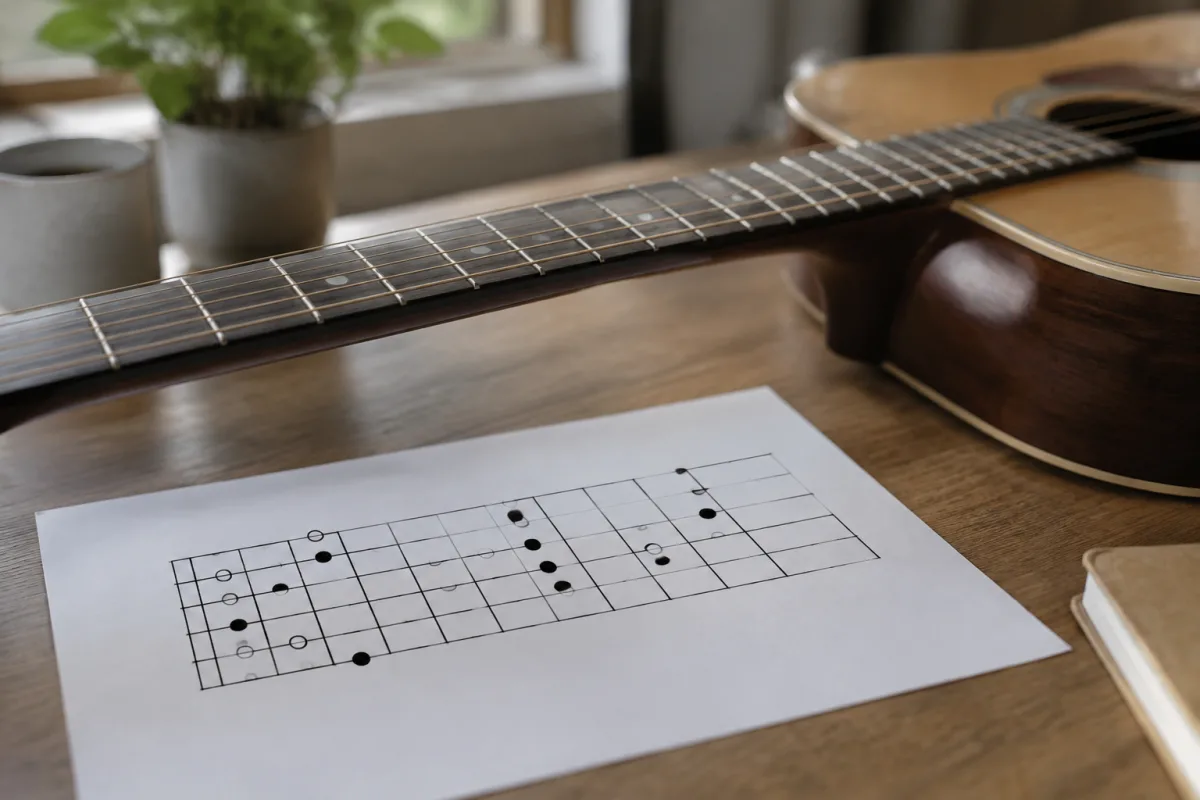
A guitar notes chart is an invaluable reference tool for guitarists of all levels, displaying where each musical note appears on the fretboard and how notes correspond to standard musical notation. Whether you are learning to read music, developing finger positioning knowledge, or understanding music theory, a well-designed guitar notes chart accelerates your musical progress and reinforces foundational knowledge. This complete guide explores different types of guitar notes charts, how to read them, and how to use them effectively in your musical development.
What Is a Guitar Notes Chart?
A guitar notes chart visually represents where each musical note appears on a guitar fretboard. The most common format shows all six guitar strings across a two-octave range (typically frets 0–24), with each note's name displayed on the corresponding fretboard position. Quality charts typically colour-code notes by pitch (highlighting all Cs in one colour, all Ds in another, etc.), making pattern recognition and learning faster and more intuitive.
Standard tuning on a guitar from lowest to highest string is E-A-D-G-B-E. A complete notes chart shows how the chromatic scale (all twelve semitones) repeats across different fret positions and different strings, helping guitarists understand fretboard geography and develop the muscle memory necessary to play fluently.
Types of Guitar Notes Charts
Different chart formats serve different purposes and learning stages:
Full Fretboard Charts
Complete fretboard charts display all six strings across the full playable range (typically 24 frets, sometimes more). These charts show every available note position and help guitarists visualise the entire fretboard. Full charts are excellent for understanding fretboard patterns but can feel overwhelming for beginners due to the sheer volume of information displayed simultaneously.
Condensed Single-Octave Charts
Simplified charts showing just one octave (usually frets 0–12) of all six strings provide focused learning material. These condensed versions are ideal for beginners who are still developing fundamental fretboard knowledge. Once a guitarist masters one octave, the pattern repeats across higher frets, making single-octave mastery a logical first step.
String-by-String Notes Charts
Individual string charts display all notes on a single string from open to beyond the 12th fret. These are valuable for targeted learning; a guitarist might spend focused practice time on one string, memorising note positions before progressing to the next string. String-by-string study builds systematic, methodical understanding.
Open Position Charts
Charts focusing on the first few frets (0–5) where beginners typically start are valuable for early learning. Open position contains many useful note combinations and common chord shapes, making it a logical starting point for developing fretboard knowledge.
Chromatic Scale Charts
Charts displaying only chromatic notes (all twelve semitones within an octave) help guitarists understand the semitone intervals between each fretted position. These reinforcing the concept that each fret represents one semitone of pitch rise.
How to Read a Guitar Notes Chart
Understanding chart notation is straightforward once you learn the basics:
Fret Numbering
Frets are numbered from left to right: 0 (open string), 1, 2, 3, etc. The "0" position represents playing an open string without fretting any note. Each number increases by one semitone going up the fretboard.
String Identification
Strings are typically displayed from top to bottom in charts as high to low pitch (E-B-G-D-A-E from high to low). Some charts reverse this orientation; always check the legend to ensure correct interpretation.
Note Names and Colour Coding
Each chart position displays the note name (C, D, E, F, G, A, B, with sharps and flats shown as needed). Colour coding helps pattern recognition—visualising all Cs in red across the fretboard helps guitarists understand where their preferred notes appear.
Octave Markings
Quality charts often mark octaves (indicated by superscript numbers like C4, C5, etc. in scientific pitch notation) to help guitarists understand pitch relationships and recognise which octave they are playing in.
Why Guitar Notes Charts Matter
Effective fretboard knowledge provides numerous practical benefits:
- Faster Note Reading: Guitarists who visualise where notes appear on the fretboard read music more quickly and fluently.
- Better Improvisation: Understanding which notes sit where enables spontaneous playing and improvisation without depending entirely on memorised patterns.
- Efficient Learning: Systematic note memorisation accelerates overall musical development and supports learning scales, chords, and more advanced concepts.
- Communication with Bandmates: Guitarists who understand and can discuss specific fret positions communicate more effectively about songs and arrangements.
- Increased Confidence: Solid fretboard knowledge builds confidence and reduces dependence on memorised muscle patterns.
Using Charts Effectively: Practice Strategies
Simply viewing charts is insufficient; active practice with charts accelerates learning:
Drill Individual Strings
Select one string and practice naming notes from open to the 12th fret. Play each note while saying its name aloud. This combines auditory, visual, and kinesthetic learning, engaging multiple learning pathways simultaneously.
Find Notes Across Strings
Given a note name (like "D"), find all positions that note appears on the fretboard. This highlights that each note repeats at different octaves across different strings—a fundamental fretboard concept.
Develop Finger Muscle Memory
Use charts to guide finger positions whilst playing scales, arpeggios, and patterns. Your fingers gradually memorise positions through repetition, eventually allowing intuitive playing without constant chart reference.
Reverse Quizzing
Point to random fretboard positions and name the notes without chart reference. This tests and reinforces knowledge, revealing gaps in your understanding that warrant additional focused practice.
Digital vs. Printed Charts
Both formats have distinct advantages. Printed charts are always available without needing devices, making them ideal for dedicated study sessions. Digital charts offer interactive features—some apps play sounds for each note, allowing immediate auditory feedback. Interactive apps can also randomise quizzes, tracking progress over time. Most serious guitarists benefit from both formats, using printed charts for focused study and digital tools for interactive practice.
Conclusion
A quality guitar notes chart is a fundamental learning tool that accelerates musical development and builds the fretboard knowledge essential for confident, fluent playing. Whether you use complete fretboard charts or targeted single-string versions, consistent practice with charts transforms fretboard geography from mysterious randomness into comprehensible, predictable patterns. Invest time in systematic chart-based note learning, and you will develop the solid fretboard foundation that supports effortless playing, confident improvisation, and lifelong musical growth.


Comments