
United Kingdom Music Charts article
The Complete Guide to United Kingdom Music Charts
The United Kingdom music charts have tracked British musical taste since the 1950s, measuring commercial success through sales and streaming data.
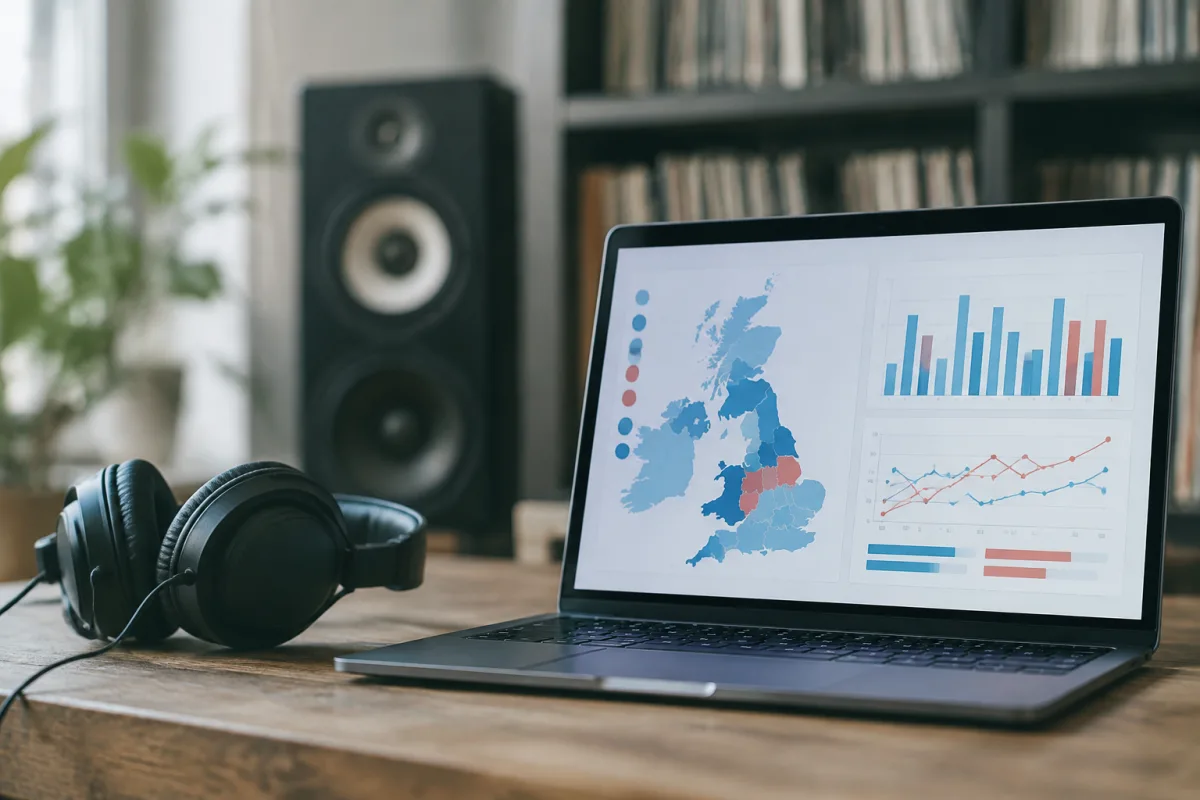
The United Kingdom music charts are the official measure of commercial success and popularity in the British music industry. Since their introduction in the 1950s, United Kingdom music charts have tracked the buying habits of millions of listeners and shaped the careers of countless artists. Whether you follow pop, rock, indie or hip-hop, the UK charts offer a weekly snapshot of what listeners are actually choosing to buy or stream.
What Are the United Kingdom Music Charts?
United Kingdom music charts are weekly rankings of the most popular music in the UK, compiled by the Official Charts Company. They measure what the British public is listening to across multiple genres and release formats. The Official UK Singles Chart ranks individual songs; the Official UK Albums Chart ranks full albums. Both charts reflect real purchasing and streaming data, not radio play or critical opinion.
The charts matter because they influence radio playlist decisions, streaming platform promotion and record label investment. A song reaching number one on the Official UK Singles Chart signals mainstream commercial success and often triggers a global marketing push. Artists cite their UK chart positions on album sleeves, in interviews and on social media. For the industry, the charts reveal trends — shifts from physical sales to streaming, the rise of particular genres or the influence of international acts on British tastes.
History of the United Kingdom Music Charts
The Official UK Albums Chart began in 1956, making it one of the world's oldest official music charts. Initially, the charts were compiled by hand, based on sales reports from record shops across the UK. The Official UK Singles Chart followed in 1952, tracking seven-inch singles — the dominant format of the 1950s and 1960s. As vinyl gave way to cassettes, CDs and eventually digital downloads and streaming, the charts evolved to capture sales across all formats.
For decades, chart positions were calculated purely from physical sales. A record shop scan would tally up Beatle albums, Rolling Stones singles and Bowie LPs to determine what the nation was buying. In the 2010s, the calculation shifted to include digital downloads via iTunes and streaming plays from Spotify, Apple Music and other platforms. This change reflected the reality of how people now consume music — immediately, on demand, without ever visiting a shop or owning a physical disc.
How Are United Kingdom Music Charts Calculated?
Today, United Kingdom music charts combine three data sources into a unified ranking. Physical sales (vinyl, CDs) still count, though they now represent only a fraction of all music consumption in the UK. Digital downloads counted directly as sales, with a single download purchase equal to one chart unit. Streaming plays are now a major factor: the Official Charts Company converts 300 audio streams into the equivalent of one sale for chart purposes. This reflects the reality that a listener might stream a song dozens of times across platforms, and the charts need a fair way to count this behaviour.
The Official Charts Company gathers data from music retailers, digital download services and streaming platforms. They verify the data, remove suspected fraud or manipulation (chart manipulation campaigns do happen), and calculate the official positions every Sunday at noon. The new chart is published the following Friday, creating a weekly rhythm that the music industry and fans follow religiously.
The Official UK Singles Chart
The Official UK Singles Chart ranks the top 100 individual songs. Number one on this chart is the most prestigious weekly achievement in British pop music. Reaching the UK top 10 is a career milestone. The chart reflects commercial performance in the most granular way — if a song is catchy, memorable or culturally significant, it will chart high. Recent years have seen UK chart dominance from global superstars (Taylor Swift, The Weeknd) as well as homegrown acts (Harry Styles, Adele).
The UK Singles Chart has a fascinating history. In the 1960s and 1970s, homegrown artists dominated — The Beatles, The Rolling Stones, David Bowie and Queen shaped the charts and the era. The 1980s saw synth-pop, new wave and the emergence of pop manufacturing (Stock Aitken Waterman dominated the late 1980s). By the 1990s, Britpop was in full swing, with Oasis, Blur and Pulp alongside American grunge imports. Today's chart is truly global, with UK listeners choosing artists from across the world.
The Official UK Albums Chart
The Official UK Albums Chart ranks full-length releases. Album success is often more artistically significant than singles dominance — a number-one album demonstrates that listeners value a body of work, not just a catchy moment. Legendary albums have charted number one: The Beatles' *Sgt. Pepper's Lonely Hearts Club Band*, Pink Floyd's *The Dark Side of the Moon*, and more recently *Midnights* by Taylor Swift or *30* by Adele.
The UK Albums Chart showed the sharpest decline in physical sales over the past decade. In the 2000s, number-one albums would shift 200,000+ copies in a week. Today, a number-one album might shift 30,000–60,000 copies as a combination of streams, downloads and remaining physical sales. Yet the chart remains highly competitive and deeply respected within the industry.
Chart Performance and Career Impact
For artists, chart success translates into tangible career benefits. A top-10 single receives daytime radio airplay on BBC Radio 1 and commercial stations, exposing it to millions. Chart success justifies investment in music videos, promotional tours and marketing. Record labels invest heavily in new artists, but chart performance is often the tipping point for whether a label maintains support. Independent artists without label backing study the charts to understand what's working; streaming playlists curated by platforms now rival chart positions as a source of exposure.
Chart nostalgia is also a significant cultural force. "Chart Hits" compilation albums, end-of-year top-40 countdowns and "Best of the 1980s" lists all lean on chart history to define what mattered musically. Your generation's chart moments — who topped the charts during your teens and twenties — become part of your musical identity and memories.
Controversies and Challenges
The United Kingdom music charts face ongoing criticism. Some argue that streaming metrics inflate the numbers for short, catchy songs — a three-minute pop single is inherently more re-playable than a seven-minute prog-rock epic. Others point out that streaming platforms can algorithmically promote certain songs, biasing the charts. Chart manipulation schemes occasionally surface, with campaigns to artificially inflate a song's chart position through coordinated buying or streaming.
The charts have also become less predictive of lasting success than they once were. A song can chart high on Tuesday, then vanish from the chart within two weeks, never to return. In contrast, many "sleeper" hits never chart at all but achieve lasting cultural significance through word-of-mouth and playlist discovery. The charts now measure immediate commercial success rather than lasting impact.
How to Follow the United Kingdom Music Charts
The easiest way to follow United Kingdom music charts is via the Official Charts Company website (officialcharts.com), which publishes the latest positions every Friday. BBC Radio 1 broadcasts a weekly chart rundown, still a cultural touchstone. Spotify and Apple Music integrate chart data into their apps, showing you what's popular. Music publications like NME, *New Musical Express*, Kerrang! and *Music Week* cover chart stories and trends. If you're curious about chart history, Discogs and Wikipedia maintain detailed historical records of UK chart positions dating back to 1952.
Conclusion
The United Kingdom music charts remain a central institution in British musical culture. They provide a weekly snapshot of what listeners are actually choosing to hear, unfiltered by critic opinion or algorithm manipulation. Whether you love pop, rock, electronic music or anything in between, the charts reveal where British musical tastes are heading. Follow them for entertainment, use them to discover emerging acts, or consult them for nostalgic journeys into the music of your youth — the United Kingdom music charts are a rich, evolving record of British musical life.



Comments