
Guitar Tuning Notes article
The Complete Guide to Guitar Tuning Notes
Understanding guitar tuning notes is the foundation of learning guitar. This guide explains standard tuning, each string's pitch, and how to tune accurately.
Learning what each string on a guitar represents musically is fundamental to becoming a confident player. Guitar tuning notes are the specific pitches assigned to each string, and understanding them unlocks the fretboard and speeds up your progress. Whether you're a complete beginner or revisiting the basics, this guide walks you through everything you need to know about standard tuning and beyond.
The Standard Guitar Tuning
Most acoustic and electric guitars use standard tuning, which assigns six specific pitches from the lowest (thickest) string to the highest (thinnest). The strings are tuned to E, A, D, G, B, and E, often remembered by the mnemonic "Eddie Ate Dynamite, Good Bye Eddie." The lowest E is two octaves below the highest E.
Standard tuning is the default because it balances playability, tone, and the range needed for most music styles. Once you master it, learning songs and building muscle memory becomes much faster.
Understanding Each String's Note
Let's look at each of the six strings individually:
- String 1 (Low E): The thickest string produces the lowest note, E2. It provides the bass foundation for chords and riffs.
- String 2 (A): Tuned to A2, this string is often used for power chords and deep melodic lines.
- String 3 (D): Tuned to D3, the D string sits in the mid-range and frequently features in chord voicings.
- String 4 (G): Tuned to G3, this string is known for its bright, singing tone and is central to many chord shapes.
- String 5 (B): The B string at B3 has a clear, cutting tone perfect for lead lines and solos.
- String 6 (High E): The thinnest string, tuned to E4, sounds two octaves above the low E and is ideal for fast, high-register melodies.
Why Standard Tuning Matters
Standard tuning is ubiquitous because it optimizes chord shapes, string spacing, and overall playability. Most song tutorials, tablature, and teaching materials assume standard tuning. Learning this foundation first makes it easier to explore alternative tunings later, and it ensures you can pick up any guitar without confusion.
How to Tune Your Guitar to Standard Pitch
Accurate tuning is essential for good intonation and enjoyment. Here are the most common methods:
- Digital tuner: Clip a digital tuner to your headstock, pluck each string, and adjust the tuning machine until the tuner shows the correct note. This is the most reliable method for beginners.
- Tune-by-ear: Experienced players compare each string to a reference note (from a piano, app, or phone) and adjust by ear. This develops pitch perception but requires training.
- Relative tuning: Tune the low E string to a known reference, then tune each subsequent string relative to the previous one. This works anywhere but can drift if the first reference is slightly off.
- Online tuning tools: Many websites and apps generate the standard pitches so you can tune by matching the sound. Convenient and free, though less precise than a clip-on tuner.
Alternate Tunings and Drop D
Many songs use tunings other than standard. Drop D is perhaps the most common, where you lower the low E string to D, creating a deeper, heavier sound popular in rock and metal. Other alternative tunings like open G, open D, or DADGAD (used frequently in folk and alternative music) change the entire harmonic landscape of the instrument.
However, start with standard tuning until you can navigate it confidently. Once you're comfortable with standard, exploring alternate tunings becomes far more accessible.
Tuning Machine Adjustments
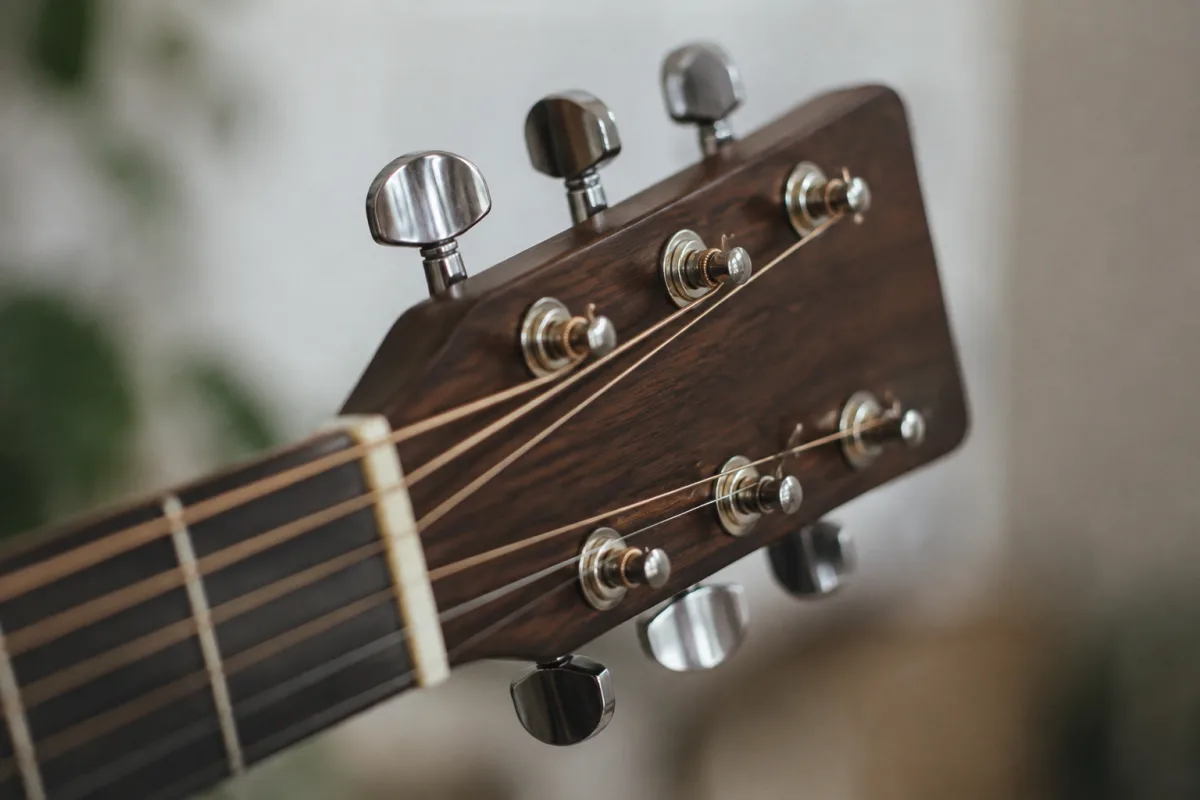
Each tuning machine (also called a tuning peg) on the headstock controls one string's pitch. Turning clockwise typically tightens the string and raises the pitch, whilst counter-clockwise loosens it and lowers the pitch. Turn smoothly and gently, especially on new strings that are still settling in. Never crank on a tuning machine aggressively, as you risk breaking a string or damaging the headstock.
Maintaining Consistent Tuning
Guitars naturally drift out of tune due to temperature changes, new strings stretching, and the normal wear of playing. Check your tuning before every practice session and after changing strings. New strings particularly need frequent retuning during their first few days. As your guitar ages and stabilizes, it will hold tuning better.
If your guitar consistently drifts sharp or flat, check the bridge, nut, and tuning machine condition. A professional setup can address intonation and tuning stability issues that a simple retune can't fix.
Conclusion
Mastering standard tuning and understanding what each string represents musically is a cornerstone of guitar playing. Take time to learn the notes, practise tuning by ear, and develop the habit of checking tuning regularly. Once standard tuning becomes second nature, you'll be free to explore alternate tunings and focus on the musical skills that make playing truly rewarding.



Comments