
Les Paul Junior Guitar article
The Complete Guide to Les Paul Junior Guitar
The Les Paul Junior is a contradiction—simple, yet perfectly formed. An affordable alternative that became essential to rock and blues music, offering warm, articulate tone and honest craftsmanship.
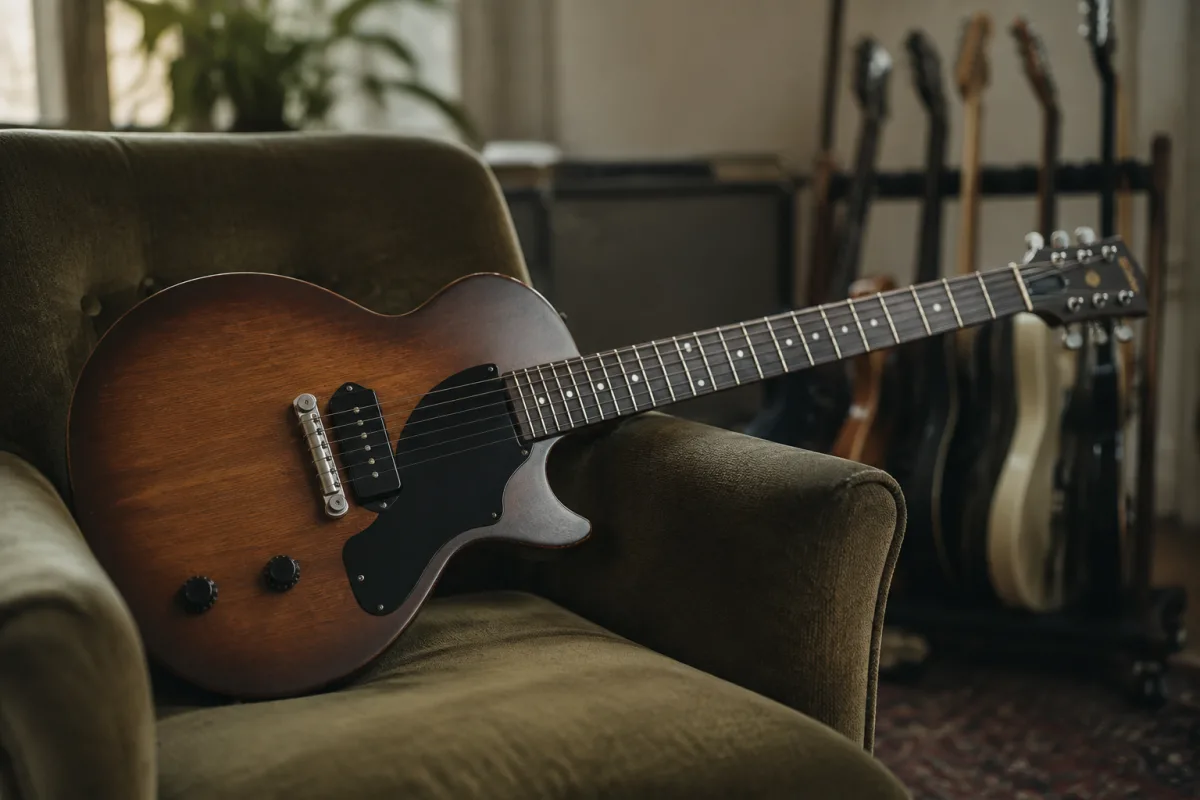
The Les Paul Junior is one of those guitars that arrives as a contradiction—simple, yet somehow perfectly formed. When Gibson introduced it in 1954, they weren't aiming for legendary status; they just wanted an affordable alternative to the more costly Les Paul Standard. Instead, what emerged was a guitar that would become a staple in the hands of some of rock's greatest innovators. If you're thinking about getting a Les Paul Junior, you're not buying an entry-level compromise; you're buying into a heritage of raw, honest tone that defined generations of music.
The History Behind the Les Paul Junior
The Les Paul Junior arrived during a fascinating moment in guitar history. The original 1954 model featured a single P-90 pickup, a single-cutaway solid mahogany body, and a stripped-down aesthetic that stood in contrast to the elaborate multi-pickup designs beginning to dominate the market. Gibson's idea was democratising access to quality instrumentation, but something unexpected happened: musicians fell in love with it. The simplicity that made it affordable also made it responsive and immediate. No frills, no excess—just a direct connection between player and amplifier.
Through the late Fifties and into the Sixties, the Les Paul Junior became a favourite of blues players and early rock pioneers. The guitar's fundamental design hasn't changed dramatically in nearly seventy years, a testament to how right Gibson got it from the start. Certain designs you encounter in music are perfect the first time, and the Les Paul Junior occupies that rare category.
What Makes the Les Paul Junior Special
The magic of a Les Paul Junior lies in its essential nature. The single-cutaway body is compact and comfortable, the neck is typically slightly slimmer and easier to navigate than its Standard cousin, and the whole instrument has a weight and balance that just feels right in your hands. The mahogany construction gives the guitar its warm, resonant character; even played unplugged, a Junior sings with a richness that cheaper instruments simply cannot match.
Most importantly, the Les Paul Junior is a genuine working player's instrument. It's not asking for reverence; it's asking to be played. The simplicity of the electronics—one pickup, one volume, one tone control—means there's nowhere to hide. Your technique, your approach, your touch on the strings: these matter infinitely more than tweaking controls. That directness is part of what makes it so rewarding.
Les Paul Junior Variations
While the original single-pickup configuration remains iconic, Gibson and other manufacturers have offered variations over the decades:
- Single P-90 (Original): The classic configuration, warm and slightly vintage-sounding with natural harmonic character.
- Dual P-90s: Added in later years, offering more tonal flexibility and output. Still maintains the warm P-90 character but with greater range.
- Single Humbucker: Modern versions sometimes feature a humbucker instead of a P-90, offering a thicker, more aggressive tone.
- Double Cutaway: A model variant introduced in 1958, offering easier access to higher frets and a slightly different aesthetic.
If you're choosing between versions, consider what kind of music you play. P-90 Juniors excel in blues, early rock, and any style where you want warm, slightly woody tone. Humbucker versions suit players who want heavier sounds, though you lose some of that Classic vintage character.
Sound and Tone
The Les Paul Junior produces a tone that's warm, woody, and surprisingly articulate. Even with a single P-90, the guitar has remarkable tonal range depending on how you approach it. Rolling back the tone control on a Junior gives you an almost mellow, almost saxophone-like quality. Cranked up full, it delivers satisfying bite and natural sustain. This responsiveness to playing technique is part of why so many working musicians prefer the Junior; it rewards thoughtful playing without demanding expensive tone-shaping equipment.
Through a clean amp, the Juniors clear and direct. Through overdrive or distortion, it maintains definition and articulation that muddier guitars lose. It's an excellent choice for players who want their technique and touch to shine through their tone, rather than relying on effects to create their voice.
Who Should Buy a Les Paul Junior?
A Les Paul Junior works beautifully for several categories of players. Beginners benefit from its lighter weight and thinner neck compared to a Standard. Intermediate players appreciate how the simple electronics force them to focus on technique. Working musicians love its reliability, straightforward design, and the fact that repairs and modifications are refreshingly simple. Anyone seeking an honest, no-nonsense guitar should seriously consider a Junior. It's not a novelty item or a stepping stone; it's a proper guitar that happens to be more affordable than many alternatives.
The Les Paul Junior is also ideal if you play styles that value warmth and clarity over sheer aggression: blues, vintage rock, folk, and even clean jazz tones. That said, the instrument is remarkably versatile. With the right amp and technique, you can pull virtually any modern tone from a Junior.
New vs. Vintage
Vintage original Les Paul Juniors from the Fifties are now collectors' items with prices to match. Fortunately, modern reproductions are excellent. Current Gibson models are built to the same standards as the originals and represent genuine value. Other manufacturers like Epiphone and various boutique builders also produce fine Juniors at various price points. Unless you specifically need the investment appeal or specific tonal characteristics of a vintage example, a new Junior from a reputable maker will serve you beautifully.
The Les Paul Junior is, ultimately, a guitar that proves simplicity in design isn't a limitation—it's a feature. When an instrument gets out of the way and lets you focus on your playing, that's when music happens. For nearly seven decades, the Junior has been doing exactly that.


Comments