
Mustang Bass article
The Complete Guide to Mustang Bass
The Fender Mustang Bass has inspired countless bassists since 1966 with its compact size, distinctive voice, and uncompromising character—learn what makes it stand apart from conventional choices.
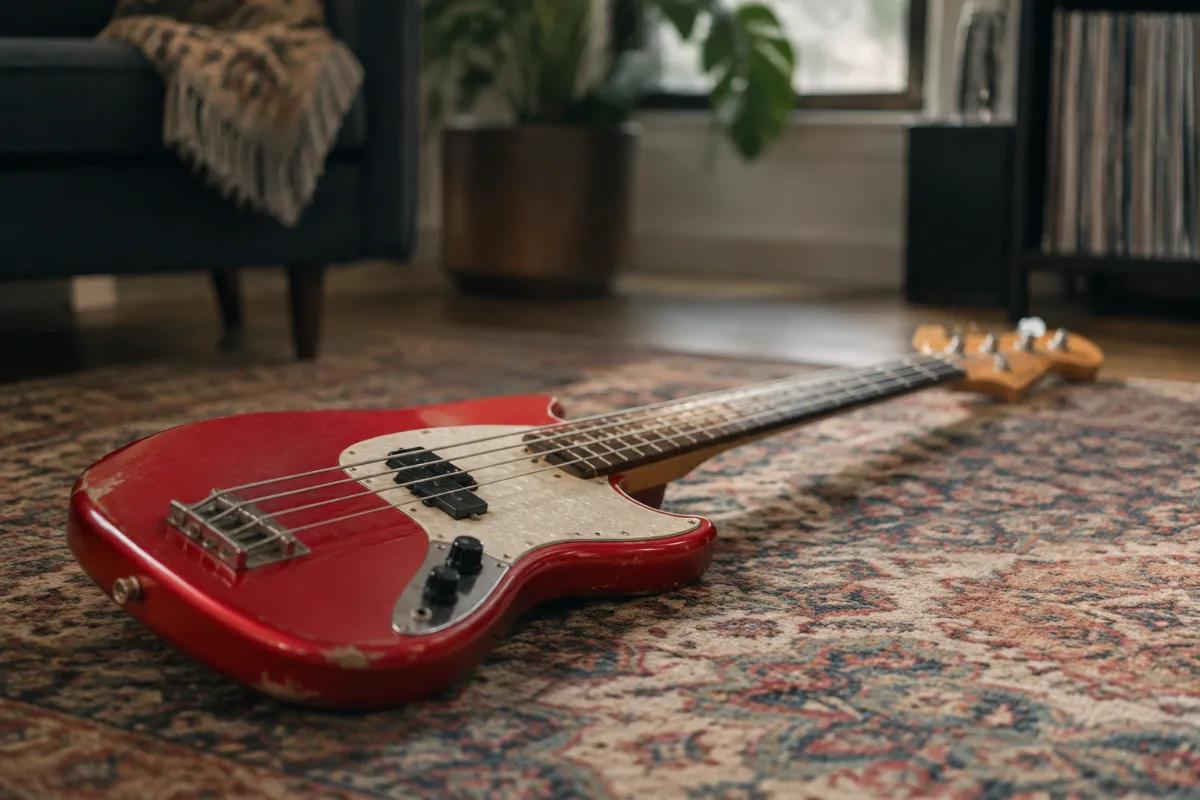
The Fender Mustang Bass has a reputation that outweighs its modest size. Despite being one of the shortest full-scale electric basses ever made, it's inspired countless bassists across rock, punk, indie, and experimental music since its debut in 1966. If you're drawn to compact instruments with distinctive character, or you've simply heard one on recordings and wondered what all the fuss is about, you're about to discover why this understated instrument punches so far above its weight.
The Mustang Bass: A Brief History
Fender introduced this model in 1966 as a companion to the Mustang guitar. The original brief was pragmatic—create a shorter, lighter bass for players with smaller frames or those who found full-scale 34-inch instruments unwieldy. At just 30 inches, the Mustang Bass landed between a half-scale student instrument and a standard jazz bass, but it was a full-featured professional tool from day one.
What made this design immediately distinctive wasn't just its size. Fender paired a unique offset body with a dynamic pickup configuration that set it apart from the Precision and Jazz basses that dominated professional playing. The instrument was never positioned as an alternative to those workhorses—it carved its own niche as the choice for players who wanted something different, both visually and sonically.
Body Design and Build Quality
The offset double-cutaway body is unmistakable. Unlike the straightforward slab design of a Precision, this guitar features sculpted curves and a bevelled edge that feels genuinely comfortable when played sitting down or standing up. The compact footprint makes it approachable for travel, recording in tight spaces, or simply playing a gig where space is at a premium.
Modern models maintain excellent build quality. The body is typically ash or alder (depending on the model), finished in a range of colours that span classic Fender hues and contemporary metallic finishes. The neck is usually maple or rosewood, with a slim profile that suits both intricate fingerstyle work and aggressive pick-driven playing. What matters is that it doesn't feel cheap or compromised—this is a legitimate instrument built to professional standards.
The Pickups and Electronics
Early models used a single wide split-coil pickup positioned close to the neck, paired with a straightforward passive tone circuit. Modern reissues have largely kept that configuration, and for good reason—it delivers clarity with punch. The split-coil design gives this bass a midrange presence that cuts through dense mixes without needing heavy EQ. The tone control allows you to dial from bright and present to warm and rounded, giving you genuine tonal range from a single pickup.
Some contemporary variants feature dual pickups or active electronics, but the single-pickup passive model remains the iconic configuration. That simplicity is actually a strength—fewer controls mean less to fuss with during a performance, and the straightforward passive circuit has inherent reliability. For players who value consistency and sonic character over endless tonal tweaking, this instrument delivers.
String Tension and Playability
Because this model uses 30-inch short-scale strings rather than standard 34-inch long-scale, string tension is lower. This means the strings feel looser, more responsive, and require less finger pressure. If you have small hands or simply prefer low string tension, a Mustang Bass plays like a dream. If you're coming from years on a full-scale bass, it will initially feel bouncy—though most players adapt within days.
The short scale also affects intonation slightly, as the interval between frets is compressed. This is negligible for most playing styles, though some jazz players find the closer fret spacing requires minute adjustments to muscle memory. For rock, punk, funk, and contemporary styles, the intonation is entirely professional-grade.
Sound Profile
What defines a Mustang Bass tone? Articulation. Because of the short scale, lower string tension, and the single split-coil pickup's position, this bass emphasises the attack and clarity of each note. It's not a warm, rumbling instrument like a Precision, nor is it the complex, chimey voice of a Jazz bass. The Mustang Bass is direct, punchy, and instantly recognisable on recordings. The midrange sits proud, which is why so many indie and alternative players gravitated to it—it cuts through without aggressive EQ.
Run this instrument through a driven amp with a touch of overdrive, and it produces surprisingly gutsy tone. The short-scale character actually helps here—less string mass means the distortion remains tight and controlled rather than woolly. This is why the Mustang Bass became a fixture in post-punk and shoegaze bass parts: it has enough character to be a melodic voice without drowning other elements.
Notable Players and Cultural Impact
Jack Bruce of Cream played one early in his career, and the instrument shows up on influential albums throughout the 1960s and beyond. Mike Watt of The Minutemen became arguably the most famous modern devotee—his aggressive, complex bass lines were defined partly by its punchy character. Countless indie and alternative bassists adopted this model because they wanted to sound different: Kim Gordon, J Mascis, and many others chose it specifically to distinguish their bass voice.
The Mustang Bass never became ubiquitous like the Precision or Jazz bass. That exclusivity is part of its appeal. When one appears on a recording, it announces intention and distinctive sensibility. It's the instrument of players who've actively chosen something other than the default option.
Buying a Mustang Bass Today
Fender has reissued this model several times, and modern examples range from affordable Asian-made versions to premium American-made instruments. A contemporary Mustang Bass delivers excellent value—you're paying for the offset design, short-scale playability, and genuine professional build quality. Used vintage instruments from the 1960s and 1970s command premium prices from collectors, but modern reissues are thoroughly professional and often sound better due to improved components and manufacturing precision.
Whether you choose an American or imported version, you're investing in an instrument with genuine character and a strong lineage. The Mustang Bass isn't the choice for every player or every style, but for those seeking compact size, distinctive voice, and honest playability, it remains uncompromising. It doesn't try to be a Precision or a Jazz bass—it's confident in what it is, and that clarity of purpose is part of its enduring appeal.
Accessories and Setup Considerations
The Mustang Bass uses standard short-scale strings, which are widely available and relatively inexpensive. Because the neck angle and bridge are optimised for the 30-inch scale, setup is straightforward. Most instruments benefit from medium-gauge strings (roughly 0.045 to 0.105 inches), which balance playability with the lower tension inherent to the shorter scale. A quality amplifier and cable round out the essential gear—this bass requires no special treatment beyond standard maintenance.
The Enduring Legacy
The Mustang Bass has never been the most popular bass on the planet, and it never will be. That obscurity is actually protective—players who choose one are making an active decision rather than defaulting to convention. Fifty years after its introduction, it remains exactly what it was designed to be: a professional bass for players who know what they want and aren't interested in compromise. Its compact size, distinctive appearance, and characterful tone have ensured it a permanent place in bass guitar history and a dedicated following that spans generations.


Comments