
EQ Effects Pedals article
The Complete Guide to Eq Effects Pedals
EQ effects pedals give you precise control over your tone, shaping frequencies and adapting your sound to different venues. Discover how they work, types available and how to choose the right EQ pedal.
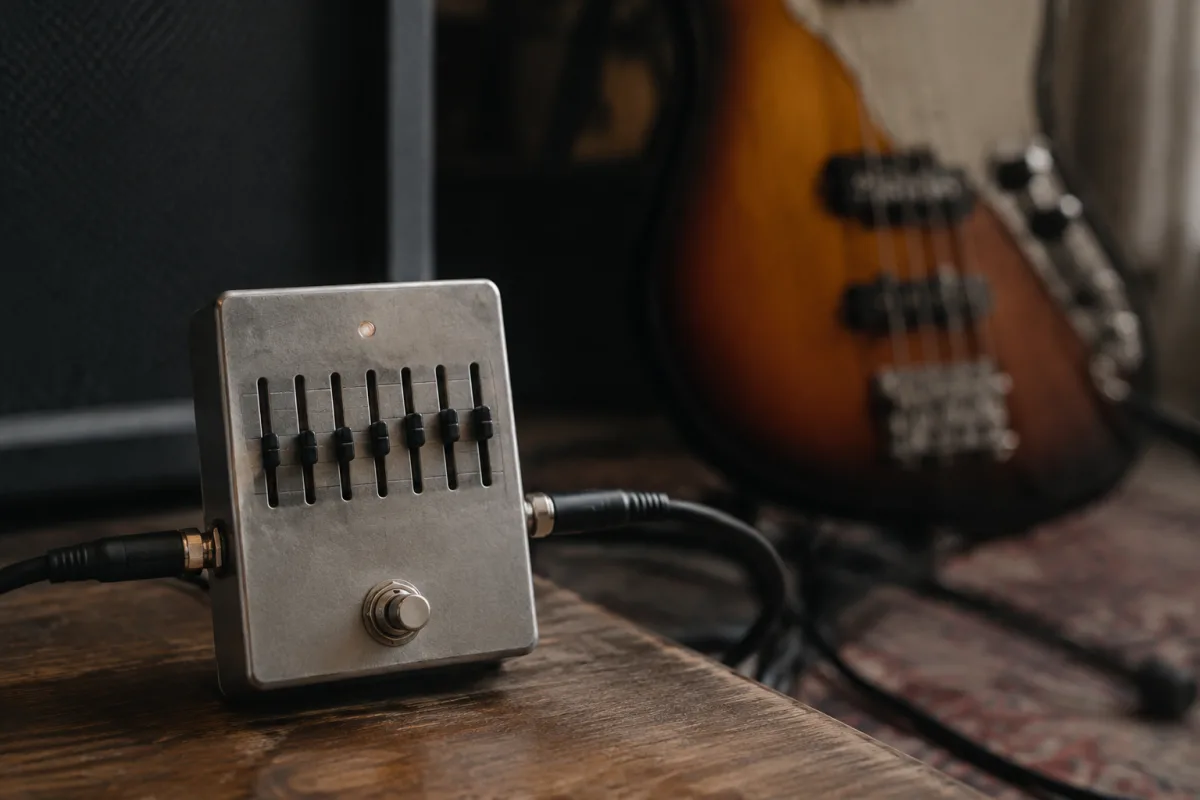
EQ effects pedals allow guitarists and bass players to shape their tone with precision, controlling frequencies and adding character that separates a mediocre setup from professional-quality sound. Whether you're cutting excessive bass mud, brightening a dark pickup or dialling in a specific tonal signature, EQ effects pedals provide control impossible to achieve with amplifier tone stacks alone. This guide explores how EQ pedals work, their types and applications, and how to choose and use one effectively.
What EQ Effects Pedals Do
An EQ effects pedal allows you to boost or cut specific frequency ranges in your signal. Unlike an amplifier's three-band tone stack (bass, mid, treble), dedicated EQ pedals typically offer more bands and finer control. A three-band EQ pedal lets you adjust bass, mid and treble independently. A five-band EQ pedal divides the spectrum into more granular slices, offering greater precision. Graphic EQ pedals feature a visual representation of the frequency curve, making it intuitive to see how adjustments affect the sound.
This control is powerful. Too much bass makes your tone muddy; an EQ pedal lets you trim low frequencies until the tone sits perfectly in the mix. A bright pickup that cuts too aggressively can be warmed by reducing high frequencies. Tonal problems that seem unsolvable by adjusting your amplifier often respond perfectly to EQ pedal adjustment.
Types of EQ Effects Pedals
EQ pedals come in several configurations, each suited to different needs:
- Graphic EQ Pedals — Feature sliding faders representing specific frequency bands. Visual feedback makes adjustments intuitive. Most graphic EQ pedals offer 7, 10 or 31 bands.
- Parametric EQ Pedals — Offer centre frequency selection, bandwidth (Q) adjustment and boost/cut control. More flexible than graphic EQ but require deeper understanding to use effectively.
- Three-Band EQ Pedals — Simple bass, mid and treble control. Ideal for beginners and players who want straightforward tone shaping without complexity.
- Multiband EQ Pedals — Five or more frequency bands offering granular control. Popular with professional players and studio recording applications.
- Combination EQ and Effects — Some pedals integrate EQ with other effects (distortion, compression, reverb) in a single unit.
Applications of EQ Effects Pedals
EQ pedals solve specific tonal problems. If your bass guitar sounds muddy through your amplifier, reducing low frequencies (100–300Hz) clears the tone. Excessive high-frequency hiss from certain pickups is tamed by rolling off brightness above 4kHz. A thin-sounding pickup gains body by boosting mids (1–2kHz).
For gigging musicians, EQ pedals adapt your tone to different venues. A small club's bass-heavy room benefits from bass reduction; an echo-prone church demands high-frequency boost to cut through reverb. Professional touring musicians often use EQ pedals as their first line of tonal defence, dialling in the sound at soundcheck rather than relying on the venue's amplifier.
EQ Pedals for Bass vs. Guitar
Bass players and guitarists use EQ pedals differently. Bass EQ is typically concerned with the sub-bass (below 50Hz), mid-bass (100–250Hz), mids (500Hz–2kHz) and presence (2–5kHz). Guitar EQ often focuses on scooping the mids (a common sound-shaping technique) or brightening presence to cut through a band mix.
Bass EQ pedals often feature dedicated sub-bass controls for the very low frequencies, whereas guitar EQ pedals may emphasis midrange shaping. However, any EQ pedal works with any instrument—it's the settings that differ, not the gear itself.
Choosing an EQ Effects Pedal
Several factors influence your choice:
| Consideration | Guidance |
|---|---|
| Frequency Bands | Three bands suit simple tone shaping. Five or more bands provide finer control. Graphic EQ is intuitive; parametric requires technical knowledge. |
| Boost/Cut Range | ±12dB is standard. ±15dB or more allows dramatic shaping; ±6dB is gentle. More range isn't always better—excessive cuts or boosts introduce noise. |
| Input/Output Options | Verify the pedal accepts your instrument's output level. Some EQ pedals are optimised for line-level signals, others for instrument level. |
| Pedalboard Integration | Size and footprint matter. Compact EQ pedals fit tight pedalboards; larger units demand space but offer bigger controls. |
| Power Requirements | Battery-powered pedals are portable; wall-powered units need mains access. Some dual-power designs offer flexibility. |
EQ Pedal Placement in Your Signal Chain
EQ pedal placement affects tone significantly. Placed early in the chain (before distortion or overdrive), EQ shapes the input to those effects. Placed after distortion, EQ shapes the final output. Many players place EQ after overdrive but before reverb and delay, allowing EQ to fine-tune the core tone before time-based effects.
Some players use multiple EQ pedals for different purposes—one to shape the core tone before overdrive, another to adjust the final output before leaving the pedalboard. This flexibility is one of EQ pedals' strengths.
EQ Effects Pedal Techniques and Best Practices
Effective EQ use requires listening. Make small adjustments—1 or 2dB—and listen carefully. Large cuts or boosts often sound unnatural. Avoid the temptation to compensate for other problems with EQ. If your amplifier sounds inherently harsh, EQ can help but shouldn't be considered a complete solution.
Many players find that cutting frequencies creates a more natural sound than boosting. If mids sound heavy, reducing mids often sounds better than boosting other frequencies. Start with a flat setting (all controls at centre) and make adjustments from there rather than starting with extreme settings.
Combining EQ with Other Effects
EQ pedals work well with other effects. Distortion plus EQ creates tonal character—shape the input to distortion, then use the final output EQ to compensate for the distortion's tonal colouration. Compression plus EQ creates even tone across your dynamics range. Reverb and delay are unchanged by EQ placement before them, but EQ after time-based effects shapes the overall sound.
Conclusion
EQ effects pedals are one of the most practical and underrated tools available to bass and guitar players. They solve tonal problems at their source and adapt your sound to different playing contexts without changing fundamental gear. Whether you need gentle tone shaping or dramatic frequency control, an appropriate EQ pedal belongs on every professional musician's board. Understanding how to use EQ effectively transforms your ability to get the exact tone you hear in your head.


Comments